
Stone Town in Sansibar, a coral-built Swahili harbour city
Published on 09/15/2026 at 18:29 | Editorial responsibility: Rafael Müller, Editor-in-Chief AD HOC NEWS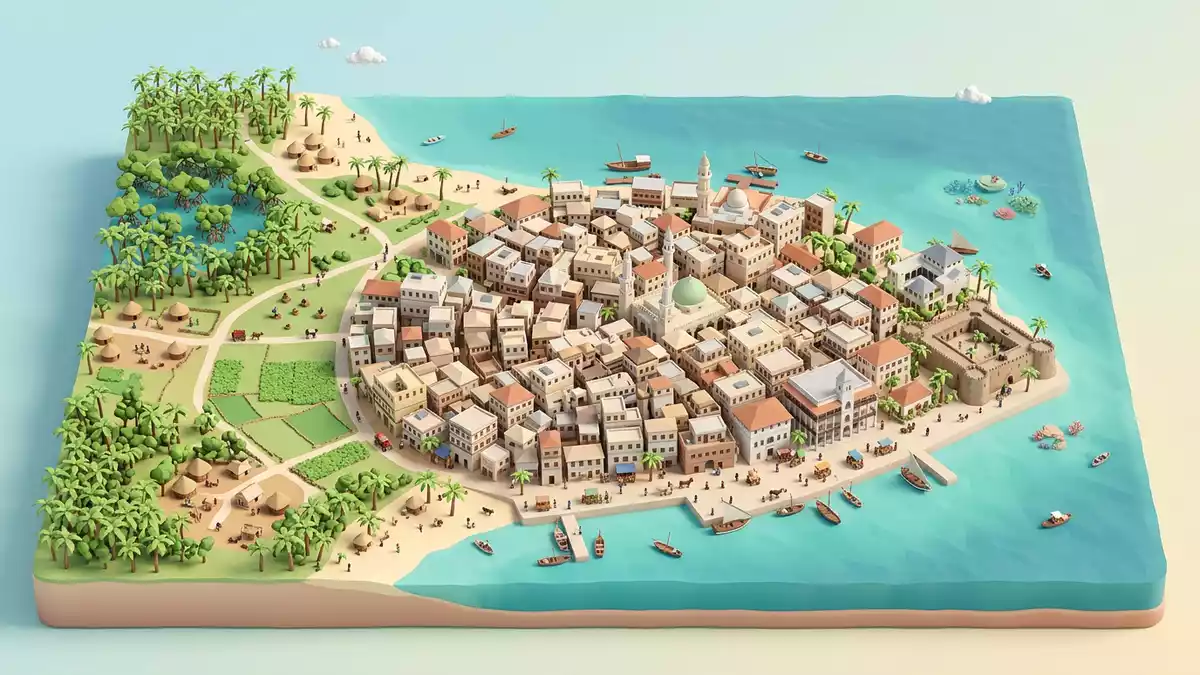
Stone Town in Sansibar, on the coast of Tansania, is the historic Swahili quarter of Zanzibar City, its dense coral-built streets carrying the memory of centuries of Indian Ocean trade. The name refers to the shift from earlier lightweight structures to houses built in coral stone and lime mortar, creating the urban fabric that UNESCO inscribed as the “Stone Town of Zanzibar” World Heritage property in 2000.
Coral stone, mangrove timber and a Swahili urban fabric
The core of Stone Town lies on the western shore of Unguja island, facing the harbour and the wider Indian Ocean, its lanes and courtyards packed into a relatively small peninsula. Many of its historic houses and civic buildings are constructed from coralline ragstone and mangrove timber, set in lime mortar, plastered and lime-washed to a pale, weathered finish that has become characteristic of the district. The thick masonry and timber roofs give these buildings a distinctive mass, with walls that read as solid surfaces broken only by doors, balconies and irregular window openings.
UNESCO describes Stone Town as a fine example of a Swahili coastal trading town, noting that its urban fabric and townscape remain “virtually intact”. The layout is a dense network of alleys, passages and small squares, with houses fronting directly onto narrow streets that turn and bend rather than following a rigid orthogonal grid. This pattern reflects centuries of maritime mercantile interaction along the East African coast, and it remains legible in the way the town tightens around the waterfront and market areas, then loosens into wider streets further inland.
Layers of influence: Oman, India, Europe and the Swahili coast
Stone Town’s present form is shaped by successive powers and trading communities whose traces are visible in its architecture. In the early sixteenth century the Portuguese empire established control over Zanzibar, and a defensive structure known as the Old Fort began to take shape on the seafront. Its current form dates to the seventeenth century, when the Sultanate of Oman took over and rebuilt the fort as part of a broader reorganisation of the town. Under Omani rule, and later under British protection, Stone Town became a hub of maritime trade in ivory, spices and enslaved people, generating the wealth that financed many of the grand houses and religious buildings still standing.
Most of the architecture that visitors recognise today dates to the eighteenth and nineteenth centuries, when Omani merchant houses, mosques, churches and administrative buildings were constructed alongside Indian and European-style structures. Architectural research and UNESCO’s nomination documents describe Stone Town as a “complex fusion” of Swahili, Indian, Arab and European influences, with coral rag walls, internal courtyards, verandas and ornamental details combining ideas and techniques from each tradition. The town served as the capital of the Sultanate of Zanzibar and, for a period, of the Sultanate of Muscat and Oman, placing it at the centre of political power as well as commerce across the western Indian Ocean.
Doors, districts and remembered trades
Among Stone Town’s most recognisable features are its large wooden doors, which frame the entrances to houses and shops along the main streets. Detailed accounts of the town’s architecture highlight these doors as a distinctive element of the Swahili and Indian Ocean aesthetic, carved with geometric, floral and occasionally calligraphic motifs, and often fitted with heavy brass studs. The doors stand within recesses in the coral stone walls, creating deep thresholds between public lanes and private interiors, and signalling the status of the household or business behind them through their size and workmanship.
Stone Town contains landmarks that recall different chapters of its trading history, including sites associated with the East African slave trade. Descriptions of the World Heritage property emphasise that remains of the last slave market, the house of a slave trader and a monument dedicated to anti-slavery efforts are located within the historic core. Elsewhere, civic buildings from the British protectorate period, mosques reflecting Omani and Swahili traditions, and churches built by European missions stand within walking distance of one another, illustrating the cultural layering that UNESCO recognised when inscribing Stone Town on the World Heritage List in 2000. The history of Zanzibar City identifies this inscription as a key moment in acknowledging the district’s architectural and historical significance.
Visiting Stone Town: what travellers from Western Europe should know
- Stone Town forms the historic centre of Zanzibar City on the western coast of Unguja island, reached by flights to the island’s main airport and by ferries that dock along the seafront close to the old quarter.
- The streets in Stone Town are narrow and irregular, with many sections accessible only on foot; surfaces are often uneven, and some routes involve staircases within older buildings.
- Stone Town lies at sea level beside the harbour, with buildings clustered close together, so views across roofs and towards the Indian Ocean open up mainly from upper floors and waterfront areas.
- Swahili and Arabic are widely spoken in Stone Town in addition to English, and the national currency throughout Tansania is the Tanzanian shilling.
- Entry requirements depend on your nationality; UK travellers can check the FCDO travel advice at gov.uk/foreign-travel-advice, Irish travellers the Department of Foreign Affairs at ireland.ie.
Searching for Stone Town on social platforms
These links open searches for Stone Town on each platform.
Frequently asked questions about Stone Town
Where is Stone Town and what is its role in Zanzibar?
Stone Town is the historic centre of Zanzibar City on Unguja island in Tansania, facing the harbour on the island’s western coast and long serving as its main urban core.
What should visitors expect when exploring Stone Town?
Visitors encounter a dense network of alleys, coral stone houses, mosques, churches and civic buildings, where carved wooden doors and irregular street lines form the backdrop to everyday life.
What makes Stone Town distinctive among coastal cities?
Stone Town is distinctive for its coral-built Swahili architecture, its fusion of Arab, Indian, African and European influences, and its recognition as a UNESCO World Heritage Swahili coastal trading town.


