
Stephansdom in Wien and its coloured Gothic silhouette
Published on 09/09/2026 at 16:55 | Editorial responsibility: Rafael Müller, Editor-in-Chief AD HOC NEWS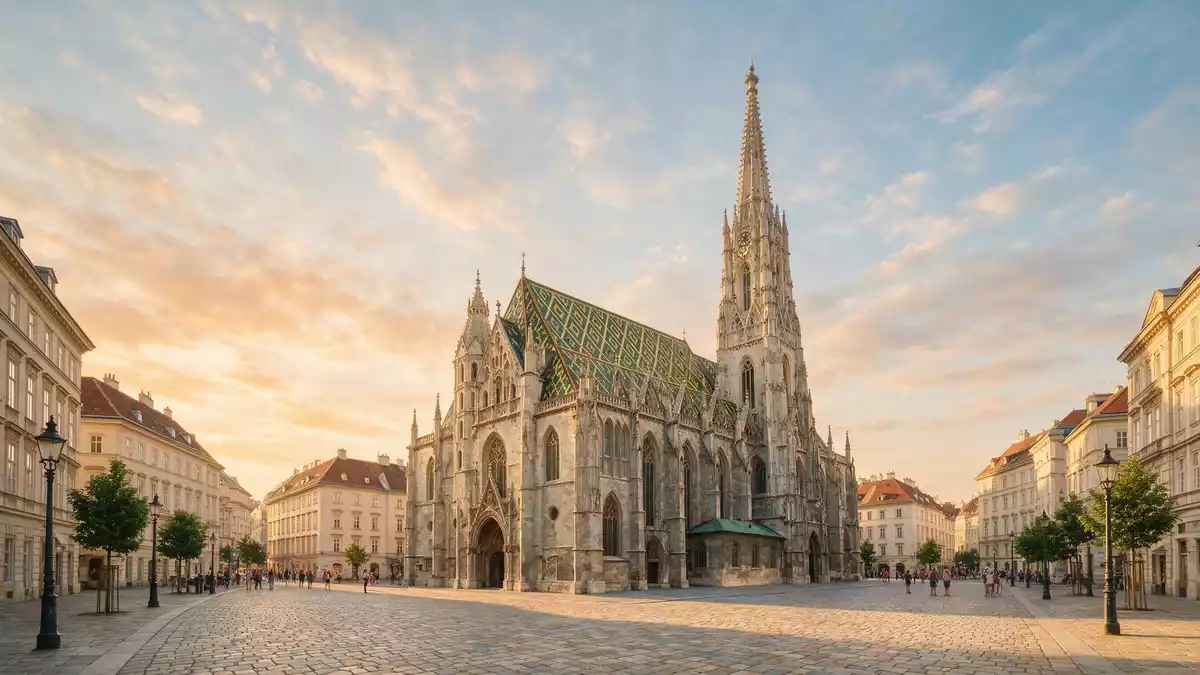
Stephansdom in Wien is a Gothic cathedral whose tall stone mass and roof of coloured tiles have shaped the skyline of Austria’s capital for centuries. Rising above Stephansplatz, it serves as the Roman Catholic cathedral of the Archdiocese of Vienna and is dedicated to Saint Stephen, the first Christian martyr.
A Gothic landmark anchored in medieval Vienna
Stephansdom stands at Stephansplatz in the Innere Stadt, the historic core of Vienna, and has long functioned as a religious and urban centre for the city.Stephansplatz in the old town The building traces its origins to a Romanesque parish church consecrated in 1147, which developed over time into the Gothic structure visible today.Romanesque beginnings in the twelfth century The present church took shape as Vienna grew under the Babenberg and Habsburg dynasties, and it later became the mother church of the Diocese of Vienna and the seat of the Archbishop.
In the fourteenth century, a major Gothic transformation began under Duke Rudolf IV, known as “the founder”, whose patronage expanded the church and set the scale of the choir and nave.Gothic work begun under Rudolf IV The south tower, started in 1359 and completed in the fifteenth century, rises to around 136 m (446 ft) and remains one of the defining verticals in Vienna’s cityscape.South tower height and Gothic style By the early sixteenth century, construction of the north tower had stalled, leaving the cathedral with one soaring Gothic spire and a shorter, unfinished companion.
Stone, towers and the roof of coloured tiles
The exterior of Stephansdom is built largely of limestone, its surfaces articulated by buttresses, traceried windows and sculpted portals that show the progress of Gothic design over several centuries.Gothic limestone construction The long nave stretches to around 107 m (351 ft), with a width of about 34 m (112 ft), results of expansions that absorbed earlier Romanesque elements into a larger medieval church.Nave length and width The south tower rises high above the western end, while the lower front towers recall the earlier Romanesque phases that survived a thirteenth-century fire.
Visitors often recognise Stephansdom instantly by its roof of coloured glazed tiles laid in geometric patterns. On the south side, the tiles form a mosaic of chevrons, while a large section on one slope depicts the double-headed eagle associated with the Habsburg monarchy.Roof of multicoloured tiles From the ground, the roof appears as a steep, patterned surface rising above the stone walls, and from nearby higher viewpoints it reads as a broad graphic carpet over the body of the church. Together with the tall south tower, the tiled roof gives Stephansdom a distinctive silhouette among the more modest roofs of the surrounding streets.
Interior spaces and the long life of the cathedral
Inside, Stephansdom combines the vertical emphasis of Gothic architecture with later furnishings from the baroque period. Slender clustered columns carry ribbed vaults over the nave, creating a long central space lined with side chapels and altars.Gothic nave and side chapels Over centuries, painters, sculptors and patrons enriched the interior with altarpieces, tombs and pulpits in changing styles, so a walk through the cathedral moves between medieval stonework and later baroque ornament.
Stephansdom has endured fire and war damage, including severe destruction during the final phase of the Second World War, after which the building was reconstructed and fully reopened by 1952.Post-war reconstruction completed in 1952 Beneath the floor, catacombs hold burials and historical remains, while in the towers several bells mark liturgical time, among them the Pummerin bell in the north tower, recast after wartime loss from metal taken from older bells.Pummerin bell in the north tower The cathedral continues to function as a parish church, a site of major religious ceremonies and a landmark that connects Vienna’s medieval, baroque and modern histories.
Visiting Stephansdom: what travellers from Western Europe should know
- Stephansdom stands on Stephansplatz in central Vienna, in the Innere Stadt district, reached by the U-Bahn lines U1 and U3 at the station Stephansplatz and by several city bus routes.
- The building rises over a compact urban square, and many routes within the cathedral involve stone steps, narrow staircases in the towers and uneven flooring in older parts of the structure.
- Vienna lies in Austria, where the official language is German and the currency is the euro.
- Entry requirements depend on your nationality; UK travellers can check the FCDO travel advice at gov.uk/foreign-travel-advice, Irish travellers the Department of Foreign Affairs at ireland.ie.
Searching for Stephansdom on social platforms
These links open searches for Stephansdom on each platform.
Frequently asked questions about Stephansdom
Where is Stephansdom located in Wien?
Stephansdom stands on Stephansplatz in the Innere Stadt, the historic centre of Vienna, surrounded by narrow streets and traditional buildings.
What should visitors expect inside Stephansdom?
Inside, visitors encounter a long Gothic nave with high vaults, side chapels, baroque altars and catacombs beneath the floor that have served as burial spaces.
What makes Stephansdom distinctive among European cathedrals?
Stephansdom is distinctive for its tall south tower, its roof of multicoloured tiles forming heraldic patterns and its layered history from Romanesque beginnings to post-war reconstruction.


