
Stephansdom and the coloured Gothic roof of Wien
Published on 09/23/2026 at 22:03 | Editorial responsibility: Rafael Müller, Editor-in-Chief AD HOC NEWS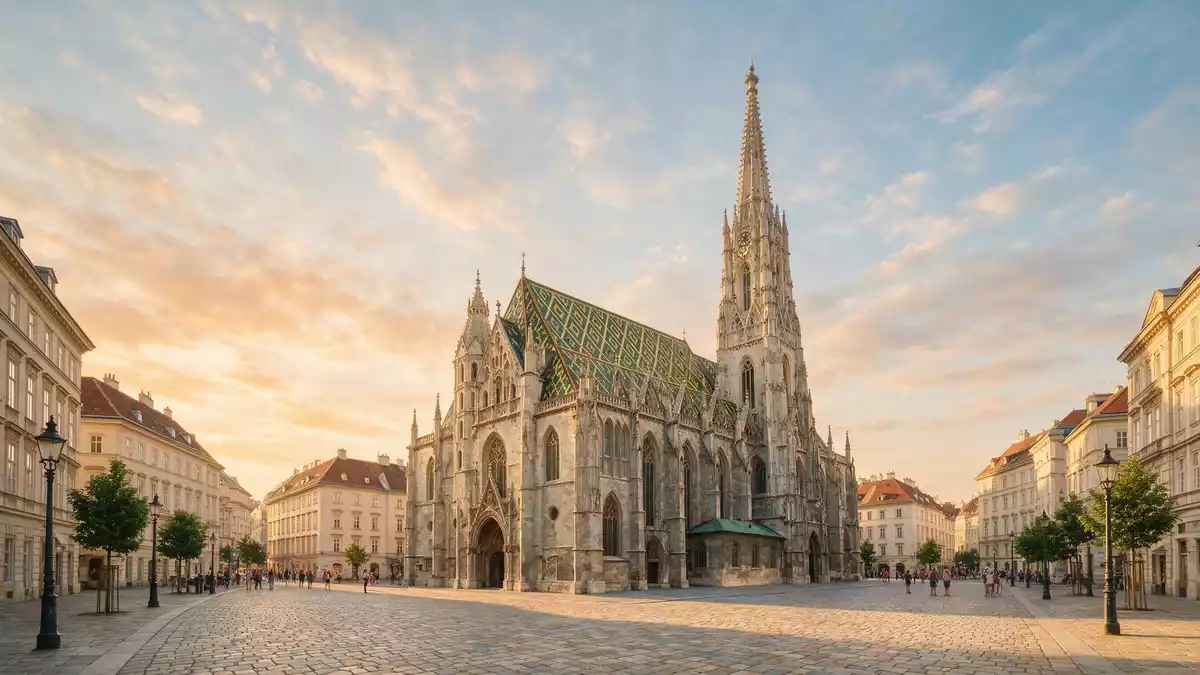
Stephansdom rises from Stephansplatz in Wien with a limestone body, a patterned tiled roof and the tall South Tower known as the Steffl. The cathedral combines Romanesque remnants with Gothic work developed across several centuries, while its roof adds a strong field of colour above the medieval city centre.
Stephansdom: a cathedral built across centuries
The first church associated with Stephansdom dates from the twelfth century. Construction began in 1137, and the building was consecrated in 1160. A major fire in 1258 damaged the church, after which parts were rebuilt in Romanesque form.
The cathedral’s Gothic transformation began under Duke Rudolf IV in 1304. Rudolf IV, known as the Founder, shaped the expansion of the choir and nave. Work continued through the fourteenth and fifteenth centuries, with the South Tower completed in 1433 under master builder Hans Puchsbaum. A record of cathedral dimensions places the building at roughly 110 metres long, with the South Tower reaching 136.44 metres.
From Romanesque masonry to Gothic height
Stephansdom is built largely from limestone. Buttresses, carved portals, traceried windows and pointed arches mark the Gothic sections, while the western front retains the rounded forms of the earlier Romanesque church.
The South Tower forms the cathedral’s highest vertical element. Its steep spire rises above the nave and carries the familiar name Steffl. The North Tower is lower and unfinished, giving the cathedral an asymmetrical outline that is visible across central Wien. The building’s Gothic tower profile includes the South Tower, the North Tower and the two lower western towers.
The roof is covered with glazed tiles arranged in coloured patterns. Geometric bands and the Austrian eagle appear across the roof surface, adding a graphic layer to the limestone architecture. From ground level, the roof reads as a broad, sloping plane behind the ornate stonework.
The interior, chapels and musical tradition
Inside, the nave, choir and side aisles create a long sequence of stone spaces. Ribbed vaults rise above the central areas, while pillars divide the interior into bays. Chapels, altars, tombs and sculpted details record the cathedral’s religious role and its connection with Habsburg Vienna.
The pulpit associated with Anton Pilgram is among the best-known interior works. Pilgram’s self-portrait appears within the stonework, giving a named face to the late Gothic decoration. The cathedral also contains the tomb of Emperor Frederick III, made from red marble and completed in the sixteenth century.
Stephansdom remains a functioning cathedral and a venue for sacred music. Organ music and choral works form part of its cultural life, alongside regular liturgical use. The cathedral’s architectural history is therefore visible in both its stone fabric and its continuing religious function.
Visiting Stephansdom: what travellers from Western Europe should know
- Stephansdom stands on Stephansplatz in Vienna’s first district. U-Bahn lines U1 and U3 serve Stephansplatz station, and trams and buses connect the surrounding central districts.
- The South Tower contains a narrow staircase with several hundred steps. The climb reaches a high viewing level inside the Gothic tower.
- The cathedral lies in a pedestrian-focused historic centre, with Kärntner Straße, Graben and the Hofburg within the central urban area.
- The official language is German and the currency is the euro.
Searching for Stephansdom on social platforms
These links open searches for Stephansdom on each platform.
Frequently asked questions about Stephansdom
Where is Stephansdom?
Stephansdom stands on Stephansplatz in the first district of Wien. The cathedral occupies the centre of Vienna’s historic urban core.
What can visitors expect inside?
The interior contains a Gothic nave, side aisles, chapels, altars, tombs and sculpted stonework. The South Tower also contains a narrow stairway leading to a high viewing level.
What makes Stephansdom distinctive?
Its coloured tiled roof, limestone Gothic fabric and tall South Tower create a recognisable architectural combination. The building also preserves Romanesque elements within a cathedral expanded under Rudolf IV from 1304.


