

Stephansdom and its patterned roof over old Wien
Published on 08/20/2026 at 14:07 | Editorial responsibility: Rafael Müller, Editor-in-Chief AD HOC NEWS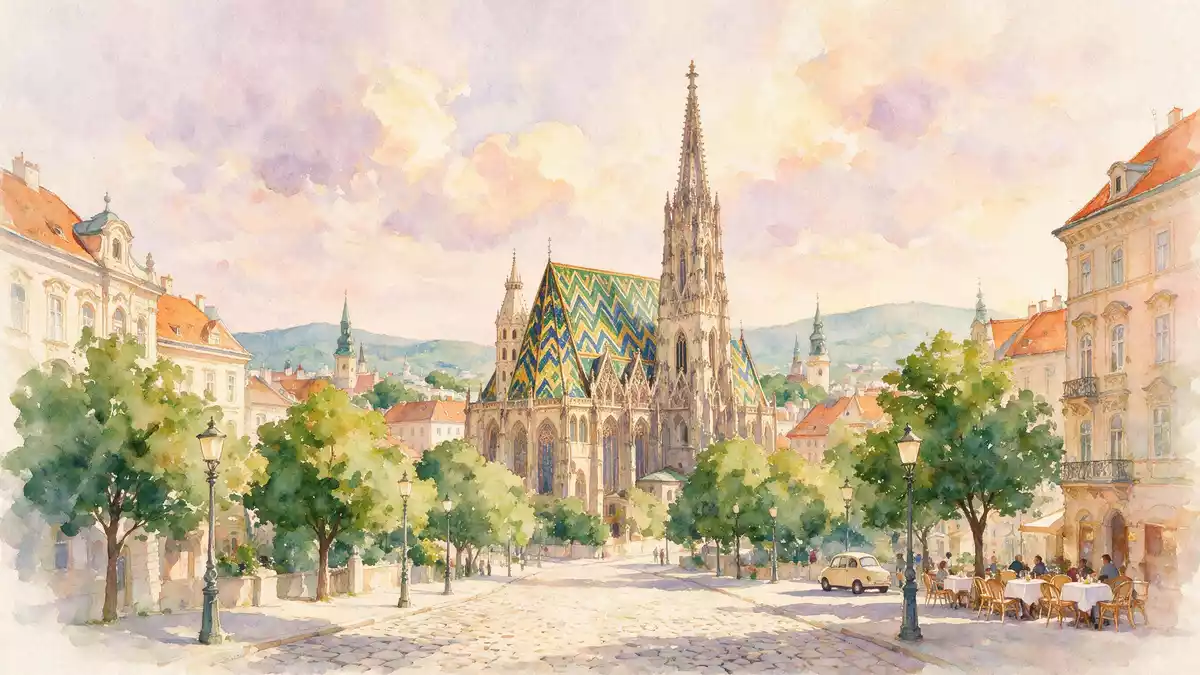
Stephansdom, also known as St Stephen’s Cathedral, stands at Stephansplatz in Wien and has grown from a Romanesque church into a major Gothic landmark of Austria’s capital. Its steep patterned roof and soaring south tower give the building a profile that has dominated the historic centre since the late Middle Ages.
A Gothic giant shaped over centuries
The origins of Stephansdom lie in the twelfth century, when a first church of St Stephen was founded under Babenberg margrave Leopold IV and Bishop Reginmar of Passau.Romanesque beginnings placed the church outside the early city walls of Wien and anchored worship in what would become the mediaeval centre.Leopold IV and Reginmar Over the thirteenth and fourteenth centuries, successive expansions transformed the building into a Gothic cathedral, with the Albertine Choir added in the first half of the fourteenth century under Duke Albrecht II.
A decisive step came when Duke Rudolf IV established the cathedral chapter in 1365, formalising Stephansdom’s role as the principal church of Wien.Creation of the chapter In 1722 a papal bull elevated the church to the status of a metropolitan cathedral, and the diocese of Wien became an archdiocese with Stephansdom as its seat.Metropolitan status This layered history is legible in stone: Romanesque elements remain in the western façade, while the soaring Gothic choir and tower reflect later ambitions.
South tower and the patterned roof
The single most striking feature of Stephansdom is the Gothic south tower, known as the Hoher Turm, which reaches about 136 m (446 ft) above the square.Height of the south tower Begun in the fourteenth century and completed in the fifteenth, this slender structure rises beside the nave rather than directly above the western entrance, a lateral placement characteristic of southern German and Austrian staggered churches.Staggered church type Its stonework climbs in stages, punctuated by tracery and openings, and culminates in a richly articulated crown.
Beneath the tower, the roof of Stephansdom draws the eye almost as strongly as the vertical rise of the stone. The nave and choir are covered by a steeply pitched roof clad in glazed tiles forming regular coloured patterns.Decorative tiled roof From surrounding streets and distant viewpoints, this patterned surface appears as a broad geometric field lifted high above the masonry. On the north side, a shorter tower topped with a Renaissance cupola marks the unfinished ambition for a second Gothic spire, underscoring how the cathedral’s silhouette reflects changing styles and interrupted projects.Unfinished north tower
Interior, chapels and crypts
Inside Stephansdom, the spatial impression shifts from the sharp exterior lines to a tall stone hall formed by clustered columns and ribbed vaults. The high Gothic choir extends eastwards from the nave, with windows admitting shafts of light that fall across altars and memorials. Side aisles run alongside the central space and lead to chapels, each with its own arrangement of sculpture, paintings and liturgical furnishings.
Beneath the floor, catacombs and burial chambers reflect Stephansdom’s long-standing role in the religious life of Wien. The cathedral houses the tomb of Emperor Frederick III and other significant burials, tying Habsburg dynastic history directly to the building.Frederick III tomb As the mother church of the Archdiocese of Vienna, Stephansdom continues to serve as the seat of the archbishop and hosts liturgical ceremonies that mark both ecclesiastical and civic occasions.Seat of the archbishop
Visiting Stephansdom: what travellers from Western Europe should know
- Stephansdom stands on Stephansplatz in the Innere Stadt district of Wien, and is reached directly by underground and tram services serving the central square.
- The interior involves walking on historic stone floors and, for tower views, climbing narrow staircases with many steps inside the south tower.
- Nearby sights include the Graben, Kärntner Straße and other streets of the old town, where historic façades and shops line pedestrian routes.
- The official language is German and the currency is the euro.
Searching for Stephansdom on social platforms
These links open searches for Stephansdom on each platform.
Frequently asked questions about Stephansdom
Where is Stephansdom located in Wien?
Stephansdom stands on Stephansplatz in the Innere Stadt, the historic central district of Wien, surrounded by narrow streets and mediaeval plots.
What can visitors expect inside Stephansdom?
Visitors encounter a tall Gothic hall with stone columns, altars, chapels and burial sites, including imperial tombs and catacombs beneath the floor.
What makes Stephansdom distinctive among churches?
Its combination of a high Gothic south tower, decorative tiled roof and layered Romanesque and Gothic fabric gives Stephansdom a silhouette closely associated with Wien.


