
Stellenbosch Winelands, South Africa’s classic wine heartland
Published on 08/28/2026 at 20:38 | Editorial responsibility: Rafael Müller, Editor-in-Chief AD HOC NEWS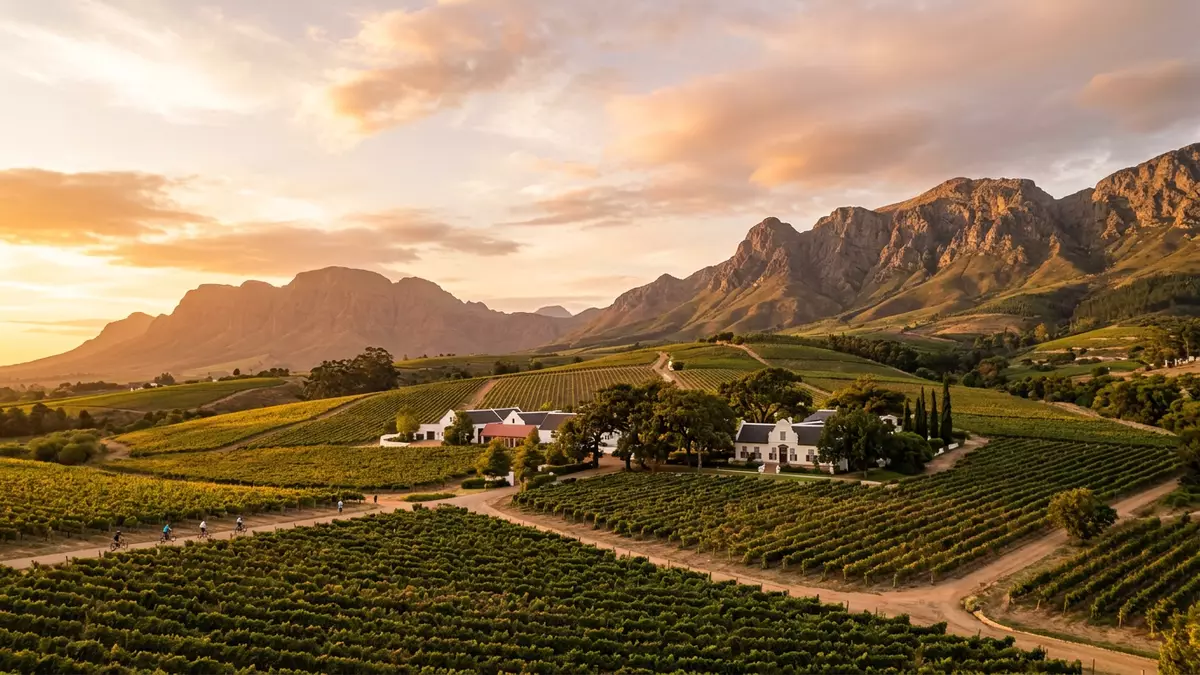
Stellenbosch Winelands east of Stellenbosch in South Africa brings together mountain vineyards, a formally recognised wine route and a long winemaking tradition that still shapes the landscape.
Mountains, valleys and the character of Stellenbosch’s vineyards
The Stellenbosch Winelands spread across hilly terrain framed by the Helderberg, Simonsberg and Stellenbosch mountains, creating a varied backdrop of slopes and valleys planted to vines.hilly terrain between mountains Mediterranean climatic patterns with warm, dry summers and cooler, wetter winters underpin grape growing here, while air from False Bay and the Atlantic reaches inland and tempers afternoon heat.winds from False Bay
The soils beneath the vineyards range from granite-derived layers on the mountain slopes to sandstone-derived and alluvial soils lower down, giving growers a palette of terroirs within a compact area.granite and sandstone soils This diversity supports plantings of Cabernet Sauvignon, Pinotage, Syrah and Bordeaux-style blends alongside Chardonnay and Chenin Blanc, with different parts of the winelands favouring particular styles.numerous grape varieties
A historic wine route and its sub-regions
The Stellenbosch Winelands are organised around the Stellenbosch Wine Routes, a network representing more than 200 wine and grape producers within the Stellenbosch Wine of Origin classification.more than 200 producers Launched in 1971, this was South Africa’s first formal wine route, modelled on European examples and giving visitors structured access to cellars and estates spread across the district.launched in 1971
Because of the size and variety of the winelands, the Stellenbosch Wine Route is divided into five sub-routes: Stellenbosch Valley, Stellenbosch Berg, Greater Simonsberg, Bottelary Hills and Helderberg.five sub-routes Each area offers its own mix of estates and vineyard settings, from Bottelary’s rolling hills to Helderberg’s sites near False Bay, and together they form the structured backbone of touring in the Stellenbosch Winelands.distinct wards and terroirs
Three and a half centuries of winemaking around Stellenbosch
Winegrowing in the broader Stellenbosch area dates back to the late seventeenth century, when Governor Simon van der Stel founded the town in 1679 and early settlers planted vines on nearby hillsides.founded in 1679 By the eighteenth century, vineyards around Stellenbosch already covered extensive areas and wine was being exported to European markets, establishing the region as a major Cape winemaking centre.eighteenth-century exports
Through changes in South African history, including the period after 1994 when the national wine industry moved towards higher quality, Stellenbosch Winelands retained their role as a core region for Cabernet-based blends, Pinotage and other classic styles.prestige wine region Historic estates on long-established farms share the landscape with newer cellars, all drawing on the same combination of climate, topography and soils that make Stellenbosch synonymous with South African wine.
Visiting Stellenbosch Winelands: what travellers from Western Europe should know
- Stellenbosch Winelands lie east of Stellenbosch in South Africa’s Western Cape, reached by road links from Cape Town and its international airport.
- Many estates sit on slopes and undulating ground, so walks between vineyards and cellar buildings can involve gradients and uneven farm tracks.
- The surrounding mountains form a visible presence, and some viewpoints in the winelands look towards False Bay and the distant Cape Peninsula.
- The official language is Afrikaans and English is widely used; the currency is the South African rand.
- Entry requirements depend on your nationality; UK travellers can check the FCDO travel advice at gov.uk/foreign-travel-advice, Irish travellers the Department of Foreign Affairs at ireland.ie.
Searching for Stellenbosch Winelands on social platforms
These links open searches for Stellenbosch Winelands on each platform.
Frequently asked questions about Stellenbosch Winelands
Where are Stellenbosch Winelands located?
Stellenbosch Winelands occupy the countryside around Stellenbosch in South Africa’s Western Cape, inland from False Bay and east of Cape Town.
What can visitors expect in the Stellenbosch Winelands?
Visitors encounter vineyards on mountain slopes and in valleys, cellar buildings, tasting rooms and rural roads linking estates across the organised wine route.
What makes Stellenbosch Winelands distinctive among wine regions?
The region combines a historic wine route, climatic influences from nearby oceans and a mix of granite, sandstone and alluvial soils within a single winemaking district.


