
Staromestske namesti and Prague’s layered historic square
Published on 09/24/2026 at 06:46 | Editorial responsibility: Rafael Müller, Editor-in-Chief AD HOC NEWS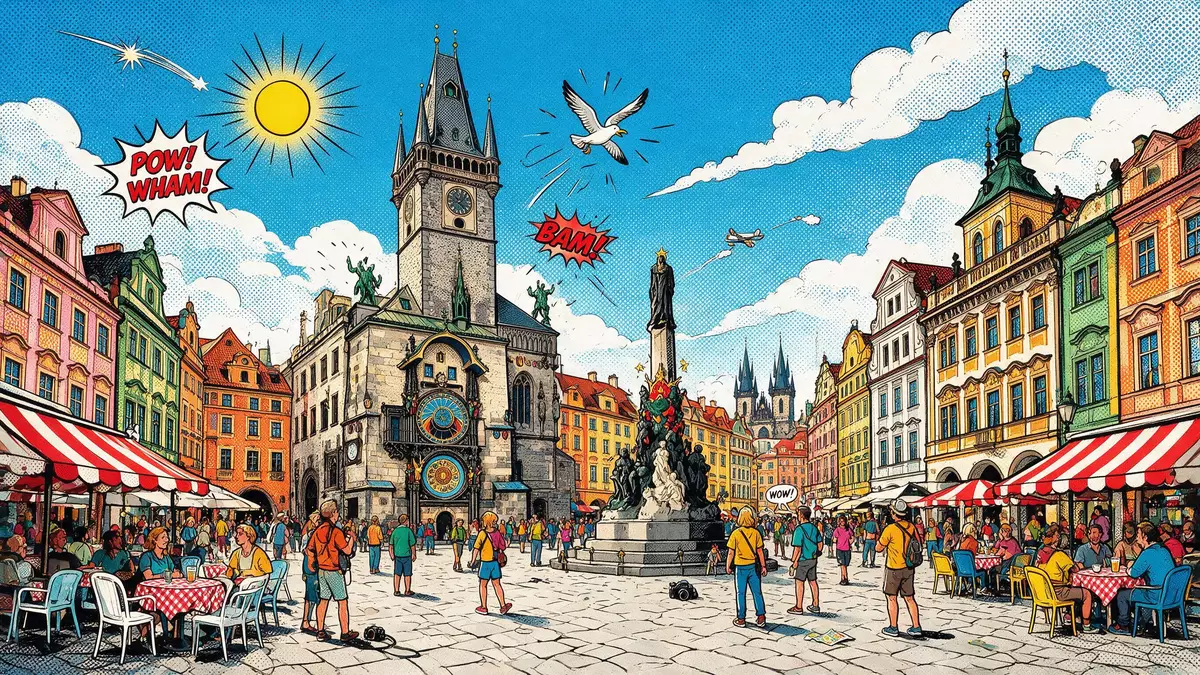
Staromestske namesti is Prague’s Old Town Square, an open historic space framed by churches, palaces, town houses and the Old Town Hall. Its irregular cobbled outline preserves the character of a marketplace that took shape in the twelfth century.
Staromestske namesti began as a medieval marketplace
The square developed at the centre of Prague’s Old Town beside routes used by merchants travelling across Central Europe. Markets operated here from the medieval period, with permanent shops, temporary stalls and specialist traders occupying the space around the town houses.
Its history reaches back to the tenth century, when the area functioned as a marketplace near the customs centre known as Ungelt. The square’s present name has been used since 1895. Romanesque foundations, Gothic cellars and later façades record the growth of Prague around this commercial centre.
The Old Town Hall gives the square its civic focus. Prague’s burghers received the right to establish their own municipal seat in 1338, and the complex expanded through several building phases. Its tower carries the astronomical clock installed in 1410, while the surrounding buildings preserve medieval, Renaissance, Baroque and Art Nouveau elements. Old Town Square history
Gothic spires meet Baroque façades
The Church of Our Lady before Týn dominates the eastern side with its Gothic towers and dark stone silhouette. The church has served as a principal religious building of Prague’s Old Town since the fourteenth century, and its façade rises behind the houses lining the square.
Across the open space, St Nicholas Church presents a Baroque composition associated with Kilian Ignaz Dientzenhofer. Its pale exterior, sculptural decoration and spacious interior form a clear contrast with the vertical Gothic character of Týn Church.
Kinský Palace adds a Rococo façade, while the House at the Stone Bell preserves a Gothic architectural core. Other buildings around the perimeter combine Romanesque foundations with Gothic, Renaissance, Baroque, Rococo, neo-Baroque and Art Nouveau alterations. The result is not a single architectural set, but a sequence of visible layers from different centuries. Gothic and Baroque landmarks
The Old Town Hall supplies another change of scale. Its medieval tower rises above the square, and the astronomical clock occupies the southern wall. The mechanism links the building to Prague’s scientific, civic and artistic history without separating those subjects from the surrounding streetscape.
Memorials make the paving part of the history
Staromestske namesti is also marked by monuments and inscriptions set directly into the square. The Jan Hus Monument stands near the centre, created by Ladislav Šaloun and unveiled in 1915, five centuries after Jan Hus was executed at the Council of Constance in 1415.
The monument shows Hus among figures connected with the Hussite tradition and the Czech religious reform movement. Its presence gives the open space a strong national and religious reference, while the surrounding churches represent several stages of Prague’s Christian architecture.
Near the Old Town Hall, memorial stones mark the execution of twenty-seven leaders of the Czech revolt on 21 June 1621. The pavement also contains the Prague meridian, identified by an inscription as a former reference for local timekeeping. These modest marks sit alongside the larger buildings and turn the ground itself into part of the square’s historical record.
The square forms part of Prague’s Historic Centre, inscribed on the UNESCO World Heritage List in 1992. Its significance rests in the combination of an old market layout, civic buildings, religious monuments and domestic architecture within one compact urban setting. Prague’s historic square
Visiting Staromestske namesti: what travellers from Western Europe should know
- Staromestske namesti lies in Prague’s Old Town, in Praha 1, on the right bank of the Vltava. Starom?stská and M?stek metro stations provide access to the surrounding central districts.
- The square has a cobbled surface, while nearby lanes retain uneven stone paving. The approach includes pedestrian streets and historic urban surfaces rather than a single smooth route.
- The official language is Czech and the currency is the Czech koruna.
Searching for Staromestske namesti on social platforms
These links open searches for Staromestske namesti on each platform.
Frequently asked questions about Staromestske namesti
Where is Staromestske namesti?
Staromestske namesti is the Old Town Square in Prague’s historic Old Town. It lies in Praha 1, on the right bank of the Vltava.
What can visitors expect at Staromestske namesti?
The square contains cobbled paving, the Old Town Hall, the astronomical clock, Týn Church, St Nicholas Church, Kinský Palace and the Jan Hus Monument.
What makes Staromestske namesti distinctive?
Its medieval marketplace layout brings Gothic, Renaissance, Baroque, Rococo and Art Nouveau architecture together around one civic space.


