
Stari most, the stone arch binding Mostar across the Neretva
Published on 09/15/2026 at 13:33 | Editorial responsibility: Rafael Müller, Editor-in-Chief AD HOC NEWS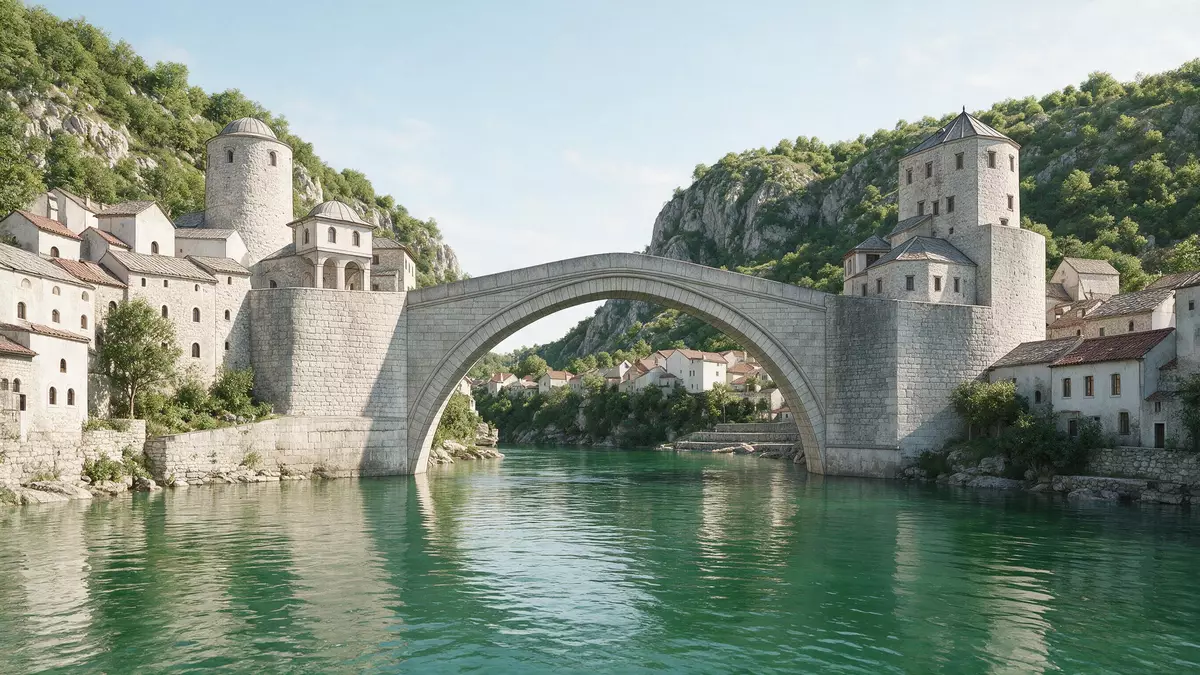
Stari most, the Old Bridge of Mostar in Bosnia and Herzegovina, is a slender stone arch of pale limestone spanning the Neretva River and tying the city’s two historic banks into one continuous townscape. Completed in the sixteenth century under Ottoman rule and rebuilt in the early twenty-first century after its wartime destruction, it remains the defining structure of Mostar’s old core and a focal crossing in the southern Balkans.
The Ottoman stone arch over the Neretva
The bridge known as Stari most carries a single masonry arch over the Neretva River at the narrowest point of the gorge where Mostar first grew as a settlement along the water.The Old Bridge connects the two banks and links the streets of the historic neighbourhoods on the eastern and western sides into one continuous route through the old town.Stari Most stands in the city of Mostar in southern Bosnia and Herzegovina The arch itself is a single span of stone that reaches roughly 30 m (98 ft) from bank to bank, rising around 24 m (79 ft) above the river at its highest point and carrying a roadway about 4 m (13 ft) wide between its parapets.
Stari most is built of tenelija limestone, a local stone that gives the bridge its distinctive pale colour against the deeper tones of the river and the older buildings along the banks.The bridge is described as a stone arch built of tenelija On either side of the span stand fortified towers that once formed part of the defended approach to the river crossing, marking the line where the streets narrow towards the bridge deck.Stone towers guard each end of the bridge From the parapets the view runs out along the Neretva, framed by limestone slopes and the roofs of Mostar’s old houses.
From sixteenth-century crossing to World Heritage site
Stari most was commissioned under the Ottoman sultan Süleyman the Magnificent and constructed between 1557 and 1566 by the architect Mimar Hayruddin, whose training lay in the circle of the imperial architect Sinan.The bridge was completed in 1566 under Süleyman the MagnificentConstruction took place between 1557 and 1566 under Hayruddin It replaced an earlier wooden crossing with a permanent stone structure and stood for more than four centuries as the principal link between the two halves of Mostar’s urban fabric.
In November 1993 the original bridge collapsed into the Neretva after sustained artillery fire during the Bosnian War, leaving only its abutments and the flanking towers above the water.The bridge was destroyed in November 1993 A reconstruction effort in the early 2000s used limestone from the traditional Tenelija quarry near Mostar and techniques recorded from the Ottoman period, rebuilding the single-span arch to the original form and reopening the crossing in 2004.Reconstruction was completed in 2004 using Tenelija limestone The Old Bridge Area of the Old City of Mostar, including Stari most and its surrounding streets, was inscribed as a UNESCO World Heritage site in 2005, recognising both the architectural value of the bridge and its role in the historic townscape.The bridge and old city were inscribed on the World Heritage List in 2005
Stari most in the fabric of Mostar’s old town
The position of Stari most in the centre of Mostar’s old town means that the approaches to the bridge run through narrow stone streets, stepped lanes and small squares lined with houses and trading buildings that reflect centuries of life around the crossing.The bridge spans the Neretva at the centre of the Old Town The Neretva flows beneath the arch in a deep channel cut into the limestone, and the water’s line defines the edge of the historic quarters on both banks. Mosques and other Ottoman-era structures stand within sight of the bridge, their minarets rising above the roofs and their courtyards opening towards routes that converge on the river crossing.
Stari most functions as a pedestrian bridge, carrying foot traffic between the markets, dwellings and viewpoints on each side of the Neretva and linking the different communities that make up Mostar’s urban core.Stari Most is described as a pedestrian bridge over the Neretva From the stone deck the steepness of the arch is apparent, as the path climbs from the level of the streets up to the central high point before descending again to the opposite bank. The bridge’s alignment frames long views along the valley, while nearby terraces and towers offer vantage points back towards the arch, showing how its curve dominates the riverscape and anchors the composition of the old town on both sides.
Visiting Stari most: what travellers from Western Europe should know
- Stari most spans the Neretva River in the centre of Mostar’s old town in southern Bosnia and Herzegovina, reached on foot from the surrounding streets and riverfront lanes.
- The bridge deck rises steeply between its parapets, with stone steps set into the roadway, and the approaches run along cobbled streets where surfaces can be uneven underfoot.
- The immediate surroundings of Stari most include historic towers on each bank and mosque courtyards nearby, all set among limestone slopes that drop towards the river channel.
- The official language is Bosnian, and the currency is the convertible mark (BAM).
- Entry requirements depend on your nationality; UK travellers can check the FCDO travel advice at gov.uk/foreign-travel-advice, Irish travellers the Department of Foreign Affairs at ireland.ie.
Searching for Stari most on social platforms
These links open searches for Stari most on each platform.
Frequently asked questions about Stari most
Where is Stari most located?
Stari most stands in the city of Mostar in southern Bosnia and Herzegovina, spanning the Neretva River between the historic quarters on both banks.
What should visitors expect when crossing the bridge?
Visitors walk across a steep stone arch with steps set into the roadway, moving between cobbled streets and river views framed by towers, houses and limestone slopes.
What makes Stari most distinctive among river bridges?
Its single pale limestone arch, sixteenth-century Ottoman origin, post-war reconstruction and World Heritage status together make Stari most a distinctive crossing over the Neretva.


