
Stari most, the stone arc linking Mostar across the Neretva
Published on 08/25/2026 at 18:25 | Editorial responsibility: Rafael Müller, Editor-in-Chief AD HOC NEWS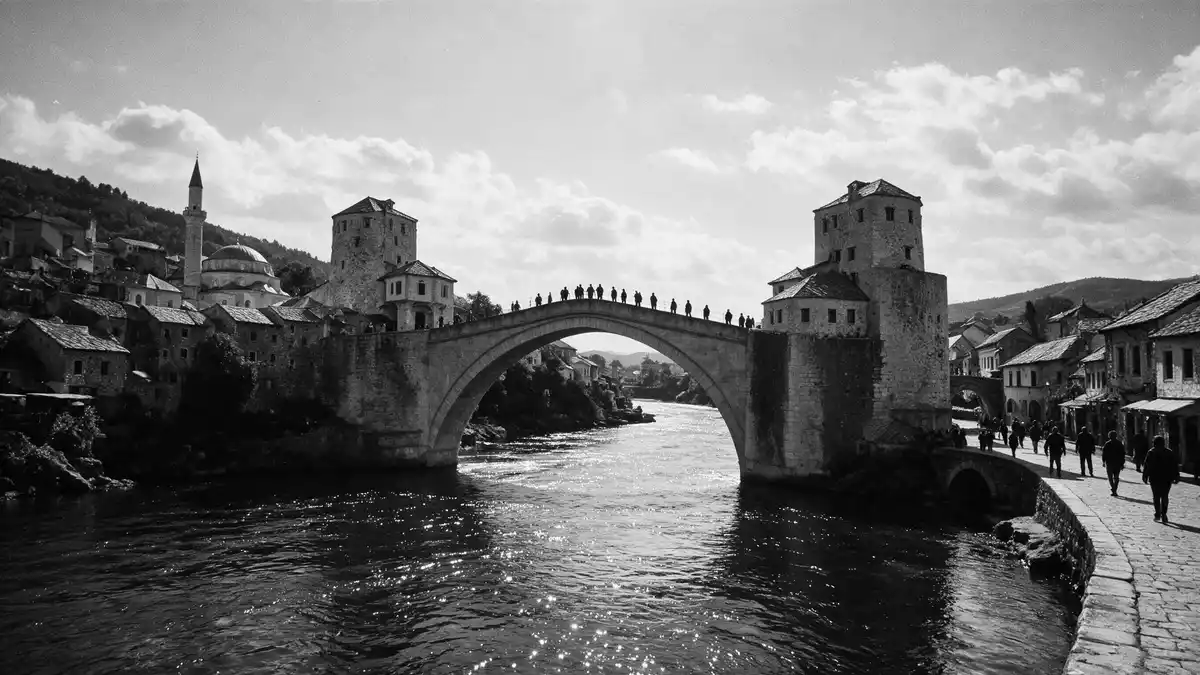
Stari most, the Old Bridge of Mostar, is a single-span Ottoman stone arc over the Neretva River whose rebuilt profile still links the city’s two banks in Bosnia and Herzegovina. Commissioned under Sultan Suleiman the Magnificent in the mid-sixteenth century and designed by the Ottoman architect Mimar Hayruddin, it has become the defining landmark of Mostar’s old town and a focal point of its riverside life.
An Ottoman stone arc above the Neretva
The form of Stari most is dominated by its slender masonry arch, springing from abutments cut into the rocky gorge and carrying a narrow roadway high above the water. In the sixteenth century, the Ottoman administration in Mostar replaced an earlier wooden bridge with this stone crossing, and Hayruddin’s design created a single humpbacked span that avoided intermediate supports in the river.single-span masonry arch The bridge is built from pale limestone blocks, known locally as tenelija, which give its parapets and soffit a light colour against the darker rock of the gorge.tenelija limestone
Stari most stands at the narrowest point of the Neretva gorge where the medieval settlement first grew, so its stone arc connects the historic quarters on both banks at a natural pinch point in the landscape.narrowest point of the river gorge The deck rises in a gentle curve from either end to a central apex, so crossing the bridge involves a short climb on cut stone steps, with the parapets framing views up and down the river. Flanking the ends of the bridge are two defensive towers, Halebija on one bank and Tara on the other, which form a stone gate to the span and mark the approach from the streets of the old town.Halebija and Tara towers
From sixteenth-century construction to reconstruction
Construction of Stari most began in 1557 under Suleiman the Magnificent and ran for about nine years before completion in 1566, creating a durable stone crossing where only a wooden suspension bridge had existed before.commissioned in 1557 and completed in 1566 Hayruddin, a pupil of the celebrated Ottoman architect Sinan, applied techniques of classical Ottoman stone construction to span the river without piers and anchor the structure into the banks.constructed by Mimar Hajruddin, a pupil of Sinan For centuries the bridge served as the main crossing at Mostar, carrying foot traffic and pack animals between the markets and streets on either side.
In November 1993, during the conflict in Bosnia and Herzegovina, Stari most was shelled and collapsed into the Neretva after having stood for more than four hundred years as a functioning bridge.destruction on 9 November 1993 An internationally backed reconstruction project led by UNESCO and partners including the World Bank and cultural foundations began in the early 2000s, using traditional techniques and stone comparable to the original material to restore the arch and its approaches.UNESCO-led reconstruction using traditional techniques Divers recovered original blocks from the riverbed, new tenelija stone was quarried, and the rebuilt bridge reopened to pedestrians in July 2004, reconnecting the historic quarters over the river.
Stari most as World Heritage and city symbol
Stari most today forms the centrepiece of the “Old Bridge Area of the Old City of Mostar”, a World Heritage Site recognised by UNESCO for its blend of eastern Ottoman, Mediterranean and western European architectural features in a single urban ensemble.Old Bridge Area of the Old City of Mostar The inscription in 2005 formally acknowledged the significance of the reconstructed bridge and the restored old town around it, which includes stone houses, small mosques and market streets clustered along the banks.World Heritage inscription in 2005 Stari most gives the city its name and continues to act as a recognisable emblem on photographs, souvenirs and local signage.
The bridge also supports cultural traditions that have grown around its high arc and deep drop into the river. Written accounts from the seventeenth century describe young men of Mostar diving from the parapet into the Neretva below, and the practice of organised dives from the bridge remains associated with the span.seventeenth-century account of dives For visitors, the bridge frames views of the river gorge, the clustered stone buildings of the old town and the hills beyond, while its humpbacked profile is visible from many vantage points along the banks and nearby streets.
Visiting Stari most: what travellers from Western Europe should know
- Stari most crosses the Neretva River in the historic centre of Mostar in southern Bosnia and Herzegovina, linking the old quarters on the eastern and western banks.
- The bridge deck rises in a curve and is surfaced with stone steps, so a crossing involves short ascents and descents on uneven limestone underfoot.
- The surrounding streets of the old town are paved and relatively compact, with approaches to the bridge passing between stone houses, market stalls and the Halebija and Tara towers.
- The official language is Bosnian, and the currency is the Bosnia and Herzegovina convertible mark.
- Entry requirements depend on your nationality; UK travellers can check the FCDO travel advice at gov.uk/foreign-travel-advice, Irish travellers the Department of Foreign Affairs at ireland.ie.
Searching for Stari most on social platforms
These links open searches for Stari most on each platform.
Frequently asked questions about Stari most
Where is Stari most located?
Stari most spans the Neretva River in the historic centre of Mostar, a city in southern Bosnia and Herzegovina.
What should visitors expect when crossing the bridge?
The bridge has a curved stone deck with steps and parapets, so crossings involve short climbs and descents on uneven limestone with open views over the river.
What makes Stari most distinctive among river crossings?
Its sixteenth-century single-span stone arch, reconstruction after wartime destruction and role as the centrepiece of a UNESCO-listed old town give it a distinctive profile among European bridges.


