
Stare Miasto w Krakowie and its medieval urban frame
Published on 09/23/2026 at 07:29 | Editorial responsibility: Rafael Müller, Editor-in-Chief AD HOC NEWS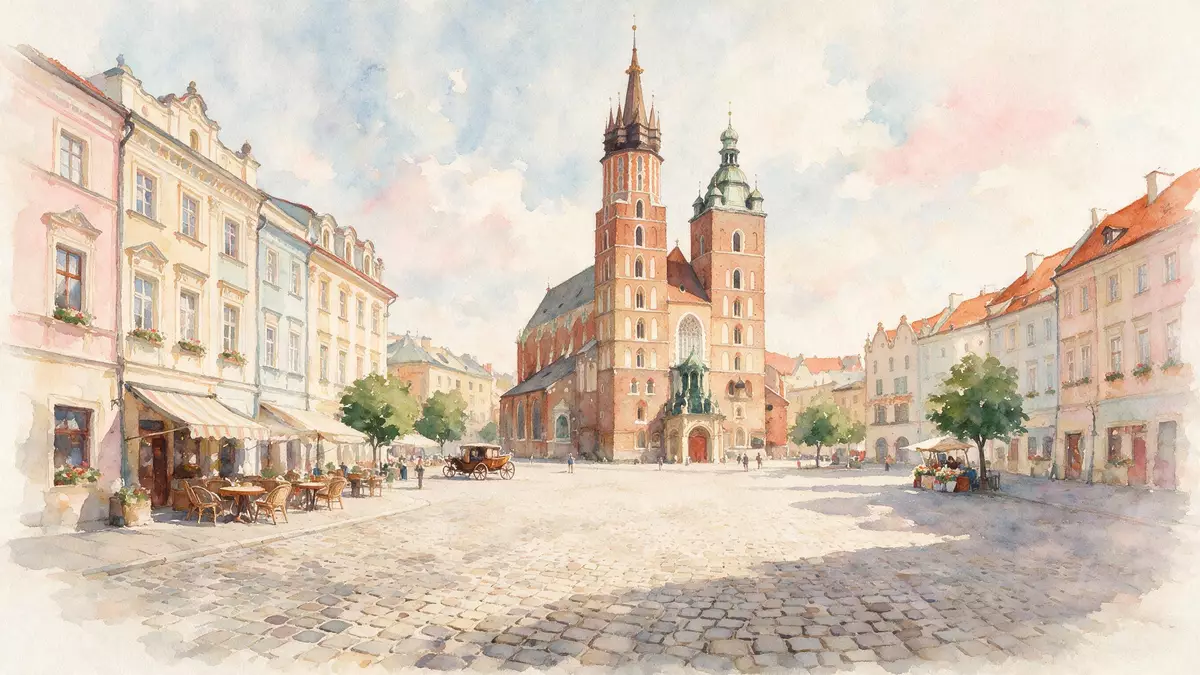
Stare Miasto w Krakowie is a historic urban district where a medieval street plan remains visible around Rynek G?ówny, the city’s Main Market Square. Gothic churches, Renaissance arcades, Baroque façades and Planty Park form a sequence of spaces around Krakau’s oldest centre.
Rynek G?ówny at the centre of Stare Miasto w Krakowie
Rynek G?ówny dates from the thirteenth century and remains the district’s principal urban space. Its broad surface is framed by historic houses, St Mary’s Basilica, the Town Hall Tower, St Adalbert’s Church and the Cloth Hall.
The Cloth Hall, known in Polish as Sukiennice, occupies the middle of the square. Its long Renaissance form contains arcades and a richly ornamented attic. St Mary’s Basilica rises beside the square with two unequal towers and a Gothic interior. The church contains the great wooden altarpiece carved by Veit Stoss, whose work belongs to the late fifteenth century. The square’s buildings bring together commerce, worship and civic architecture within a single urban setting. Krakow’s medieval layout remains a defining feature of the district.
From the 1257 charter to the Historic Centre
Krakow received Magdeburg rights in 1257, when the streets and market space were organised as a planned medieval town. The arrangement established a grid that remains legible in the streets leading from Rynek G?ówny towards Wawel Hill and the former city gates.
Stare Miasto w Krakowie forms part of the Historic Centre of Kraków, inscribed on the UNESCO World Heritage List in 1978. The wider protected centre includes the medieval city, Wawel Hill and Kazimierz. The historic urban fabric contains buildings from Romanesque, Gothic, Renaissance, Baroque and later periods, with churches, palaces, university buildings and burgher houses occupying the same compact area. Historic Centre of Kraków is situated beside the Vistula River, at the foot of the Royal Wawel Castle.
Planty, Wawel and the streets beyond the square
Planty Park forms a green belt around the Old Town. It follows the line of the former defensive circuit and separates the historic district from surrounding streets. St Florian’s Gate, the Barbican and surviving fragments of the fortifications remain near the northern approach.
South of the Main Market Square, Grodzka Street leads towards Wawel Hill, where the Royal Castle and Wawel Cathedral stand above the Vistula. Collegium Maius, the oldest surviving building of the Jagiellonian University, lies within the Old Town. Its Gothic courtyard and university rooms add an academic layer to the district’s religious, royal and commercial architecture. Wawel and the Main Square are linked by streets lined with churches, monasteries, palaces and historic houses.
Visiting Stare Miasto w Krakowie: what travellers from Western Europe should know
- Stare Miasto w Krakowie lies in central Krakau, beside the Vistula and below Wawel Hill. Kraków G?ówny railway station is north-east of the Old Town, with pedestrian routes leading towards St Florian’s Gate.
- The district is largely explored on foot. Cobbled streets, paved squares, church steps and the raised approach to Wawel create an uneven walking surface.
- Planty Park encircles the historic district. St Florian’s Gate, the Barbican and the Main Market Square form a clear north-to-south sequence.
- The official language is Polish and the currency is the Polish z?oty.
Searching for Stare Miasto w Krakowie on social platforms
These links open searches for Stare Miasto w Krakowie on each platform.
Frequently asked questions about Stare Miasto w Krakowie
Where is Stare Miasto w Krakowie?
It occupies central Krakau beside the Vistula River, with Wawel Hill at its southern edge and Planty Park around much of the historic district.
What can visitors expect to see?
The area contains Rynek G?ówny, the Cloth Hall, St Mary’s Basilica, historic streets, university buildings, Planty Park, St Florian’s Gate and the Barbican.
What makes the district distinctive?
Its medieval urban layout remains legible, while buildings from Gothic, Renaissance, Baroque and later periods stand within the same compact centre.


