
Stanley Park, Vancouver’s forested peninsula by the sea
Published on 09/16/2026 at 12:14 | Editorial responsibility: Rafael Müller, Editor-in-Chief AD HOC NEWS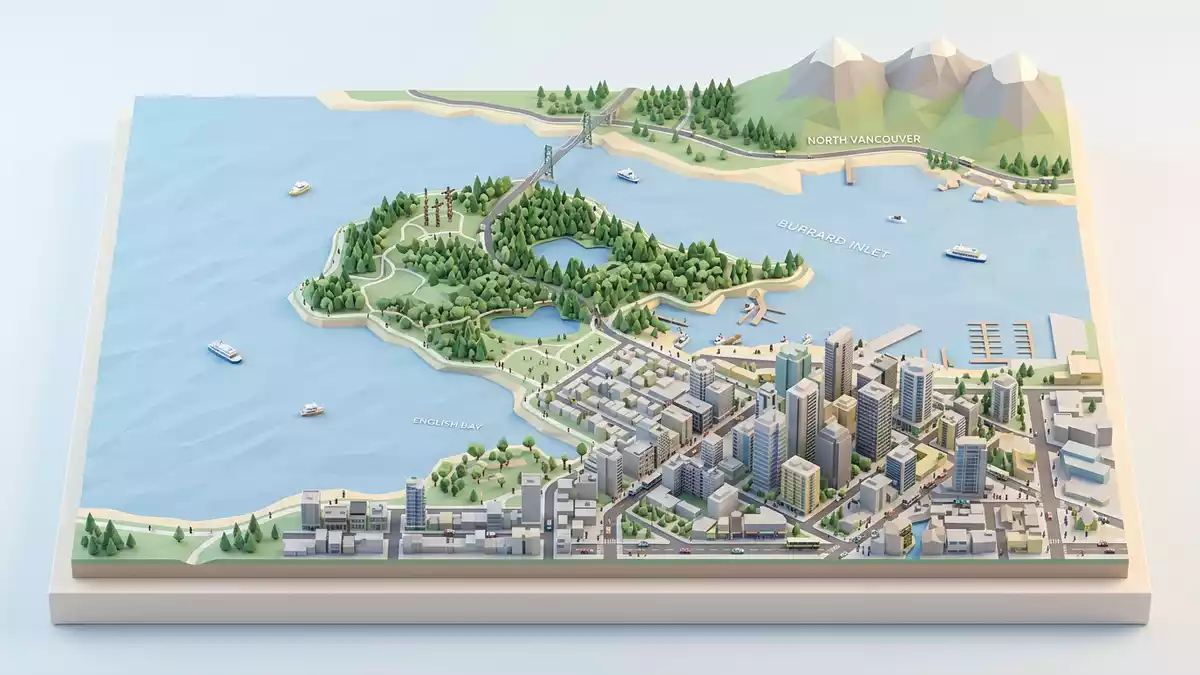
Stanley Park in Vancouver is a forested peninsula of coast, trails and ceremonial sites where Pacific rainforest meets the city’s harbour and bay in a single expanse of urban parkland. Opened as a public park in 1888 and named for Lord Stanley, Governor General of Canada, it remains defined by its mixture of dense woodland, shorelines and commemorative places tied to Indigenous and colonial histories.
Stanley Park as Vancouver’s first great urban park
Stanley Park occupies a peninsula that projects between Burrard Inlet and English Bay on the edge of downtown Vancouver, forming one continuous green mass enclosed by water on three sides. The city leased the land in the 1880s and the park was formally opened in 1888, taking its name from Lord Stanley, 16th Earl of Derby and Governor General of Canada, during a ceremony that marked its new civic role.Opened in 1888 under Lord Stanley’s name The peninsula had long been part of the traditional territory of Coast Salish peoples, including the Musqueam, Squamish and Tsleil Waututh Nations, whose habitation and ceremonial use predate the city by many centuries.Traditional territory of Coast Salish communities
As an urban park, Stanley Park was laid out under the influence of early twentieth-century park design, combining retained forest with constructed features such as gardens, drives and recreational facilities. A superintendent, W.S. Rawlings, guided much of this work between roughly 1911 and the 1930s, shaping areas of formal planting and landscape architecture within the wider woodland.Development led by superintendent W.S. Rawlings in the early twentieth century The park’s scale and form led to its recognition as the Stanley Park National Historic Site of Canada, a status that foregrounds both its designed landscapes and its earlier uses as Indigenous territory and military reserve.
Forest, shoreline and the celebrated seawall
One of the defining experiences of Stanley Park is the encounter with Pacific rainforest immediately beside city water. The park contains a large area of coniferous woodland, described by the City of Vancouver as natural West Coast rainforest, with trails that thread between tall trees, clearings and small lakes.Natural West Coast rainforest and scenic trails Within this forest, named features such as Beaver Lake and Lost Lagoon create quieter pockets of water enclosed by vegetation, contrasting with the open views available along the outer shores.
Encircling the peninsula’s edge is the Stanley Park seawall, a paved waterfront path that links Coal Harbour with English Bay in a continuous loop along the rock-lined coast.Continuous paved path tracing the shoreline Construction of retaining walls protecting this shoreline began in 1917, and the full circuit around Stanley Park was only completed decades later, giving the path a layered building history.Seawall construction beginning in 1917 and finished much later Moving along the seawall, the views shift from the container terminals and bridges of Burrard Inlet to open water, distant mountains and the beaches of English Bay, always with forest rising behind the path.
First Nations presence, totem poles and geological landmarks
Long before the park’s dedication in the nineteenth century, the Stanley Park peninsula contained villages and ceremonial sites of Coast Salish peoples. One Squamish settlement, X?wáy?x?way, stood near the area now known as Lumberman’s Arch, and the land still carries visible traces of Indigenous history, including culturally marked trees and named rock formations.X?wáy?x?way village and First Nations presence The park’s continued role as a ceremonial and commemorative site is reflected in monuments to figures such as writer Pauline Johnson, whose “Legends of Vancouver” helped fix the story of Siwash Rock in local memory.Commemorative monuments within the national historic site
At Brockton Point, near the eastern edge of the peninsula, a group of totem poles stands in a meadow set back from Burrard Inlet, bringing carvings from several First Nations into one outdoor display. The collection includes poles by artists from Squamish, Haida, Kwakwaka’wakw, Nisga’a and Nuxalk communities, with pieces relocated and added across the twentieth century.Brockton Point totem pole collection Elsewhere on the coast, Prospect Point and Siwash Rock mark distinctive geological formations shaped by volcanic activity tens of millions of years ago, giving Stanley Park abrupt cliffs and isolated stacks that interrupt the otherwise wooded shoreline.Prospect Point and Siwash Rock as volcanic formations
Visiting Stanley Park: what travellers from Western Europe should know
- Stanley Park lies immediately north-west of downtown Vancouver, on a peninsula between Burrard Inlet and English Bay, and is reached on foot, by bicycle, by public bus or via roads that cross into the park.
- The terrain combines paved paths such as the seawall with forest trails, beaches and modest gradients; some interior routes include stepped sections and unpaved surfaces under tall coniferous trees.
- Key sites within the park include Brockton Point with its totem poles, Prospect Point above the narrows of Burrard Inlet, and lakes such as Beaver Lake and Lost Lagoon set within the forest.
- The official language is English and the currency is the Canadian dollar.
- Entry requirements depend on your nationality; UK travellers can check the FCDO travel advice at gov.uk/foreign-travel-advice, Irish travellers the Department of Foreign Affairs at ireland.ie.
Searching for Stanley Park on social platforms
These links open searches for Stanley Park on each platform.
Frequently asked questions about Stanley Park
Where is Stanley Park and how does it relate to Vancouver’s centre?
Stanley Park occupies a peninsula adjoining downtown Vancouver, between Burrard Inlet and English Bay, and forms a large green area immediately beside the city’s streets.
What can visitors expect when exploring Stanley Park?
Visitors encounter coastal paths such as the seawall, beaches, forest trails, lakes and cultural sites including totem poles and commemorative monuments within a single extensive park.
What makes Stanley Park distinctive among urban parks?
Its combination of Pacific rainforest, encircling waterfront path, long Indigenous history and designation as a national historic site gives Stanley Park an unusual depth of landscape and culture.


