
Stanley Park’s forested peninsula beside downtown Vancouver
Published on 09/18/2026 at 20:48 | Editorial responsibility: Rafael Müller, Editor-in-Chief AD HOC NEWS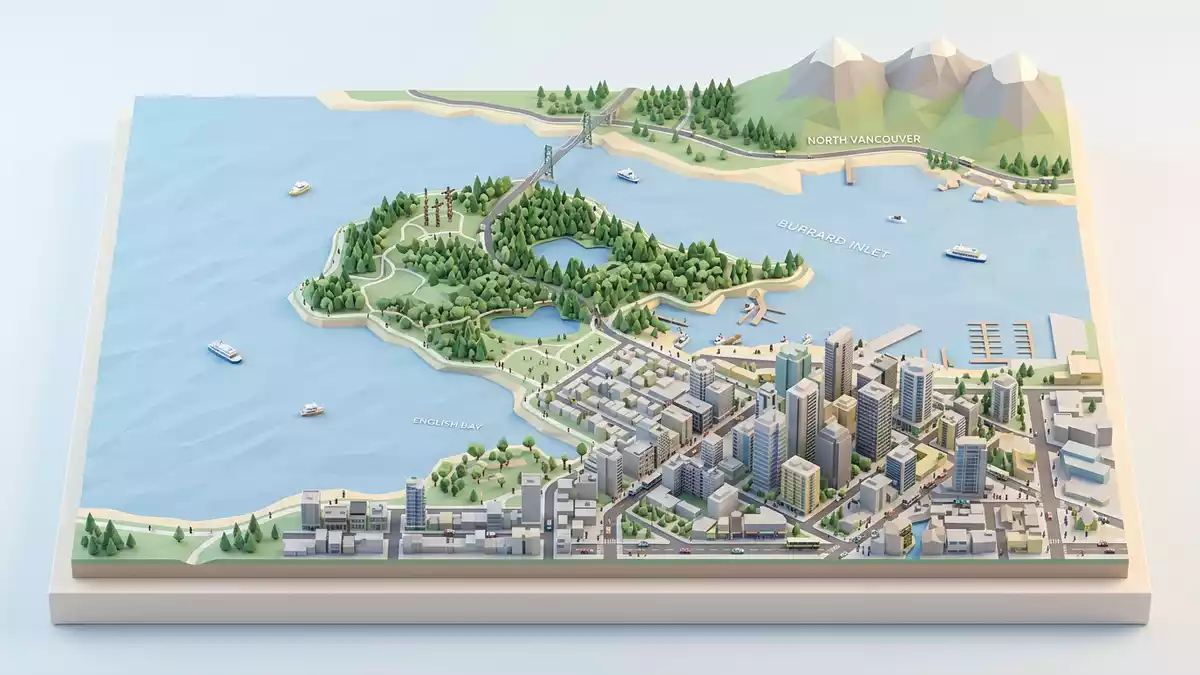
Stanley Park is a forested peninsula on the edge of downtown Vancouver where dense coastal woodland, seawall views and city towers share the same horizon. The park was officially opened as a public space in 1888 and named for Frederick Arthur Stanley, the Governor General of Canada, embedding a nineteenth-century date and a British political name into the fabric of Vancouver’s first municipal park.opened in 1888 and named in honour of Lord Stanley
A coastal rainforest park shaped as a peninsula
Stanley Park occupies a peninsula that projects between Burrard Inlet and English Bay, adjoining Vancouver’s downtown grid at Coal Harbour and stretching out towards the Lions Gate Bridge. The park’s area is recorded at around 405 hectares, making it a large tract of urban woodland where coniferous forest, roads and recreation areas interlock.400-hectare natural West Coast rainforest The terrain has been shaped over geological time, with features such as Prospect Point and Siwash Rock formed from volcanic activity tens of millions of years ago, giving the shoreline a mix of cliffs, rock outcrops and lower beaches.Prospect Point and Siwash Rock resulted from a volcanic eruption more than 32 million years ago
Much of the peninsula is covered in coastal temperate rainforest, dominated by western red cedar, hemlock and Douglas fir, with internal roads and trails threading between stands of mature trees and younger second-growth areas. Pockets of open grass, ornamental gardens and formal recreation spaces are set within this fabric rather than replacing it, so visitors move repeatedly between forest shade and open shoreline as they explore different parts of the park. Freshwater bodies such as Lost Lagoon and Beaver Lake bring a further layer of habitat and reflection, with paths and viewpoints arranged along their edges.
Indigenous land and the making of a municipal park
Long before Vancouver existed as a city, the land now called Stanley Park formed part of the traditional territory of Coast Salish peoples, including the Musqueam, Squamish and Tsleil-Waututh nations.land on which it sits is unceded, belonging to the Musqueam, Squamish and Tsleil-Waututh peoples Archaeological and historical work identifies village sites such as Whoi Whoi, also rendered as Xwayxway, near the present-day Lumbermen’s Arch, where large longhouses and ceremonial life were rooted for generations.site of a large Coast Salish village called Whoi Whoi This Indigenous presence gives the park a human history that long predates its designation as a recreational landscape.
In the nineteenth century the peninsula was set aside by colonial authorities as a government and military reserve, guarding the approaches to Burrard Inlet and Vancouver harbour.European settlers designated the peninsula a government reserve in 1859 After Vancouver incorporated in 1886, the city council petitioned the federal government to lease the reserve as a public park, and the park was formally established in 1888 and named for Lord Stanley of Preston, the 16th Earl of Derby.named after Lord Stanley, 16th Earl of Derby Early twentieth-century park planning under superintendent W.S. Rawlings introduced roads, gardens and recreational facilities, drawing on British precedents in large urban parks while retaining extensive woodland and shorelines.developed by the City of Vancouver between 1913 and 1936 under superintendent W.S. Rawlings
Walking the Seawall and meeting monuments
One of the defining experiences of Stanley Park is the continuous waterfront path known as the Seawall, which traces the edge of the peninsula and offers long sequences of views to downtown Vancouver, the North Shore Mountains, Burrard Inlet and English Bay. Constructed progressively through the twentieth century with stonework by stonemason Jimmy Cunningham, the Seawall provides a paved route for walking and cycling that passes by beaches, rock formations and viewpoints.a 9-kilometre paved seawall around the park’s edge Sections of the route run beneath the Lions Gate Bridge and around headlands such as Prospect Point, combining infrastructure, forest and maritime traffic in a single panorama.
Along the park roads and the Seawall, visitors encounter a sequence of cultural landmarks. At Brockton Point a group of totem poles, assembled from Indigenous communities including Haida and Kwakwaka’wakw carvers, stands near the shoreline as one of the park’s most recognised sites.totem poles at Brockton Point tell stories of the land and people Elsewhere, monuments commemorate figures such as poet Pauline Johnson, whose writing recorded Coast Salish stories linked to features like Siwash Rock, and plaques recall events from naval history and local logging, reflecting the multiple layers of human activity around the peninsula.
Visiting Stanley Park: what travellers from Western Europe should know
- Stanley Park adjoins Vancouver’s downtown district at Coal Harbour and is bordered by Burrard Inlet and English Bay; it is reached on foot, by bicycle, by public transport or by road.
- The terrain combines paved roads, forest trails and the Seawall path, with some sections involving sustained gradients and stairways as routes climb between the shoreline and higher viewpoints.
- Beach areas, lakes and forest interior lie within the same park, so footwear and clothing need to suit both paved surfaces and unpaved woodland paths.
- The official language is English and the currency is the Canadian dollar.
- Entry requirements depend on your nationality; UK travellers can check the FCDO travel advice at gov.uk/foreign-travel-advice, Irish travellers the Department of Foreign Affairs at ireland.ie.
Searching for Stanley Park on social platforms
These links open searches for Stanley Park on each platform.
Frequently asked questions about Stanley Park
Where is Stanley Park located?
Stanley Park forms a peninsula beside downtown Vancouver in the province of British Columbia, bordered by Burrard Inlet and English Bay.
What can visitors expect on a visit to Stanley Park?
Visitors encounter coastal rainforest, lakes, beaches, the paved Seawall and cultural landmarks such as totem poles and commemorative monuments within a single large urban park.
What makes Stanley Park distinctive among city parks?
Its combination of extensive coniferous forest, surrounding seawall views and Indigenous, military and civic histories on one peninsula gives Stanley Park a layered character beside Vancouver’s city centre.


