
Stanley Park in Vancouver: forest, seawall and city skyline
Published on 09/12/2026 at 22:59 | Editorial responsibility: Rafael Müller, Editor-in-Chief AD HOC NEWS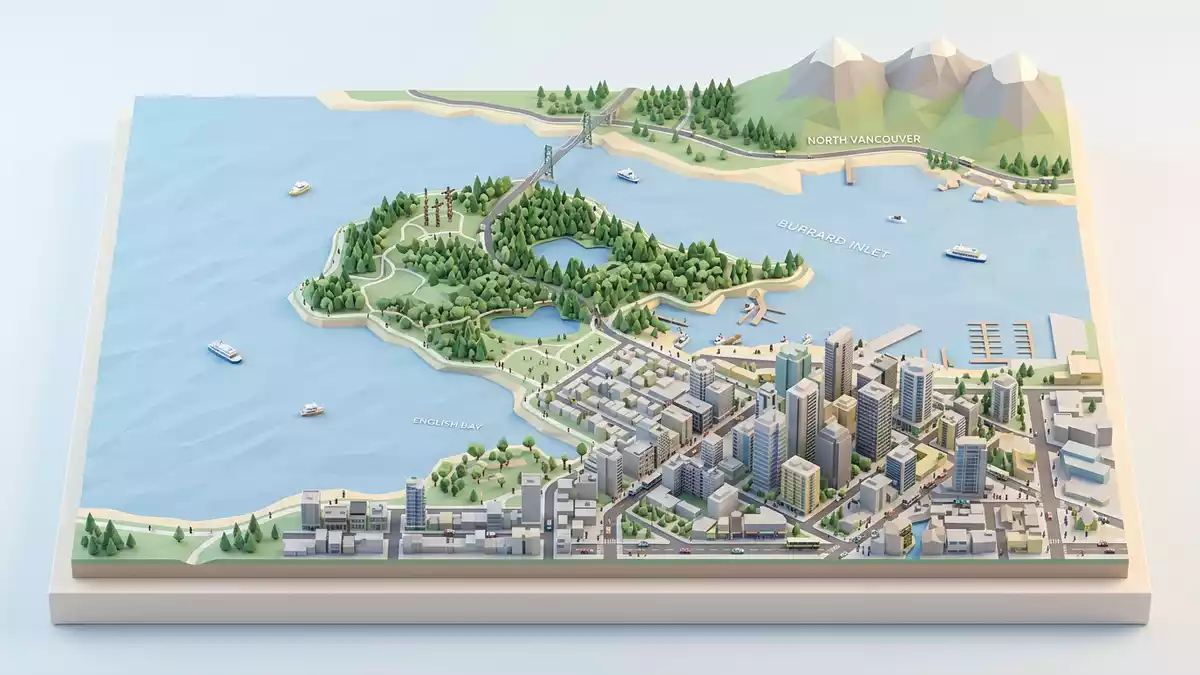
Stanley Park in Vancouver is a coastal forested peninsula where dense trees, open water and the city’s glass towers stand side by side. Formally opened as a public park in 1888 and named after Lord Frederick Stanley, then Governor General of Canada, it has grown into one of the best known large urban parks in North America, combining strands of coastal rainforest, gardens and shoreline paths.Opened in 1888 and named in honour of Lord Stanley
A peninsula of rainforest beside Vancouver’s downtown
Stanley Park occupies a peninsula at the western edge of downtown Vancouver, bounded on one side by Burrard Inlet and on the other by English Bay. The park covers more than 400 ha (around 1,000 acres) of mainly forested ground, with a mix of coniferous and broadleaf trees rising between the city and the harbour.The park covers about 1,001 acres on a peninsula beside downtown From viewpoints such as Prospect Point and Siwash Rock, the skyline of Vancouver, the Lions Gate Bridge and the North Shore mountains form a layered backdrop above the water.
Much of Stanley Park appears as continuous coastal rainforest, and several interior areas retain trees that pre-date the park’s creation, while other parts show second-growth forest from nineteenth-century logging.Pockets of genuine old-growth and areas of second-growth forest sit within the park The network of trails runs beneath this canopy, crossing small creeks and skirting wetlands, so that short walks can feel distinctly separate from the nearby streets and apartment towers even though the city lies just beyond the trees.
The seawall and shoreline: walking the edge of the park
The most recognisable built feature of Stanley Park is its stone seawall, which traces the entire outer edge of the peninsula. Constructed progressively during the twentieth century to prevent erosion of the foreshore, the Stanley Park section of the Vancouver seawall forms a paved loop of about 9 km (5.6 mi) around the park’s waterfront, with the broader waterfront path extending well beyond into other districts.The Stanley Park portion of the Vancouver Seawall is approximately 9 kilometres The route passes under the Lions Gate Bridge, around Brockton Point, past beaches and viewpoints, and offers continuous views across the harbour and bay as it curves.
Between the paved edge and the forest behind it, the shore alternates between beaches, rocky foreshore and small coves. At Brockton Point the harbour side of Stanley Park opens towards the Port of Vancouver and the distant Coast Mountains, while the English Bay side faces out towards open water and sunset skies. Landmarks such as Siwash Rock, rising out of the water close to the cliff, and the lighthouse at Brockton Point give the circuit distinct waypoints, and the seawall’s even surface makes it a straightforward route for pedestrians and cyclists following the peninsula’s outline.Features along the shore include Brockton Point and Siwash Rock
First Nations history, gardens and park attractions
Long before Stanley Park was designated as a municipal park, the peninsula formed part of the traditional territory of Coast Salish peoples, including the Musqueam, Squamish and Tsleil-Waututh Nations.The peninsula was traditional territory of Coast Salish First Nations One of the larger historic villages, often referred to as Whoi Whoi or Xwayxway, once stood near what is now the south-eastern part of the park, and contemporary interpretation within the park acknowledges this long human presence alongside more recent colonial history.The area was once home to a sizeable village called Whoi Whoi or Xwayxway
Within the park today, one of the most recognisable cultural features is the group of totem poles at Brockton Point, carved by Indigenous artists from different parts of British Columbia and assembled as a display during the twentieth century.Nine totem poles carved in British Columbia stand at Brockton Point Elsewhere, cultivated spaces such as the Stanley Park Rose Garden, laid out in the early twentieth century beside the park’s pavilion, sit within short walking distance of forest trails and open lawns. Attractions including the Vancouver Aquarium, children’s play areas and small concession buildings are spread through the park, but the overall character remains dominated by trees, water and views rather than intensive construction.
Visiting Stanley Park: what travellers from Western Europe should know
- Stanley Park lies immediately west of Vancouver’s downtown grid, bordered by Burrard Inlet and English Bay, and is reached easily by city streets, buses and cycling routes crossing the short distance from central districts.
- The interior of the park includes undulating ground, forest paths and staircases, and the walk around the seawall forms a continuous paved loop of several kilometres that can feel long if completed in one outing.
- Within sight of Stanley Park are the Lions Gate Bridge spanning Burrard Inlet, the residential neighbourhoods of the West End, and the North Shore mountains, which together frame many of the park’s viewpoints.
- The official language is English and the currency is the Canadian dollar.
- Entry requirements depend on your nationality; UK travellers can check the FCDO travel advice at gov.uk/foreign-travel-advice, Irish travellers the Department of Foreign Affairs at ireland.ie.
Searching for Stanley Park on social platforms
These links open searches for Stanley Park on each platform.Frequently asked questions about Stanley Park
Where is Stanley Park and what kind of place is it?
Stanley Park is a large coastal urban park on a peninsula beside downtown Vancouver, combining coastal rainforest, shoreline and gardens in one contiguous area.
What can visitors expect on a typical visit to Stanley Park?
Visitors encounter forest trails, the paved seawall loop, viewpoints over Burrard Inlet and English Bay, cultural sites such as the Brockton Point totem poles, and cultivated spaces including the rose garden.
What makes Stanley Park distinctive among city parks?
The close overlap of dense coastal forest, extensive waterfront paths and uninterrupted views of harbour, bridge and mountains gives Stanley Park a character in which city and landscape are constantly in view together.


