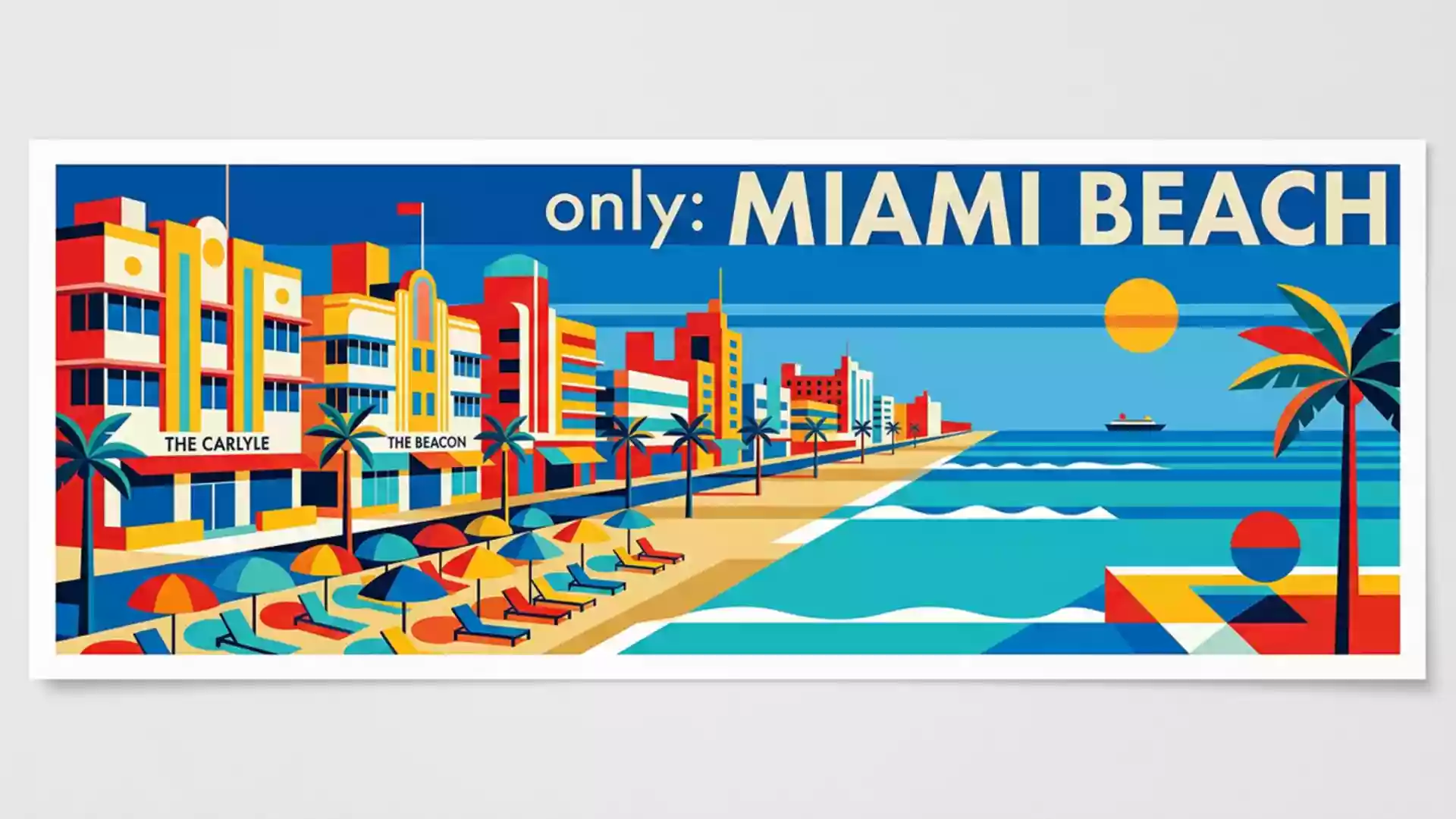
South Beach and the pastel skyline of Miami Beach
Published on 09/02/2026 at 10:12 | Editorial responsibility: Rafael Müller, Editor-in-Chief AD HOC NEWS
South Beach in Miami Beach stretches along the Atlantic shore as a band of pale sand backed by low-rise streets of pastel buildings, neon signage and palm trees. It occupies the southern part of the barrier island of Miami Beach in Florida, framed by the Atlantic Ocean to the east and Biscayne Bay to the west.South Beach lies on the eastern edge of the barrier island and much of it falls within the Miami Beach Architectural District, a historic area associated with the interwar Art Deco boom.The Miami Beach Architectural District was listed as a U.S. historic district in 1979
Art Deco streets between ocean and bay
Walk inland from the sand and South Beach reveals a compact grid of streets where Atlantic light bounces off glazed stucco and coloured bands on façades. Ocean Drive runs parallel to the shoreline, one block west of the beach, with Collins Avenue just behind it and Washington Avenue further inland.The Art Deco District in Miami Beach lies between 5th Street and 23rd Street along Ocean Drive, Collins Avenue and Washington Avenue These streets carry a dense run of two- to four-storey hotels and apartment buildings that share similar proportions yet differ in detail.
The Miami Beach Architectural District, also known as the Art Deco Historic District, was listed on the National Register of Historic Places in 1979 as a twentieth-century historic district and contains hundreds of buildings from the period between the early 1920s and early 1940s.The district is bounded by the Atlantic Ocean, Sixth Street, Alton Road and the Collins Canal and was designated on 14 May 1979 Many façades follow the familiar Art Deco pattern of strong vertical and horizontal lines, stylised ornament and geometric panels, while others draw on Mediterranean Revival motifs or later Miami Modern forms.Architecture in South Beach combines Art Deco, Mediterranean Revival and Miami Modern styles
Pastel façades, neon nights and named architects
Seen in daylight, the facades of South Beach’s Art Deco buildings lean towards peach, mint, aqua and lavender, broken by white bands and reliefs that frame windows and entrances.Descriptions of the district highlight pastel colour schemes and geometric symbols After dark, the same buildings take on a different character as neon signs trace their outlines and names along Ocean Drive, giving the seafront a continuous glow above the palms.Ocean Drive between 5th and 15th streets is known for its illuminated Art Deco hotels and neon signs
Architecturally, South Beach is closely linked with designers such as Henry Hohauser and L. Murray Dixon, whose work in the 1930s helped define its streamlined curves, stepped rooflines and decorative panels.Henry Hohauser and L. Murray Dixon are named among the principal architects of Deco South Beach Many of their buildings adopt a tripartite composition with a central vertical element and flanking bays, emphasising the entrance with panels, fluting or stylised motifs. Some windows carry projecting concrete bands above them, a detail sometimes called an eyebrow, which underlines the horizontal rhythm of the facades.Accounts of South Beach architecture mention concrete eyebrows and symmetrical facades
Beachfront sand, parks and the wider layout
South Beach is as much about open space as it is about architecture, with Atlantic sand forming a continuous beachfront strip in front of the urban grid. A broad public promenade runs along the seafront, separating the beach from Ocean Drive and giving direct access to the sand at regular intervals.Descriptions of South Beach emphasise the Atlantic shoreline and urban waterfront The shoreline faces open ocean, with lifeguard towers, volleyball courts and reserved zones for different activities laid out along the sand.
At the southern tip of the neighbourhood, South Pointe Park forms a landscaped headland beside the entrance channel to the harbour, looking across to the cruise piers of PortMiami and to Fisher Island.South Pointe Park and the Government Cut shipping channel mark the southern end of South Beach Inland, the island narrows towards Biscayne Bay, where marinas and waterfront developments line the shore. The contrast between the open Atlantic side and the sheltered bay side is easy to trace on foot, with the long, straight streets running from beach to bay.
Visiting South Beach: what travellers from Western Europe should know
- South Beach forms the southern part of the city of Miami Beach in Florida, on a barrier island east of mainland Miami, reached by road bridges that cross Biscayne Bay.
- The terrain is low and flat, with long stretches of sand and paved promenades; inland streets are laid out in a grid, and walking between the beach and the Art Deco buildings involves only gentle gradients.
- South Pointe Park occupies the southern end of South Beach on a headland beside the Government Cut channel, offering views towards PortMiami and Fisher Island across the water.
- The official language is English and the currency is the United States dollar.
- Entry requirements depend on your nationality; UK travellers can check the FCDO travel advice at gov.uk/foreign-travel-advice, Irish travellers the Department of Foreign Affairs at ireland.ie.
Searching for South Beach on social platforms
These links open searches for South Beach on each platform.
Frequently asked questions about South Beach
Where is South Beach?
South Beach is a neighbourhood of Miami Beach in Florida, occupying the southern third of the city’s barrier island between the Atlantic Ocean and Biscayne Bay.
What can visitors expect on a first walk?
Visitors encounter a long Atlantic beach, a seafront promenade and parallel streets lined with low-rise Art Deco and related architecture in pastel colours.
What makes South Beach distinctive among coastal districts?
South Beach combines an Atlantic shoreline with a dense historic district of interwar Art Deco buildings, recognised on the National Register of Historic Places and closely associated with architects such as Henry Hohauser.