
Souq Waqif in Doha, Qatar’s standing market reborn
Published on 08/30/2026 at 11:28 | Editorial responsibility: Rafael Müller, Editor-in-Chief AD HOC NEWS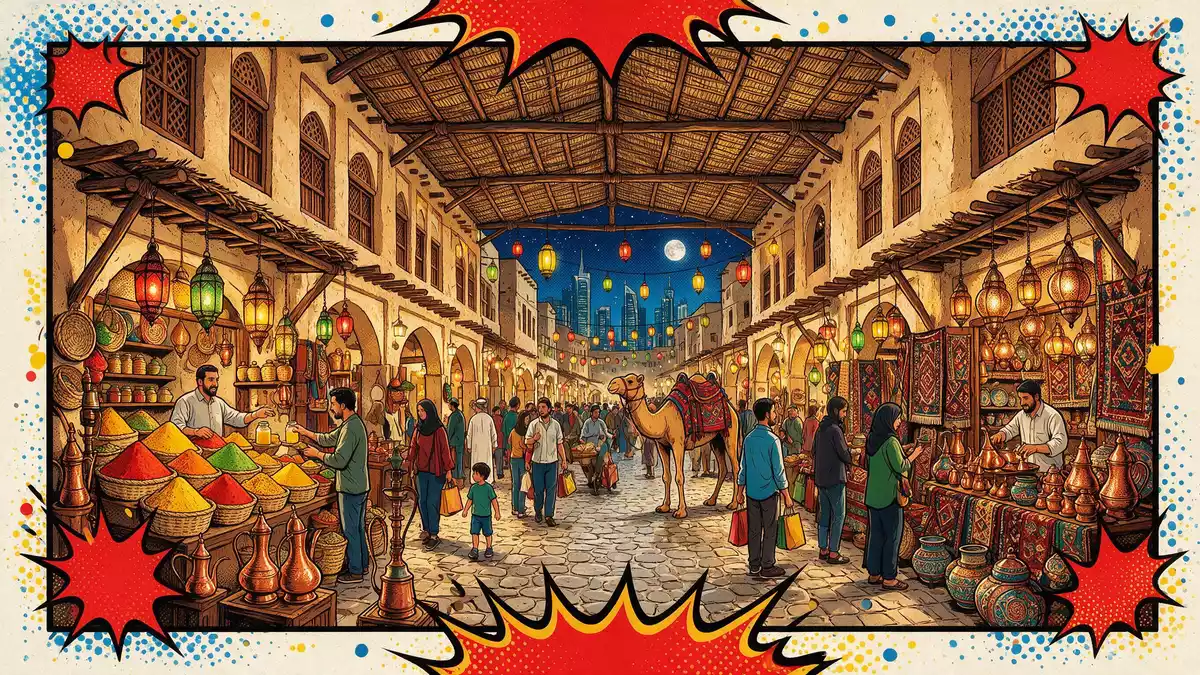
Souq Waqif in Doha is a traditional marketplace where a historic trading hub has been rebuilt in period style, with narrow alleys, mud-rendered shops and exposed timber beams evoking an older Gulf town.historic trading hub The souq stands on ground that functioned as a market for Bedouin and local merchants for more than a century, giving it a rare continuity between past and present.market for Bedouin and local merchants
A standing market shaped by Doha’s trading past
The name Souq Waqif, meaning “standing market” in Arabic, reflects trading practices on low-lying ground near the old shoreline where merchants conducted business on their feet as the area was prone to flooding.meaning standing market The site lay close to Wadi Musheireb, a dry river bed that formed a natural edge to early Doha and provided a gathering place for exchanges between Bedouins and coastal residents.Wadi Musheireb
Historical accounts describe Souq Waqif as a centre where livestock, dairy products, wool, timber charcoal, grains and textiles were traded, linking nomadic communities with the town’s residents.livestock and dairy traded The first permanent shops at the market are reported to date back around 250 years, giving the place roots in the late eighteenth century even though much of what visitors see was built later in a traditional idiom.first permanent shops around 250 years ago
Restoration in traditional Qatari architectural style
After a period of decline in the late twentieth century and extensive fire damage in 2003, Souq Waqif became the focus of a large restoration project launched in 2006, backed by Qatari authorities and completed around 2008.restoration launched in 2006project completed by 2008 The Private Engineering Office led by Mohamed Ali Abdullah was appointed to design and renovate the heritage site between 2004 and 2007, with newer buildings removed and older ones preserved to form the core of the present-day souq.Private Engineering Office Mohamed Ali Abdullah
The restored Souq Waqif uses traditional Qatari materials and techniques, including whitewashed mud-rendered walls, timber beams and roofs constructed from wood and bamboo bound with clay and straw.whitewashed mud-rendered buildings Narrow lanes and courtyards form a dense urban fabric that recalls a nineteenth-century souq in layout and surface appearance, with many facades deliberately kept simple to emphasise the texture of plaster and timber.
Souq Waqif as a contemporary cultural quarter
Souq Waqif extends across a network of streets close to the Doha Corniche, making it a bridge between the city’s waterfront and its older commercial area.close to Doha Corniche Many of the shops specialise in textiles, spices, perfumes, handicrafts and traditional household items, echoing the market’s historic trading role while operating in renovated premises.
Architecturally, the quarter includes restored historic buildings such as Hotel Bismillah, recognised as the first hotel in the souq and a reminder of mid-twentieth-century urban life in Doha.Hotel Bismillah first hotel The combination of heritage architecture and present-day commercial activity turns the souq into a cultural quarter where the built environment deliberately follows traditional forms rather than high-rise development.rebuilt using traditional materials and design
Visiting Souq Waqif: what travellers from Western Europe should know
- Souq Waqif lies in central Doha, close to the Doha Corniche and the Msheireb area, and is reached by city streets used by local traffic and public transport.central Doha location
- The market is laid out as a network of narrow alleys and passages with uneven cobbled surfaces, so walking involves short flights of steps and frequent turns between close-packed buildings.labyrinthine alleys and cobbled pathways
- The Arabian Gulf shoreline lies nearby, and the area can feel exposed to sun and coastal weather, making shade from the arcades and building overhangs a notable feature of the walkways.close to former shoreline
- The official language is Arabic and the currency is the Qatari riyal.
- Entry requirements depend on your nationality; UK travellers can check the FCDO travel advice at gov.uk/foreign-travel-advice, Irish travellers the Department of Foreign Affairs at ireland.ie.
Searching for Souq Waqif on social platforms
These links open searches for Souq Waqif on each platform.Frequently asked questions about Souq Waqif
Where is Souq Waqif in Doha?
Souq Waqif stands in central Doha near the Doha Corniche and the Msheireb district, on the site of an older market that grew beside Wadi Musheireb.site beside Wadi Musheireb
What can visitors expect on a visit to Souq Waqif?
Visitors encounter a maze of alleys lined with mud-rendered shops selling textiles, spices, perfumes and handicrafts, housed in buildings restored in traditional Qatari style.restored in traditional Qatari style
What makes Souq Waqif distinctive among Gulf markets?
Souq Waqif combines roots that reach back at least a century with a twenty-first-century restoration that deliberately retains mud plaster, timber beams and narrow streets instead of replacing the quarter with high-rise structures.retains traditional quarter rather than high-rise


