
Souq Waqif in Doha, a market rebuilt in traditional style
Published on 09/05/2026 at 13:10 | Editorial responsibility: Rafael Müller, Editor-in-Chief AD HOC NEWS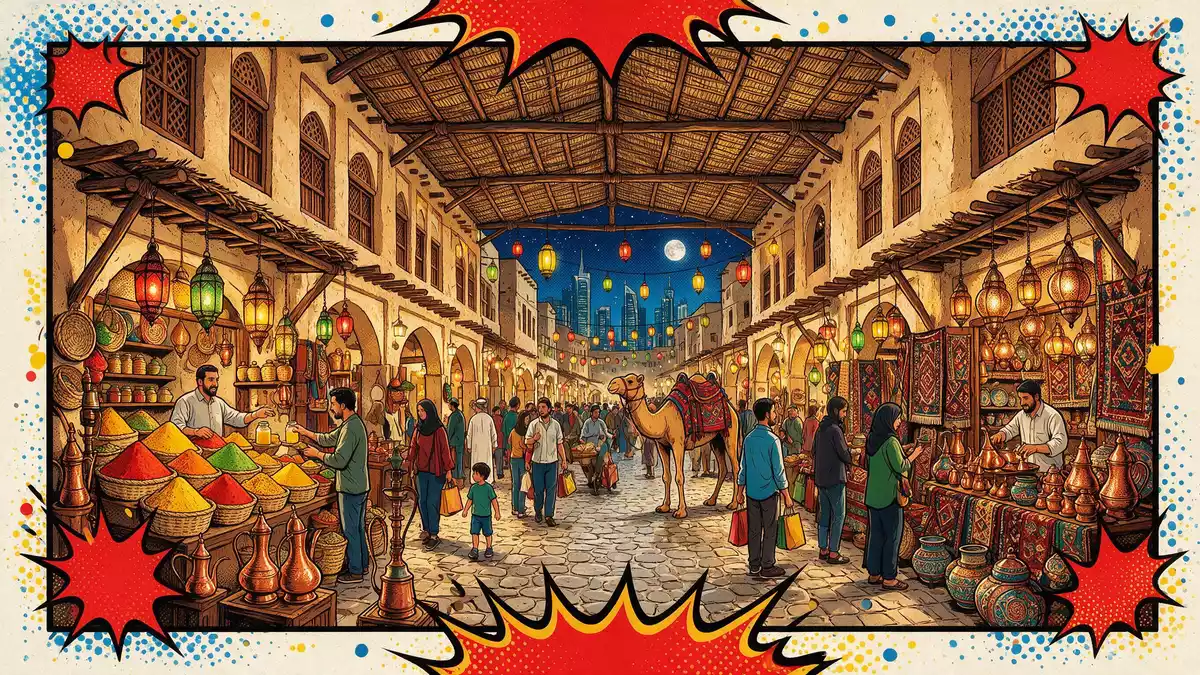
Souq Waqif in Doha is a traditional market rebuilt in the early twenty-first century on an old trading site beside the dry river bed known as Wadi Musheireb, where Bedouins once gathered to trade livestock and everyday goods.The market in its present form dates from a major restoration completed in 2008, but its layout and construction echo a much older souq that was already active around the late nineteenth and early twentieth centuries.The complex stands in central Doha near the Corniche, in the Al Souq and Al Jasra districts, and has become a place where traditional Qatari architecture frames narrow lanes, courtyards and market halls.
Traditional architecture rebuilt for a historic marketplace
Souq Waqif is built in a style that recalls traditional Qatari architecture, with low-rise buildings rendered in mud and plaster, exposed timber beams and roofs made from mangrove or dangeal wood, bamboo and layers of clay and straw.The restoration replaced metal roofs and modern finishes with traditional materials, creating shaded passageways lined with shops and workshops. Many of the façades are punctuated by wooden details and projecting elements, giving the market an appearance that matches its late nineteenth-century roots while accommodating contemporary use. Behind the continuous fronts, lanes and alleys run between buildings, creating an irregular grid that feels like a historic neighbourhood adapted for trading.
The restoration of Souq Waqif was initiated after a fire in 2003 destroyed much of the older market fabric.A government-led programme began in 2006, and the rebuilt souq opened to the public in stages until completion in 2008. The project drew on historic photographs and oral histories to revive building techniques and details, and it removed later concrete and metal additions that did not fit the traditional character.Architects studied the earlier market and aimed to reverse the dilapidation of its historic structures. As a result, walking through Souq Waqif today means moving through a complex that has been deliberately shaped to resemble the older trading quarter.
A marketplace rooted beside Wadi Musheireb
The origins of Souq Waqif lie in a time when Doha was a small coastal settlement and traders gathered on the banks of Wadi Musheireb to sell livestock, wool and other goods.The name, meaning “standing market” in Arabic, refers to merchants who traded while standing, as water from the sea and the wadi sometimes flooded the ground. Over decades a more permanent marketplace formed, with simple structures lining the trading area and providing shelter from the sun.
The market’s location near the shoreline and the wadi made it a natural hub for exchange in Doha, connecting inland Bedouin routes with coastal trade.Early traders brought animals and wool to Souq Waqif, and the souq grew as the settlement expanded. In the twentieth century parts of the surrounding waterfront were reclaimed and modern roads and buildings appeared, but the market area remained a recognisable nucleus of commercial life. The recent restoration keeps that relationship visible: the souq still sits near major streets such as Al Asmakh Street and Al Ahmed Street, with its entrances leading directly from the modern city into the historic-style lanes.Its address in Al Jasra places it between these streets in the heart of Doha.
Souq Waqif as a cultural and commercial hub
Souq Waqif functions as a traditional market where textiles, spices, perfumes, handicrafts and souvenirs are sold from small shops that open directly onto the passageways.Stalls and shops specialise in traditional garments and household items, and some areas concentrate on particular goods such as incense or decorative pieces. The repetition of stone and plaster walls, timber doors and shaded verandas gives the souq a coherent character, even as individual shops present their own arrangements of wares.
The market is also known for its restaurants and cafés, many of which provide outdoor seating along wider lanes or around open spaces.Food outlets and shisha lounges occupy buildings within the same traditional architectural envelope, so dining areas sit among the market halls rather than in a separate district. Together, these uses mean Souq Waqif is both a place to shop for everyday goods and a setting where people spend time in the evening, surrounded by architecture that recalls Doha’s earlier trading quarter.
Visiting Souq Waqif: what travellers from Western Europe should know
- Souq Waqif stands in central Doha in the Al Souq and Al Jasra districts, between Al Asmakh Street and Al Ahmed Street, close to the Corniche waterfront.
- The market consists of narrow paved lanes, covered walkways and open courtyards, so visiting involves walking on level surfaces with occasional kerbs and short flights of steps.
- Souq Waqif Metro Station on the Gold Line provides rail access nearby, with an entrance on Abdullah Bin Jassim Street leading towards the market area.
- The official language is Arabic and the currency is the Qatari riyal.
- Entry requirements depend on your nationality; UK travellers can check the FCDO travel advice at gov.uk/foreign-travel-advice, Irish travellers the Department of Foreign Affairs at ireland.ie.
Searching for Souq Waqif on social platforms
These links open searches for Souq Waqif on each platform.
Frequently asked questions about Souq Waqif
Where is Souq Waqif in Doha?
Souq Waqif is in central Doha in the Al Souq and Al Jasra districts, between Al Asmakh Street and Al Ahmed Street, close to the Corniche waterfront.
What should visitors expect at Souq Waqif?
Visitors encounter traditional-style market buildings with lanes lined by shops selling garments, spices and handicrafts, alongside restaurants and cafés arranged around courtyards and wider streets.
What makes Souq Waqif distinctive among markets?
Souq Waqif is distinctive for its reconstruction in traditional Qatari architectural style after a fire in 2003, using mud-rendered walls, timber beams and clay-and-straw roofs on the site of a much older marketplace.


