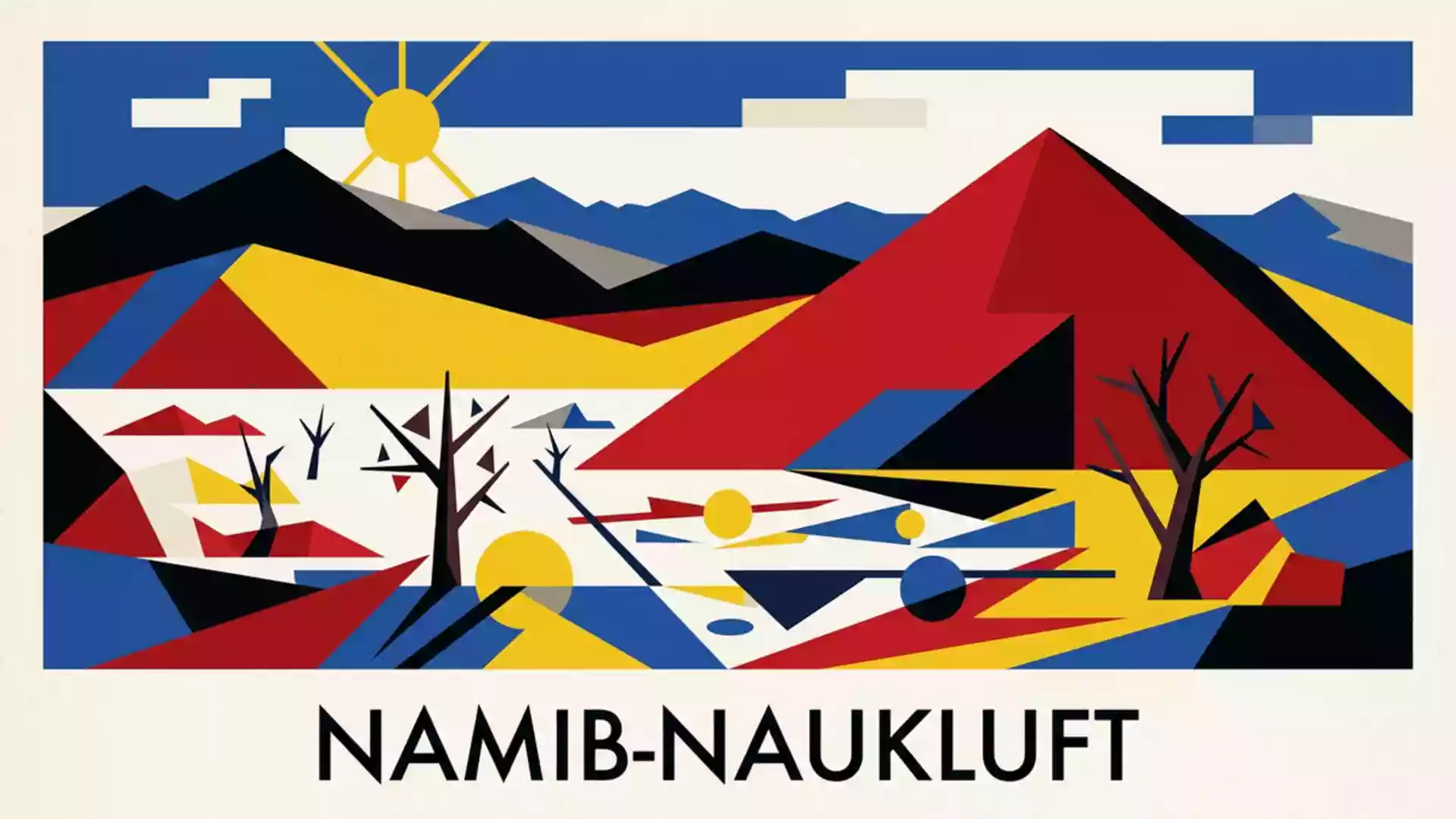
Sossusvlei’s red dunes and white pans in Namib-Naukluft
Published on 09/08/2026 at 09:40 | Editorial responsibility: Rafael Müller, Editor-in-Chief AD HOC NEWS
Sossusvlei in Namibia’s Namib-Naukluft National Park is a broad salt and clay pan ringed by towering red dunes, set deep within the Namib Sand Sea. Its name, drawn from Afrikaans and English as “dead-end marsh”, reflects the point where the ephemeral Tsauchab River meets a wall of sand and can go no further.
Red dunes, white pans and the dead-end river
At its core, Sossusvlei is a flat depression of white salt and clay where floodwater from the Tsauchab River sometimes pools before evaporating, leaving behind a pale crust against the surrounding sand. This endorheic pan, with no outlet to the sea, sits at the inland terminus of the Tsauchab, an ephemeral river that flows only after rare desert rainfall and ends within the Namib Sand Sea rather than reaching the Atlantic Ocean.salt and clay pan The name “Sossusvlei” combines the Afrikaans word “vlei” for a shallow pan with a term that evokes a blind or blocked river course.
The dunes around the pan form part of the Namib Sand Sea, a vast belt of overlapping dune systems recognised as a World Heritage landscape for its active geological processes and coastal desert environment.Namib Sand Sea Here, sand grains carried by rivers from the interior of southern Africa, then moved by ocean currents and wind, accumulate into high, star-shaped dunes whose reddish colour comes from iron oxides in the sediment.orange-red dunes The pan-and-dune system at Sossusvlei, with the Tsauchab River repeatedly entering the dune field and being dammed, has produced a network of clay pans across the area.
Sossusvlei within Namib-Naukluft National Park
Sossusvlei lies in the southern part of the Namib Desert, inside Namib-Naukluft National Park, a conservation area that extends over a large swathe of Namibia’s Atlantic coastal belt.Namib-Naukluft National Park The surrounding dunes rise hundreds of metres above the pans and belong to one of the oldest desert systems on Earth, where hyper-arid conditions have prevailed for tens of millions of years.ancient desert Within this setting, Sossusvlei has become a visual shorthand for the Namib, with its interplay of red dunes, white pan surfaces and occasional green patches when water reaches the vlei.
Although Sossusvlei strictly denotes the main salt and clay pan at the end of the Tsauchab, the name in practice covers a wider cluster of pans and dunes along the valley. Travellers encounter places such as Deadvlei and Hiddenvlei, smaller pans separated by dunes, as well as named dune summits that line the access road and frame the pans.Deadvlei and Hiddenvlei Collectively, these features form one of Namibia’s most recognisable desert landscapes, where the national park protects both the geology and the sparse desert-adapted life that persists in and around the pans.
Deadvlei and the wider pan system
Among the satellite pans near the main vlei, Deadvlei has become known for its dry clay surface punctuated by the dark trunks of long-dead camelthorn trees, preserved by aridity and standing in stark contrast against the bright ground and surrounding dunes.ancient trees of Deadvlei Geologically, both Sossusvlei and Deadvlei belong to a playa-lake system on the eastern flank of the Namib Sand Sea, where fluvial sediments from the Tsauchab River mingle with aeolian sands in a shifting pattern of dunes, interdune corridors and pans.playa-lake system Over geological time, the river has repeatedly been blocked by migrating dunes, creating successive pans that dry out between infrequent floods.
The Tsauchab’s path from the interior highlands towards the coast ends at Sossusvlei roughly 50 km inland from the Atlantic shoreline, where the dunes converge and absorb its flow.Tsauchab River terminus In years when rainfall is sufficient to send water down the river, the main pan can hold a shallow lake for a time, turning the normally dry basin into a mirror that reflects the flanks of the red dunes around it.rare floodwater As the water evaporates, the pan returns to its familiar cracked surface, and the trees and shrubs that have taken root along the river course depend again on groundwater and brief flows.
Visiting Sossusvlei: what travellers from Western Europe should know
- Sossusvlei lies in the southern Namib Desert within Namib-Naukluft National Park in western Namibia, reached via the small settlement of Sesriem on the park access road.
- The terrain around the pans consists of soft desert sand and dune slopes, requiring walking on loose surfaces and, on dune ascents, sustained uphill sections on shifting sand.
- Nearby features include Deadvlei, Hiddenvlei and several named dunes along the Tsauchab valley, which can be viewed from the access route and explored on foot from designated parking areas.
- The official language is English and the currency is the Namibian dollar.
- Entry requirements depend on your nationality; UK travellers can check the FCDO travel advice at gov.uk/foreign-travel-advice, Irish travellers the Department of Foreign Affairs at ireland.ie.
Searching for Sossusvlei on social platforms
These links open searches for Sossusvlei on each platform.
Frequently asked questions about Sossusvlei
Where is Sossusvlei in Namibia?
Sossusvlei lies in the Namib Desert within Namib-Naukluft National Park in western Namibia, on the eastern margin of the Namib Sand Sea.
What should visitors expect on a visit to Sossusvlei?
Visitors encounter a white salt and clay pan surrounded by high red dunes, walking on soft desert sand and, if they choose, climbing dune slopes for wide views over the pans.
What makes Sossusvlei distinctive among desert landscapes?
Its combination of an endorheic clay pan, the dead-end course of the Tsauchab River and towering iron-rich dunes within the Namib Sand Sea gives Sossusvlei a sharply defined desert geometry.