
Sky Tower in Auckland: a vertical landmark of concrete and glass
Published on 08/24/2026 at 07:03 | Editorial responsibility: Rafael Müller, Editor-in-Chief AD HOC NEWS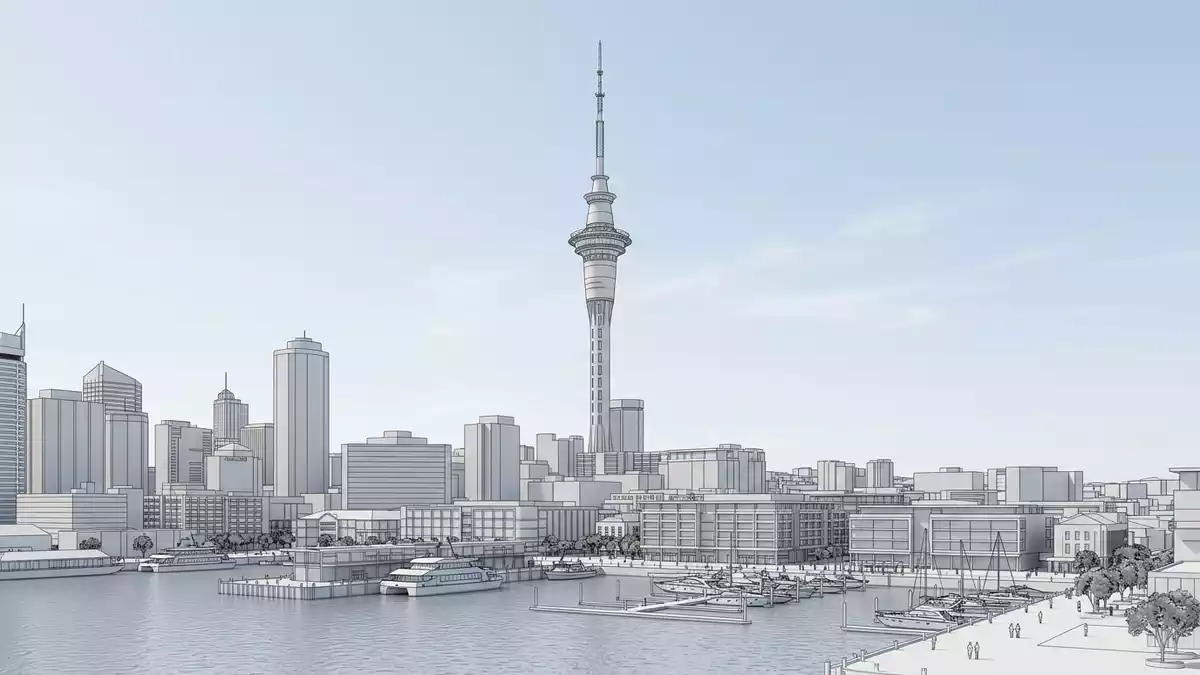
Sky Tower is the concrete and glass needle that anchors Auckland’s skyline, combining a telecommunications role with sweeping views over T?maki Makaurau and the Hauraki Gulf. Rising to 328 m (1,076 ft) from its foundations in the central business district, it has become a fixed point in the city’s modern identity since its completion in 1997.
Concrete engineering and a late twentieth-century tower
Sky Tower belongs to the generation of late twentieth-century high-rise structures built around high-strength concrete cores, and its form is inseparable from that engineering choice. Architectural design was led by Craig Craig Moller, with architect Gordon Moller associated closely with the project, and engineering was undertaken by Beca Carter Hollings & Ferner.architectural design by Craig Craig Moller The main construction contract was carried out by Fletcher Construction, a major New Zealand building firm.construction was entrusted to Fletcher Construction
Foundation work for Sky Tower began in 1994, and the tower structure rose over central Auckland through the mid-1990s before opening to the public in 1997.construction of the foundations began in September 1994 The project used substantial volumes of concrete and reinforcing steel to form the shaft and base, with additional structural steel concentrated in the mast section above the main observation levels.Sky Tower consists of concrete, reinforcing steel and structural steel Within the broader SkyCity Auckland precinct, the tower provides both an engineering focal point and a visual marker for the casino and entertainment complex that surrounds its base.the tower is part of the SkyCity Auckland Casino complex
Observation levels above the city and harbour
The most tangible way many visitors encounter Sky Tower is as an observation tower, with glazed decks set high above Auckland’s street grid, the Waitemat? Harbour and the volcanic cones scattered across the region. Several public observation levels are stacked within the upper portion of the tower, including a main observation level, a lookout level and a higher sky deck, each encircling the core to provide views in every direction.three public observation levels Glass-fronted lifts ascend through the reinforced concrete shaft to reach these decks, giving passengers a direct sense of the height as they move from the base up towards the antenna mast.glass-fronted elevators take visitors to the observation levels
From the observation levels, views extend across the urban sprawl of Auckland, northwards towards the Leigh Peninsula, east to islands of the Hauraki Gulf such as Great Barrier Island, west to the Wait?kere Ranges and south to the low hills beyond the metropolitan area.on a clear day you can see approximately 82 kilometres The decks are enclosed, with sections of floor glazing allowing direct downward views to the streets and buildings clustered around the SkyCity precinct. Higher levels host dining spaces and other visitor facilities, so time spent within the tower often combines viewing with eating and socialising, all framed by the changing light over harbour and city.
Telecommunications role and skyline presence
Sky Tower’s conspicuous height is rooted in its original telecommunications function, and the structure continues to carry antennas and transmission equipment near the top of its mast. As a freestanding tower in the Southern Hemisphere, it has drawn comparisons with other structures of similar scale, and for a period after its completion it was ranked as the tallest free-standing structure in the Southern Hemisphere.Sky Tower is a telecommunications and observation tower Different sources record slight variations in measured height, but the figure of 328 m (1,076 ft) from ground to mast top is consistently cited in architectural and engineering records.height 328 m
In the urban fabric of Auckland, Sky Tower stands at the corner of streets in the central business district and rises above surrounding office blocks, hotels and podium buildings.corner Victoria and Federal Streets, Auckland At street level, the base connects directly into the SkyCity complex, while the shaft and upper decks form a distinct silhouette visible from motorways, suburban hills and harbour ferries. In engineering heritage documentation, the tower is recorded as a defining feature of Auckland’s skyline and an example of late twentieth-century concrete tower construction in New Zealand.defines Auckland’s skyline
Visiting Sky Tower: what travellers from Western Europe should know
- Sky Tower stands within the SkyCity Auckland precinct at the corner of Victoria and Federal Streets in central Auckland, reached on foot or by local public transport connections through the city centre.
- Access to the observation levels involves using lifts or climbing internal stairways within the concrete shaft, with a substantial number of steps between the base and the highest public decks.
- Auckland is in New Zealand, where the official language is English and the currency is the New Zealand dollar.
- Entry requirements depend on your nationality; UK travellers can check the FCDO travel advice at gov.uk/foreign-travel-advice, Irish travellers the Department of Foreign Affairs at ireland.ie.
Searching for Sky Tower on social platforms
These links open searches for Sky Tower on each platform.
Frequently asked questions about Sky Tower
Where is Sky Tower and what surrounds it?
Sky Tower is in central Auckland, New Zealand, integrated into the SkyCity precinct at the corner of Victoria and Federal Streets and surrounded by offices, hotels and entertainment venues.
What can visitors expect inside Sky Tower?
Visitors encounter enclosed observation decks with glazing on walls and sections of floor, reached by glass-fronted lifts or internal stairways, as well as dining and leisure spaces at higher levels.
What makes Sky Tower distinctive among towers?
Sky Tower combines a concrete telecommunications mast with stacked public viewing decks high above Auckland, reaching 328 m (1,076 ft) and forming a prominent vertical landmark completed in 1997.


