
Skeleton Coast at Torra Bay where desert meets Atlantic surf
Published on 08/28/2026 at 10:01 | Editorial responsibility: Rafael Müller, Editor-in-Chief AD HOC NEWS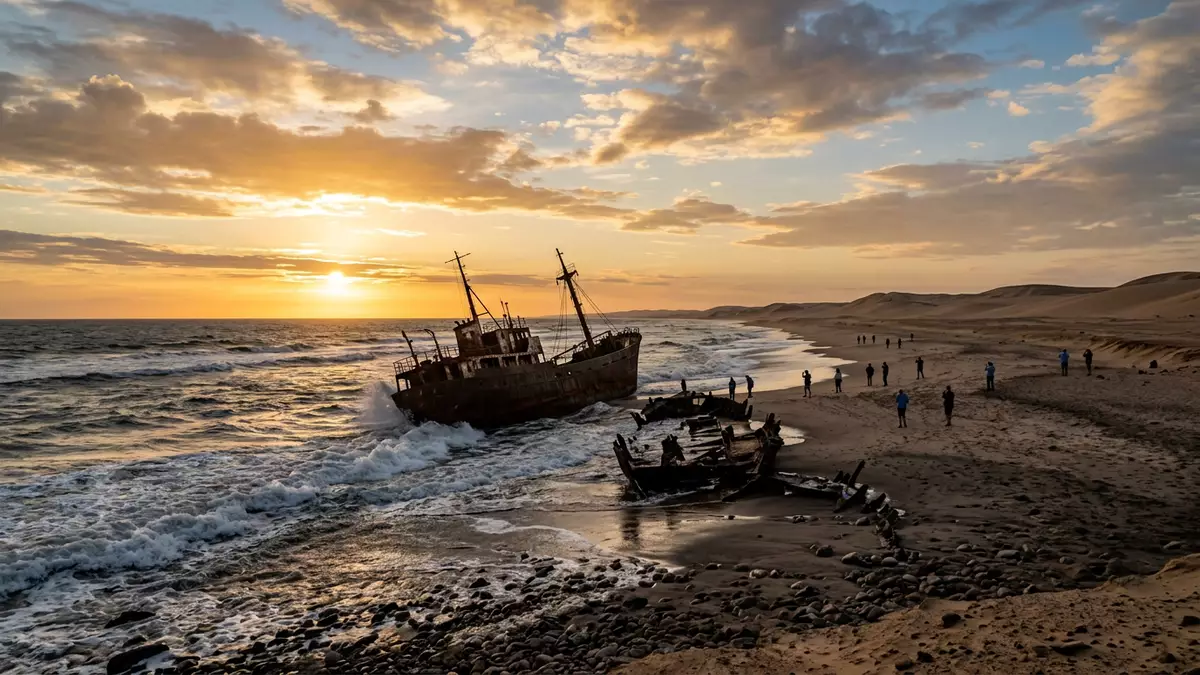
Along Namibia’s remote north-western shoreline, the Skeleton Coast forms a long corridor where Atlantic surf and Namib Desert sand meet in a narrow band of beach, gravel plains and dunes. In the southern section of Skeleton Coast National Park, Torra Bay sits as a modest camp on this harsh stretch of coast, facing the cold Benguela Current that drives waves against the desert edge.
Where desert and ocean share the same strip of sand
The Skeleton Coast describes the northern part of Namibia’s Atlantic shore, reaching between the Kunene River near the Angolan border and the Swakop River further south, with the name often extended to much of the Namib Desert coastline.northern Atlantic shore of Namibia Within this belt, Skeleton Coast National Park occupies a protected strip that runs for about 500 km from the Ugab River northwards, reaching inland for roughly 40 km and covering more than 16,000 km² of desert and shore.extends from the Ugab River in the south for 500 km Torra Bay lies inside this park on the Atlantic coast, one of the few named points along a coast otherwise marked by empty beaches and scattered shipwrecks.Torra Bay inside the Skeleton Coast Park
This coastline is shaped by the Benguela Current, a cold ocean flow that runs northwards along south-western Africa and enriches the waters with nutrients. The result is a sea that supports abundant fish while fog banks and cool air move inland over sand and gravel. At Torra Bay the desert reaches directly to the ocean, with dunes, low hills and bare plains ending at a strip of beach that faces energetic Atlantic surf.Skeleton Coast along the shoreline of northwest Namibia The meeting of desert and sea is immediate: there is little vegetation, minimal shelter and a constant sense of exposure to wind, sand and waves.
Skeleton Coast National Park and the Torra Bay camp
Skeleton Coast National Park was proclaimed as a national park in 1971 and defined in its present form in 1973, establishing a protected area that includes Torra Bay and neighbouring stretches of shoreline.proclaimed in 1971, in its present form in 1973 The park is divided into a southern zone between the Ugab River and Torra Bay, accessible on designated roads, and a more remote northern section that extends towards the Kunene River and is restricted to concession operations.southern part stretches from the Ugab River up to Torra Bay Torra Bay sits within this southern part, on the coastal road that links park gates and rest camps.
Torra Bay itself functions as a simple fishing settlement within the park, laid out as a campsite and angling area along the open shoreline. The camp occupies a strip of beach sand with plots marked near the ocean, and basic service buildings support the seasonal settlement.Torra Bay is the only official campsite Facilities are deliberately modest, with shared ablution blocks and a small shop described by several operators rather than an extensive resort structure.Torra Bay Campsite along Namibia's chilly Atlantic coast The atmosphere is closer to a temporary fishing village than to a town, and the camp retains a utilitarian character that matches the harsh environment around it.
Fishing, shipwrecks and the long gravel plains
The Skeleton Coast is associated with shipwrecks that lie along its inaccessible shores, remnants of vessels that grounded on sandbars or ran into fog and surf off Namibia’s Atlantic coast.shores, dotted with shipwrecks While many well-known wreck sites lie further north, the stretch near Torra Bay still reflects this maritime history through scattered remains, rusting structures and stories of navigation along a coast with few safe anchorages. Inland, the park’s gravel plains and low dunes extend towards rocky outcrops and the wider Namib-Skeleton Coast conservation landscape.Namib-Skeleton Coast National Park
The bay is also known as a surf fishing base, with anglers targeting species supported by the nutrient-rich Benguela waters.seasonal fishing retreat inside the Skeleton Coast Park Fishing grounds lie immediately offshore, reached on foot from the camp plots along the beach, and the combination of strong surf, cold water and sparse surroundings gives shore-based angling here a distinctive character. Birdlife along the coast, occasional seals and the constant presence of waves meeting desert sand round out the experience, with the camp forming a small human outpost in a landscape dominated by weathered rock, sand and sea.
Visiting Skeleton Coast: what travellers from Western Europe should know
- Torra Bay lies in north-west Namibia within Skeleton Coast National Park, on the Atlantic shore between the Ugab River corridor and the Kunene region. Road access runs along the coastal C34 and connects with inland routes such as the C39 through Damaraland.
- The terrain at Torra Bay is exposed and sandy, with camp plots on beach sand and wide gravel plains around them. Walking between plots, shore and service buildings involves moving across loose sand and compacted coastal surfaces rather than paved streets.
- Terrace Bay is the nearest named rest camp along the coast, further north within the same park, and the two sites are linked by the park road network used by permitted vehicles.
- The official language is English and the currency is the Namibian dollar.
- Entry requirements depend on your nationality; UK travellers can check the FCDO travel advice at gov.uk/foreign-travel-advice, Irish travellers the Department of Foreign Affairs at ireland.ie.
Searching for Skeleton Coast on social platforms
These links open searches for Skeleton Coast on each platform.
Frequently asked questions about Skeleton Coast
Where is Skeleton Coast and Torra Bay located?
The Skeleton Coast lies along north-west Namibia’s Atlantic shore, with Torra Bay situated inside Skeleton Coast National Park in the southern section of the protected coastal strip.
What should visitors expect on a visit to Torra Bay?
Visitors encounter an exposed campsite on beach sand, strong Atlantic surf, sparse structures and wide gravel plains, with amenities geared towards fishing rather than urban comfort.
What makes this part of the Skeleton Coast distinctive?
The immediate meeting of Namib Desert and cold Atlantic waves at Torra Bay, combined with the remoteness of Skeleton Coast National Park and its maritime history, gives this shore a stark character.


