
Simien Mountains National Park’s cliffs above Debark
Published on 08/23/2026 at 10:18 | Editorial responsibility: Rafael Müller, Editor-in-Chief AD HOC NEWS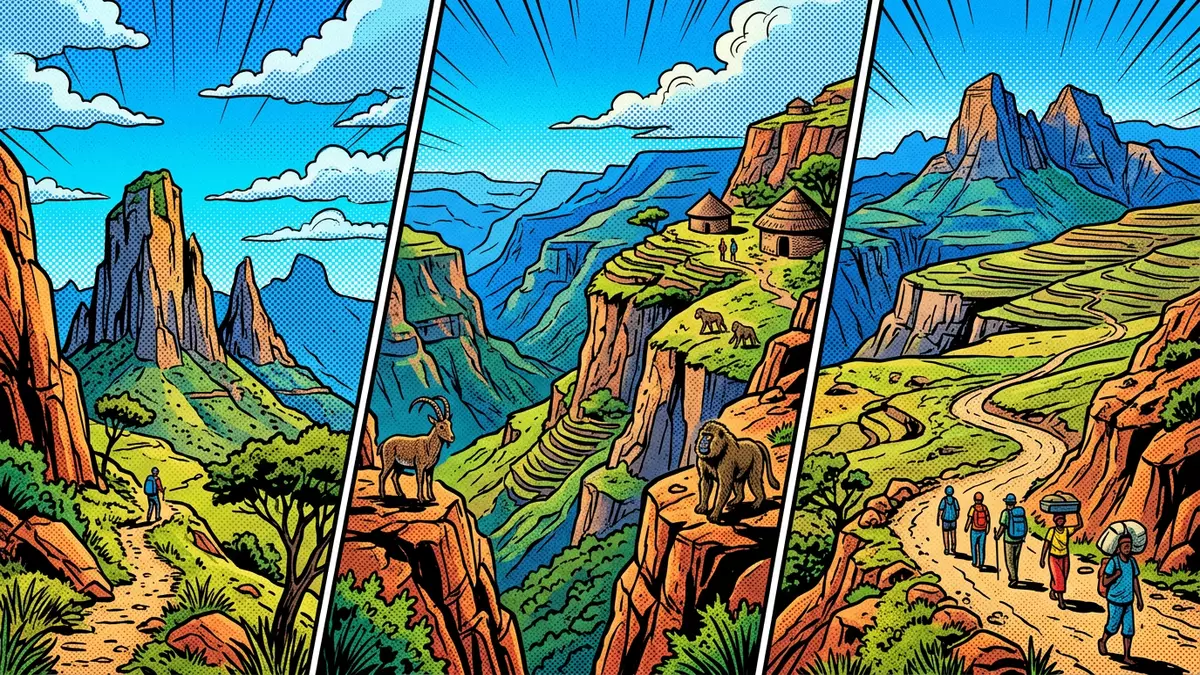
Simien Mountains National Park spreads across the highlands above Debark in northern Ethiopia, where basalt plateaus break off into cliffs and deep valleys. Established as a national park in the 1960s and recognised as a UNESCO World Heritage Site in 1978, it protects Afro?alpine scenery and rare wildlife on the Simien massif.
Basalt highlands cut into dramatic escarpments
The Simien Mountains form part of the northern Ethiopian plateau, where erosion has carved jagged peaks, knife?edge ridges and steep gorges out of thick layers of volcanic rock. The park covers high ground in the Amhara Region and includes the highest parts of the range around Ras Dashen, a mountain that rises to over 4,500 m (about 14,800 ft) above sea level.Ras Dashen stands within the boundaries of Simien Mountains National Park and dominates the skyline above the plateau.
Huge sections of the plateau end in long escarpments that drop hundreds of metres in a single step. Between these cliffs lie high valleys, buttresses and free?standing pinnacles cut from basalt flows. The protected area extends over about 412 square kilometres (159 sq mi) and sits roughly 120 km north?east of Gondar in the North Gondar Zone.Simien National Park datasheets describe escarpments that fall around 1,500 m (4,900 ft) from the plateau down to the surrounding lowlands.
A World Heritage landscape of Afro?alpine life
Simien National Park was officially established as a protected area in 1966 and legally gazetted as a national park in 1969.The park history records that legal step and notes that the original core area has since been expanded. In 1978, Simien National Park became one of the first natural sites to be inscribed on the UNESCO World Heritage List, recognised under criteria that highlight both striking scenery and exceptional biodiversity.The UNESCO World Heritage listing describes massive erosion on the Ethiopian plateau, with jagged peaks, deep valleys and sharp precipices.
The park’s high elevation supports Afro?alpine vegetation, with grasslands and shrublands spread across the upper plateaus and slopes. These habitats are home to endemic species such as the Walia ibex, an agile wild goat confined to the Simien mountains, and the gelada, a grass?eating primate that lives in large groups along cliffs and open slopes. The Ethiopian wolf also occurs in the wider Simien massif, using high?altitude grasslands and moorlands within the protected landscape.
Debark as gateway to Ethiopia’s high plateau
Simien Mountains National Park lies in the Amhara Region of northern Ethiopia, with Debark functioning as the main gateway town on its south?western edge.Descriptions of the park place it in the North Gondar Zone, with Debark and Mekane Berhan as the nearest towns. Debark serves as a base where visitors link road access, local guiding arrangements and park administration before travelling into the highlands.
From Debark, roads climb onto the plateau, reaching park posts and viewpoints along the escarpment. The approach passes farmland and scattered settlements before entering more open highland terrain, where the views widen over the surrounding valleys. Along the way, travellers move from lower cultivated slopes into the higher Afro?alpine zone that defines the park’s character.
Visiting Simien Mountains National Park: what travellers from Western Europe should know
- Simien Mountains National Park lies in the Amhara Region of northern Ethiopia, with Debark as the principal gateway town and Gondar as the nearest major city.
- The park occupies high?altitude terrain, and many viewpoints and paths lie well above 3,000 m (9,800 ft), so steep gradients and thin air combine on longer walks.
- Tracks and paths follow escarpment edges, plateaus and valleys, and sections can be uneven underfoot, with rock steps, loose stones and exposed drops beside the route.
- The official language is Amharic and the currency is the Ethiopian birr.
- Entry requirements depend on your nationality; UK travellers can check the FCDO travel advice at gov.uk/foreign-travel-advice, Irish travellers the Department of Foreign Affairs at ireland.ie.
Searching for Simien Mountains National Park on social platforms
These links open searches for Simien Mountains National Park on each platform.
Frequently asked questions about Simien Mountains National Park
Where is Simien Mountains National Park?
Simien Mountains National Park lies in the Amhara Region of northern Ethiopia, in the North Gondar Zone, with Debark as the nearest gateway town.
What can visitors expect on a visit?
Visitors encounter a high?altitude plateau cut by cliffs, ridges and valleys, along with Afro?alpine vegetation and wildlife that includes Walia ibex and gelada baboons.
What makes the park distinctive?
The combination of steep basalt escarpments, peaks around Ras Dashen exceeding 4,500 m (14,800 ft) and endemic wildlife earned Simien National Park early UNESCO World Heritage status in 1978.


