
Sidi Bou Said’s blue-and-white hilltop world above Tunis
Published on 09/14/2026 at 12:29 | Editorial responsibility: Rafael Müller, Editor-in-Chief AD HOC NEWS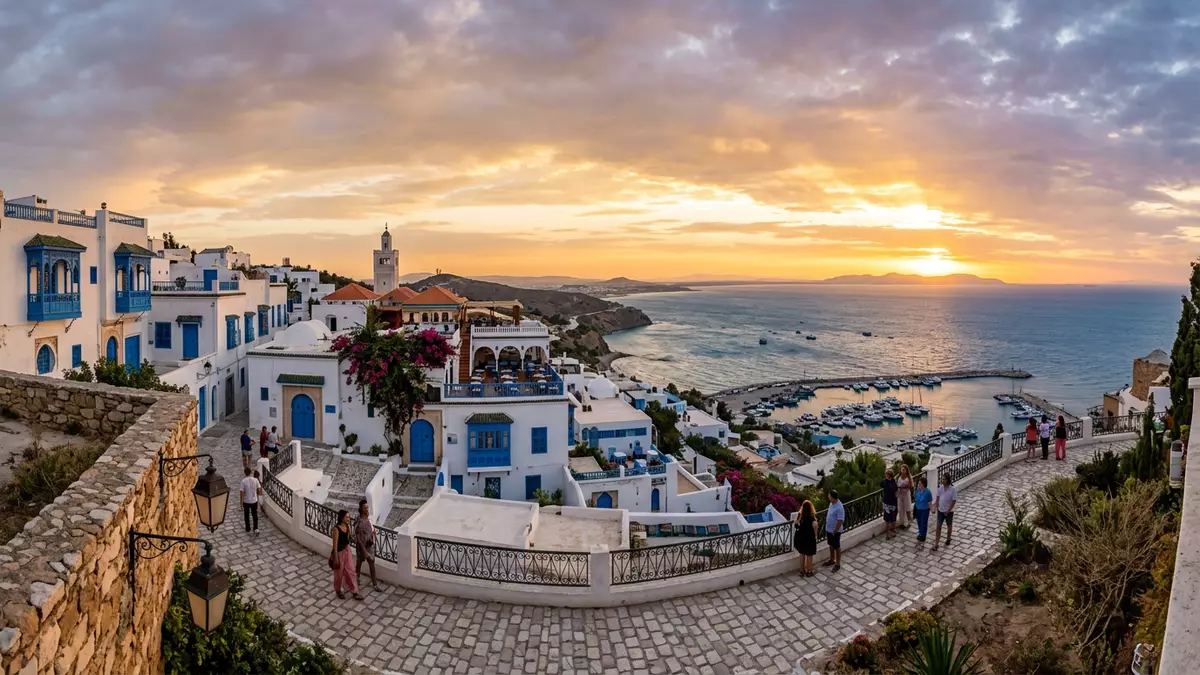
High above the Bay of Tunis, Sidi Bou Said is a hill village where whitewashed walls, blue woodwork and stone lanes climb a headland that looks out over the Mediterranean Sea. The settlement stands in northern Tunisia, and much of what visitors see today grew around a Sufi sanctuary established in the thirteenth century.
Blue-and-white houses on a Mediterranean headland
Sidi Bou Said occupies the upper part of a headland that guards the entrance to the Bay of Tunis, north-east of the city itself, with streets that step up towards a ridge and then fall away towards the water.the headland guarding the bay The houses follow the slope, forming terraces and small courtyards behind walls that line narrow lanes. Many homes are built around inner courts, with carved doors opening from the street into tiled spaces that bring light and air into the centre of the building.inner courtyards and tiled floors
The village is known above all for its colour scheme: white walls and bright blue doors, shutters and railings, set against stone paving and bougainvillea climbing over masonry.distinctive blue-and-white architecture Limewash on exterior walls and blue-painted woodwork were already part of local building practice before the twentieth century, and the effect was later reinforced by municipal regulations that encouraged white facades and blue trim and limited building heights.a 1915 decree on colour and height The consistency of the palette gives the village a strong visual identity: from many vantage points, successive rows of white houses run along the slope above the sea.
A village shaped around a thirteenth-century Sufi sanctuary
The name Sidi Bou Said honours the Sufi scholar Abu Saïd ibn Khalaf ibn Yahya al-Tamimi al-Baji, who settled on this hill in the thirteenth century and established a sanctuary here.Abu Said Ibn Khalaf Yahya al-Tamimi al-Beji At that time the headland was known as Jbel el-Menar, the Hill of the Lighthouse, and the religious complex that grew around his tomb became a centre of prayer and teaching.a zawiya dedicated to Abu Saïd al-Baji The mausoleum and adjoining buildings still anchor the upper part of the village, which spreads around the sanctuary on the slopes of the hill.
For centuries, Sidi Bou Said remained a relatively small settlement focused on religious life and the surrounding agricultural land. In the eighteenth century, during the period when Tunis formed part of the Beylik under the Husainid dynasty, families connected with the city built summer residences on the headland, drawn to the elevation and the proximity to the sea.residences in the town in the eighteenth century These houses introduced arcaded galleries, salons and planted courtyards, and many of their architectural details echo styles from Andalusian towns, with decorative tilework, lattice screens and carved doors appearing beside features associated with Tunisian religious buildings.Andalusian-influenced style
Baron d’Erlanger, Ennejma Ezzahra and codified heritage
The early twentieth century brought another layer to Sidi Bou Said’s character when Baron Rodolphe d’Erlanger, an Anglo-French painter and musicologist, settled below the village and built the palace of Ennejma Ezzahra, the “Star of Venus”, between 1909 and the early 1920s.Ennejma Ezzahra built between 1909 and 1921 The residence combines Tunisian, Arab and European elements, with ornamented ceilings, carved stone and views over the bay, and it stands just below the older village streets.
D’Erlanger is closely associated with efforts to protect the visual coherence of Sidi Bou Said. Under the French Protectorate, a heritage decree in 1915 and subsequent municipal regulations formalised rules about building height, colour and architectural details, giving legal backing to the blue-and-white scheme already present on many streets.the 1915 decree and blue-and-white design Ennejma Ezzahra and the surrounding village have since drawn visitors interested in architecture, music history and views over the Gulf of Tunis, and Sidi Bou Said is recognised for its coastal setting, its colour palette and its spiritual heritage.coastal character and spiritual heritage
Visiting Sidi Bou Said: what travellers from Western Europe should know
- Sidi Bou Said stands north-east of Tunis on a hill above the Bay of Tunis, and is reached by road and suburban rail services that link the capital with the coastal settlements towards Carthage.
- The lanes through the village rise steeply in places, with cobbled paving and stairways between terraces; exploring on foot involves climbing stone steps and walking on uneven surfaces.
- The hilltop position brings views over the Gulf of Tunis and towards the remains of ancient Carthage on the neighbouring headland, so many vantage points look out over water and archaeological sites.
- The official language is Arabic and the currency is the Tunisian dinar.
- Entry requirements depend on your nationality; UK travellers can check the FCDO travel advice at gov.uk/foreign-travel-advice, Irish travellers the Department of Foreign Affairs at ireland.ie.
Searching for Sidi Bou Said on social platforms
These links open searches for Sidi Bou Said on each platform.
Frequently asked questions about Sidi Bou Said
Where is Sidi Bou Said and what kind of place is it?
Sidi Bou Said is a hill village above the Bay of Tunis in northern Tunisia, built on a headland north-east of the capital and known for its blue-and-white houses.
What should visitors expect on a first walk through the village?
Visitors encounter cobbled lanes that climb the slope, whitewashed houses with blue doors and windows, planted courtyards and several viewpoints where the streets open towards the Mediterranean Sea.
What makes Sidi Bou Said distinctive among Tunisian coastal settlements?
The village combines a thirteenth-century Sufi sanctuary, Ottoman-era courtyard houses and early twentieth-century heritage regulations into a compact hilltop settlement with a consistent blue-and-white palette and broad views over the Gulf of Tunis.


