
Sidi Bou Said and the architecture of blue and white
Published on 09/24/2026 at 09:44 | Editorial responsibility: Rafael Müller, Editor-in-Chief AD HOC NEWS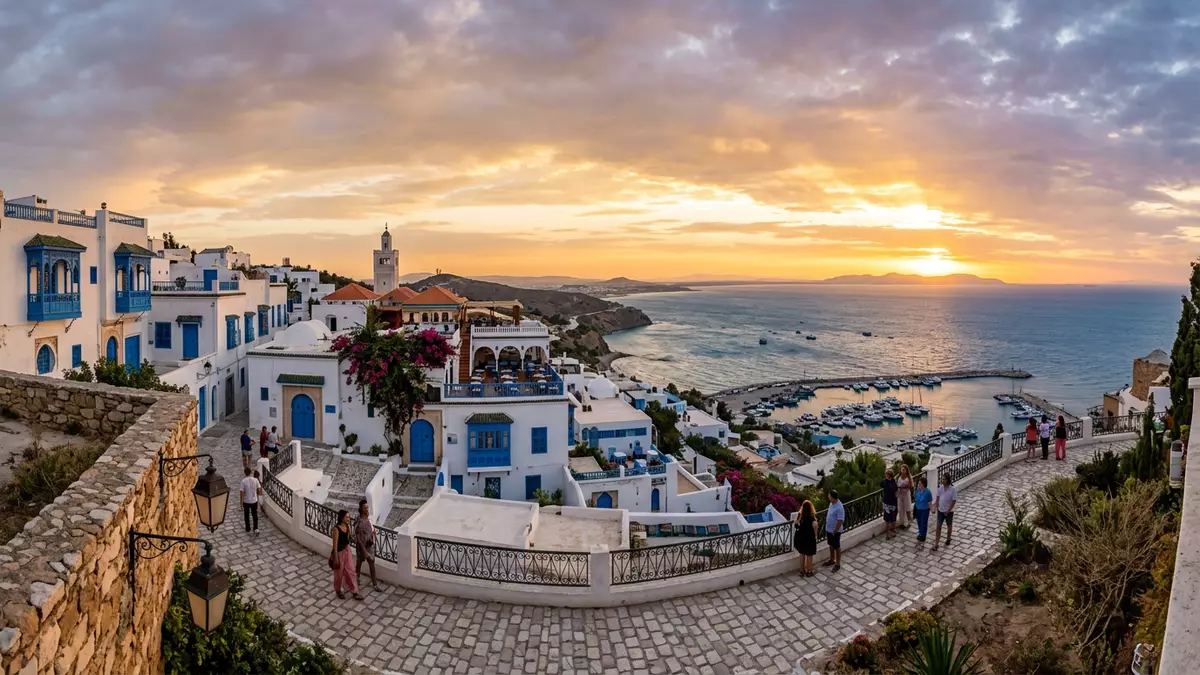
Sidi Bou Said rises above the Gulf of Tunis with whitewashed walls, blue doors and a compact hillside of stone-paved lanes. The village bears the name of Abu Said al-Baji, a thirteenth-century Sufi scholar whose sanctuary became the spiritual centre of the settlement.
Sidi Bou Said: white walls above the Gulf of Tunis
The village occupies a rocky headland north-east of Tunis, overlooking the Gulf of Tunis and the archaeological landscape of Carthage. Its lanes climb and bend across the slope, joining houses, courtyards, shrines and terraces in a dense coastal townscape.
White exterior walls form the dominant surface, while blue appears on doors, shutters, railings and other painted details. Stone paving, tiled surfaces, arched openings, carved woodwork and lattice screens add texture to the restrained palette. The result is an architectural character that belongs to the village itself, not to a single monument.
Blue-and-white building traditions existed in the area before the twentieth century. A local ordinance introduced in 1915 gave the colour scheme and architectural character formal protection, linking the visible streetscape with a documented period of heritage regulation. The village’s white facades and blue joinery remain its clearest visual language.
Abu Said al-Baji and a village shaped around a sanctuary
Sidi Bou Said takes its name from Abu Said Ibn Khalaf Yahya al-Tamimi al-Baji, also known as Abu Said al-Baji. He settled on the hill during the thirteenth century and established a religious sanctuary associated with teaching and Sufi practice.
After his death in 1231, a zawiya developed around his tomb. Religious buildings and houses gathered around this spiritual centre, and the settlement expanded across the headland. The name preserves the Arabic honorific “Sidi”, meaning a revered master or saint.
During the eighteenth century, families connected with Tunis built residences on the hill. Their houses introduced courtyards, shaded arcades, ceramic decoration and interior spaces adapted to domestic life. Elements associated with Tunisian and Arab-Andalusian architecture appear together in the village’s doors, tiles, plasterwork and screens.
Rodolphe d’Erlanger brought another strand of cultural history to the hill. The French baron was a painter, musicologist and collector whose residence, Ennejma Ezzahra, stands below the village. The palace is associated with his interest in Arab music and with the artistic life of Sidi Bou Said.
Ennejma Ezzahra and the cultural landscape near Carthage
Ennejma Ezzahra, also known as the Star of Venus, is a palace set on the hillside below Sidi Bou Said. Its architecture combines a North African setting with decorative details drawn from Islamic, Mediterranean and Andalusian traditions.
The palace forms a separate landmark within the wider cultural landscape. Sidi Bou Said’s lanes, shrine, houses and painted facades belong to the village above, while Ennejma Ezzahra provides a grander architectural counterpart lower on the slope. Together they connect domestic architecture, religious history, music and collecting.
The view from the headland reaches across the Gulf of Tunis towards Carthage and the northern Tunisian coast. Carthage, the ancient city associated with the Punic Wars and Roman history, lies close to Sidi Bou Said. The village therefore sits beside an archaeological landscape whose periods extend far beyond its own Ottoman and modern history.
Sidi Bou Said is also associated with artists, writers and musicians who worked in or travelled through Tunisia. Its importance lies in the combination of a living settlement, a Sufi sanctuary, coastal architecture and cultural institutions. The blue-and-white streets provide the visible thread connecting these different histories.
Visiting Sidi Bou Said: what travellers from Western Europe should know
- Sidi Bou Said lies north-east of Tunis on the Gulf of Tunis, above Carthage. The Tunis light-rail network reaches the village through the TGM line.
- The village is built on a hillside. Stone-paved lanes include slopes, steps and uneven surfaces, while the upper streets rise above the coastal road.
- Carthage lies below and beside the headland, with archaeological remains spread through the surrounding district. Ennejma Ezzahra stands on the hillside beneath the village.
- The official language is Arabic and the currency is the Tunisian dinar.
Searching for Sidi Bou Said on social platforms
These links open searches for Sidi Bou Said on each platform.Frequently asked questions about Sidi Bou Said
Where is Sidi Bou Said?
Sidi Bou Said is a coastal village north-east of Tunis, overlooking the Gulf of Tunis and the archaeological area of Carthage. The TGM light-rail line connects it with Tunis.
What can visitors expect in the village?
Visitors encounter sloping lanes, steps, whitewashed houses, blue-painted doors, courtyards, tiled details and views across the gulf. The village also contains the sanctuary associated with Abu Said al-Baji.
What makes Sidi Bou Said distinctive?
Its distinctive character comes from the combination of a blue-and-white streetscape, a thirteenth-century Sufi heritage and a Mediterranean setting above Carthage. Ennejma Ezzahra adds a separate palace and music-historical landmark below the village.


