
Shwezigon Pagoda, the golden prototype of Bagan
Published on 09/07/2026 at 19:01 | Editorial responsibility: Rafael Müller, Editor-in-Chief AD HOC NEWS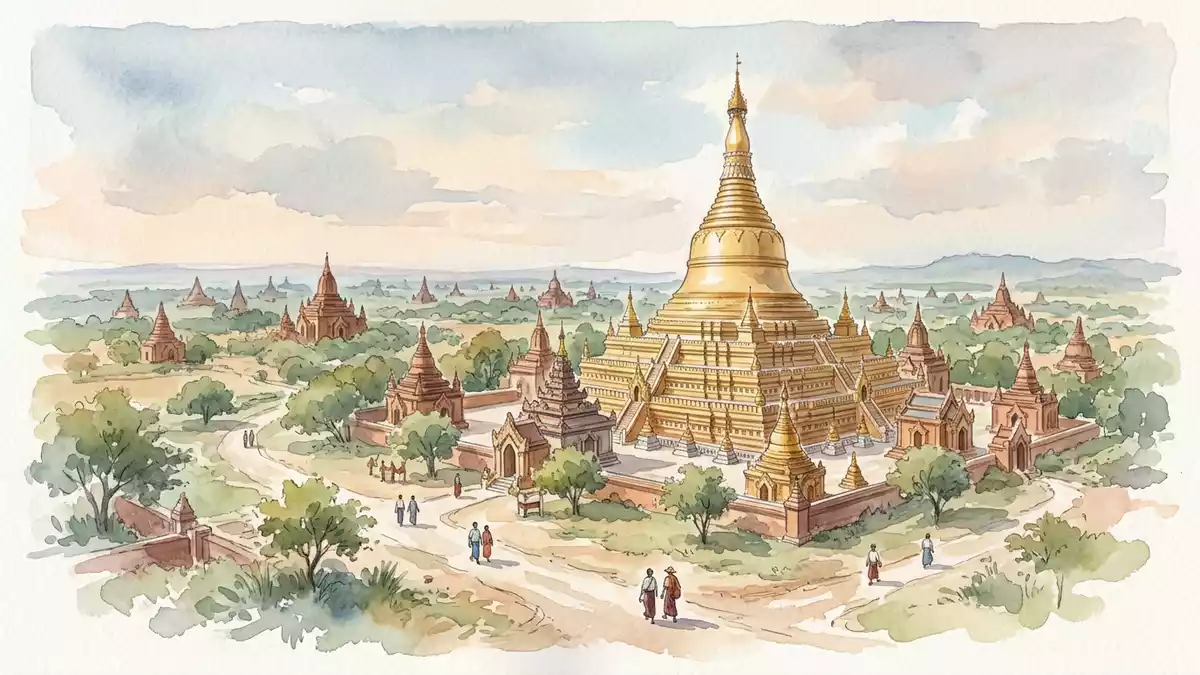
Shwezigon Pagoda in Bagan is a gilded Buddhist stupa that helped define the religious landscape of Myanmar, binding Theravada Buddhism to older nat worship within a single walled compound. Built in the eleventh century under King Anawrahta and completed under King Kyansittha, it stands near the town of Nyaung-U on a low river plain north-east of Old Bagan as a solid, bell-shaped mass rising from tiered terraces.
An early royal stupa of the Pagan Empire
Shwezigon Pagoda belongs to the early Pagan period, when King Anawrahta, who ruled from 1044 to 1077, consolidated the Bagan Kingdom and adopted Theravada Buddhism as a state-backed faith.King Anawrahta ordered the pagoda’s construction in the mid-eleventh century, and the project was completed in the reign of his successor King Kyansittha, who ruled into the early twelfth century.King Kyansittha’s reign The site lies in Nyaung-U, a town a short distance from the main temple plain of Bagan, placing the pagoda close to a regional centre while remaining within the wider archaeological area.location in Nyaung-U
Royal chronicles and later inscriptions associate Shwezigon Pagoda with relics of the historical Buddha, including a bone relic and a tooth relic that mirror the venerated tooth housed at Kandy in Sri Lanka.relic shrine in Bagan Anawrahta’s initial terraces and Kyansittha’s upper stupa together formed a substantial reliquary in brick and later gilded metal, creating a focus for royal ritual and for pilgrims from the Bagan plain and beyond.
Gilded terraces, encased structure and courtyard life
The pagoda itself is a solid brick stupa, encased within a later shell and resting on a series of square terraces that step up towards a bell-shaped dome, mouldings and a finial crowned by a multi-tiered umbrella known in Burmese as a hti.solid cylindrical structure The surfaces are covered in gold, so the central stupa catches light against the paler stone and brick of surrounding buildings.
A paved courtyard and inner enclosure ring the main stupa, lined with small shrines, image houses and pavilions that frame views back towards the golden mass in the centre.Mon architectural details Staircases and gateways lead into this inner court, and the layout shows elements associated with Mon architecture, including ornamented spires, richly worked gateways and a prominent crowning finial. Around the terraces are stone and brick features such as guardian figures and smaller stupas, so that moving around the base reveals layers of sculptural detail and alternating bands of gilded and plain surfaces.
Nat spirits and Theravada Buddhism side by side
Shwezigon Pagoda is closely linked to the formal recognition of thirty-seven nat spirits within Burmese religion, a set of pre-Buddhist figures that remained important even after royal adoption of Theravada Buddhism.royal endorsement of the 37 nats Within the compound, shrines and images associated with nat worship stand alongside Buddhist stupas and prayer halls, so visitors encounter carvings and painted scenes relating to both traditions in a single precinct.
This coexistence reflects the way Bagan’s rulers framed their authority through both the new Buddhist order and older spirit cults, using monuments such as Shwezigon Pagoda to situate royal ritual within a landscape inhabited by nat figures as well as the Buddha’s relics.nat worship and Buddhism For visitors walking the tiled courtyards, this translates into a sequence of chapels, images and small monuments that echo different layers of belief while remaining anchored around the central gilded stupa.
Visiting Shwezigon Pagoda: what travellers from Western Europe should know
- Shwezigon Pagoda stands near Nyaung-U, north-east of Old Bagan on the Irrawaddy plain, and is reached by local roads from Bagan’s clusters of temples and villages.
- The main compound is paved, with terraces, steps and tiled walkways around the stupa; visitors spend time moving between shrines, image houses and gateways on foot.
- Shwezigon Pagoda lies close to the town centre of Nyaung-U, where river landings and the local market form part of the wider setting around the pagoda’s enclosure.
- The official language is Burmese and the currency is the kyat.
- Entry requirements depend on your nationality; UK travellers can check the FCDO travel advice at gov.uk/foreign-travel-advice, Irish travellers the Department of Foreign Affairs at ireland.ie.
Searching for Shwezigon Pagoda on social platforms
These links open searches for Shwezigon Pagoda on each platform.
Frequently asked questions about Shwezigon Pagoda
Where is Shwezigon Pagoda located?
Shwezigon Pagoda stands in Nyaung-U near Bagan in central Myanmar, on the Irrawaddy River plain north-east of the main Bagan temple zone.
What should visitors expect when exploring Shwezigon Pagoda?
Visitors encounter a gilded brick stupa on stepped terraces within a paved courtyard, surrounded by shrines, image houses and small stupas arranged inside a walled compound.
What makes Shwezigon Pagoda distinctive among Bagan’s monuments?
Shwezigon Pagoda is an early royal reliquary that became a prototype for later stupas in Myanmar and a visible setting for both Theravada Buddhist practice and formal nat worship.


