
Shwezigon Pagoda’s golden stupa on the plains of Bagan
Published on 09/19/2026 at 17:46 | Editorial responsibility: Rafael Müller, Editor-in-Chief AD HOC NEWS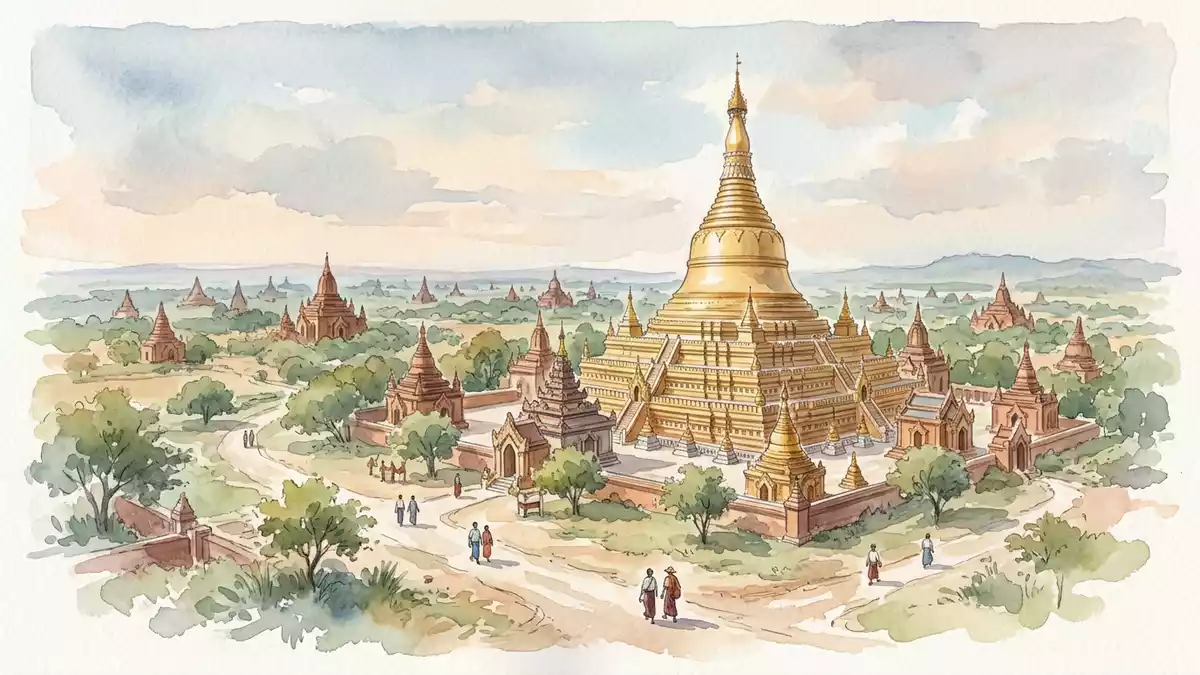
Shwezigon Pagoda in Bagan is a landmark of early Theravada Buddhism in Myanmar, with a gold-covered stupa rising from brick terraces near the Ayeyarwady River. Built in the eleventh century under King Anawrahta and completed under King Kyansittha, it stands among the earliest major stupas on the Bagan plain and helped define the form of later Myanmar pagodas.
A golden stupa from the Pagan Empire
Shwezigon Pagoda belongs to the early Bagan period, when the Pagan Empire took shape under King Anawrahta in the mid-eleventh century.The construction history is closely tied to the reigns of Anawrahta, who ruled Pagan from 1044 to 1077, and his successor King Kyansittha in the later eleventh century.The core of the monument dates to the time when Pagan emerged as the capital of a unified kingdom in central Myanmar.
Chronicles and modern accounts agree that King Anawrahta initiated Shwezigon Pagoda in the eleventh century and that King Kyansittha brought the monument to completion toward the end of that century.Construction started around 1059, with the lower terraces associated with Anawrahta and the upper structure linked to Kyansittha.Later inscriptions record that stone bricks for the enclosure were hewn at the Tuyin Taung quarries, placing the pagoda firmly within the landscape of early Bagan temple building.
Form, materials and layout
At Shwezigon Pagoda a stepped base rises in brick terraces, supporting the gilded stupa that dominates the complex and makes the structure visible across the surrounding plain.The pagoda’s form served as a prototype for later Myanmar stupas, with a massive reliquary core and a clear vertical emphasis from the square terraces to the tapering upper sections. Brick and stone elements frame the base, while the stupa itself is clad in gold-coloured metal leaf that catches the light and reinforces the pagoda’s name, in which “shwe” refers to gold.
Around the central stupa, Shwezigon Pagoda includes a courtyard with subsidiary shrines, images and halls, enclosed by outer walls that mark off the sacred precinct.Later descriptions name Shwezigon as a major reliquary shrine of Bagan, holding relics associated with the Buddha and linked symbolically to other Buddhist centres in Sri Lanka and beyond.Historical accounts place the pagoda on an open plain close to the river, where its terraces, chapels and walkways form a continuous religious space in brick and gilded metal.
Religious role and royal patronage
Shwezigon Pagoda stands at the intersection of royal power and religious practice in Pagan, reflecting the adoption of Theravada Buddhism under King Anawrahta and the consolidation of that tradition under King Kyansittha.Historical summaries describe the pagoda as an important reliquary and a centre of prayer linked to the emerging Theravada faith. The monument also occupies a place in the story of pre-Buddhist nat worship in Myanmar, with royal endorsement of the 37 nats recorded at Shwezigon and woven into its identity as a shrine.
Within the wider Bagan area, Shwezigon Pagoda is set near Nyaung U and close to the Ayeyarwady River, providing a fixed point in the landscape between the riverbank and the denser temple fields to the south.Accounts of the founding legend link the choice of the site to an elephant bearing a relic, stopping on a sand dune near the river, which gave the pagoda its name as a golden shrine on a sandbank.Travel writing on Bagan highlights Shwezigon as one of the earlier major religious structures in the area, predating much of the later temple growth across the plain.
Visiting Shwezigon Pagoda: what travellers from Western Europe should know
- Shwezigon Pagoda stands near Nyaung U on the northern edge of the Bagan archaeological zone in central Myanmar, with road access from Bagan and the Ayeyarwady River corridor.
- The complex lies on level ground, but the pagoda’s terraces and surrounding structures involve walking on stone and brick surfaces and using stairways within the religious precinct.
- The Ayeyarwady River runs nearby, and Shwezigon Pagoda can be combined with visits to other Bagan temples spread across the surrounding plain.
- The official language is Burmese and the currency is the kyat.
- Entry requirements depend on your nationality; UK travellers can check the FCDO travel advice at gov.uk/foreign-travel-advice, Irish travellers the Department of Foreign Affairs at ireland.ie.
Searching for Shwezigon Pagoda on social platforms
These links open searches for Shwezigon Pagoda on each platform.
Frequently asked questions about Shwezigon Pagoda
Where is Shwezigon Pagoda and what is its setting?
Shwezigon Pagoda stands near Nyaung U on the northern side of the Bagan temple area in central Myanmar, close to the Ayeyarwady River and surrounded by a plain dotted with other religious structures.
What can visitors expect when exploring Shwezigon Pagoda?
Visitors encounter a gold-covered stupa rising from brick terraces, with a courtyard of shrines, images and halls arranged within enclosing walls, and walkways that lead around the base of the pagoda.
What makes Shwezigon Pagoda distinctive among Bagan’s monuments?
Shwezigon Pagoda is distinctive as an early Theravada Buddhist reliquary built under King Anawrahta and completed under King Kyansittha, whose gilded stupa and terrace layout influenced later Myanmar pagodas and whose religious role includes links to relics and the royal recognition of nat worship.


