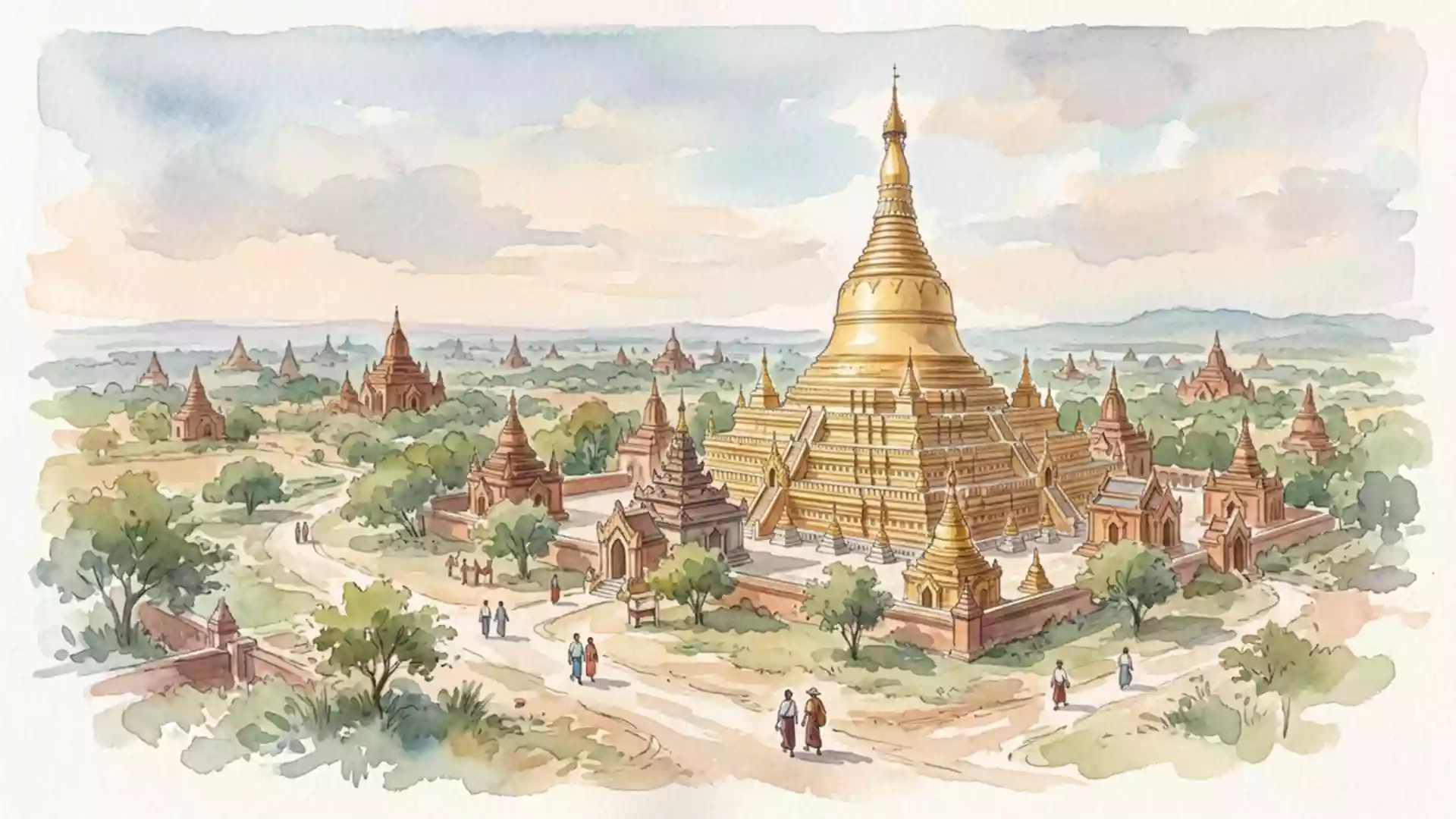
Shwezigon Pagoda’s golden stupa on the plains of Bagan
Published on 09/11/2026 at 13:48 | Editorial responsibility: Rafael Müller, Editor-in-Chief AD HOC NEWS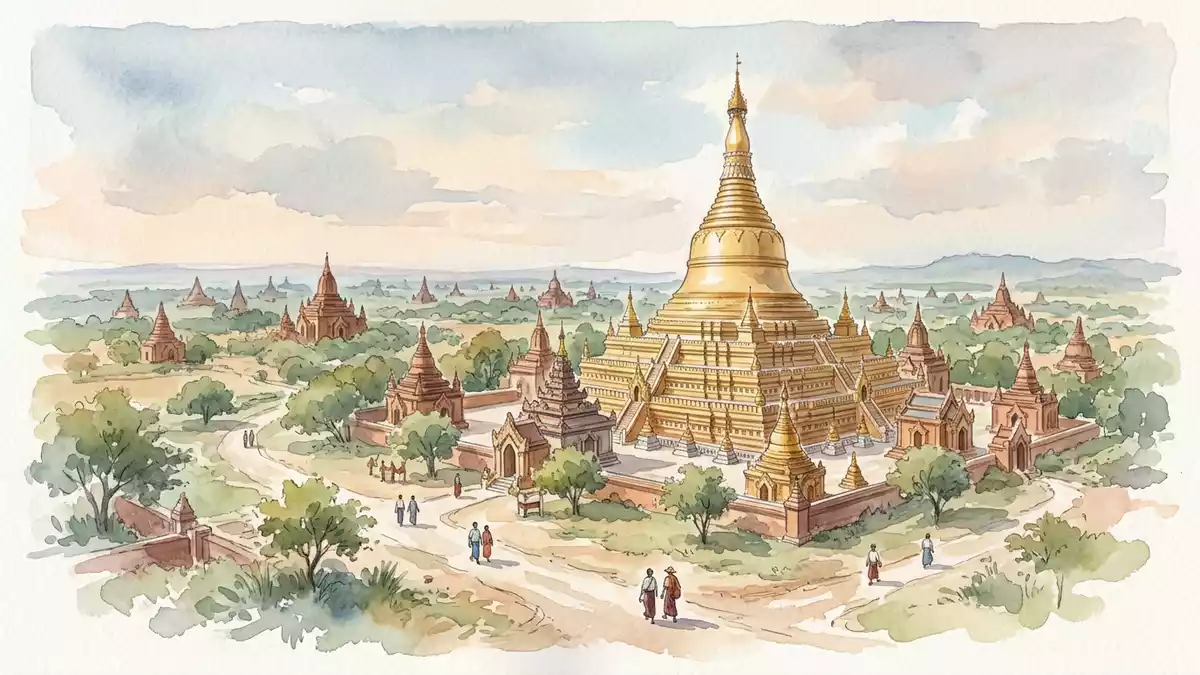
Shwezigon Pagoda near Bagan is a gilded Buddhist stupa from the eleventh century that anchors the flat river plain with its solid mass of gold-coloured brick and stone. Commissioned under King Anawrahta and completed under King Kyanzittha, it stands as a prototype for later Myanmar stupas and a fixed point in the landscape between Nyaung U and the Ayeyarwady River.
An eleventh-century royal pagoda on the Nyaung U plain
Shwezigon Pagoda stands at Nyaung U, a town on the edge of the Bagan Archaeological Zone beside the Ayeyarwady River in central Myanmar. The pagoda forms part of the wider Bagan landscape of temples and stupas, but it lies slightly apart from the densest clusters of monuments further south on the plain.
The stupa belongs to the early Bagan period and was initiated during the reign of King Anawrahta in the mid-eleventh century.Construction started around 1059, when Bagan emerged as the capital of a unified kingdom. The work continued under his successor King Kyanzittha, who brought it to completion towards the end of the eleventh century.Kyanzittha’s reign ended in the early twelfth century, and the finished pagoda belongs to that transition.
A solid, bell-shaped stupa clad in gold
The core of Shwezigon Pagoda is a solid stupa built of brick and clad in metal sheeting that gives it its characteristic golden appearance.The structure rises on three square receding terraces, with a bell-shaped dome above them and a finial topped by a multi-tiered umbrella. The whole ensemble reaches a height recorded at around 49 m (160 ft), making it a dominant mass on the relatively low-lying plain.
Each terrace carries mouldings and smaller stupas at the corners, creating a stepped progression from the broad base to the compact upper drum.The pagoda is described as a prototype of later Myanmar stupas, and the combination of square terraces, bell-shaped dome and umbrella finial became a reference form across the country. Around the base, glazed terracotta tiles illustrate Jataka stories, picking out episodes from the Buddha’s previous lives in rows of small narrative panels.
Courtyards, shrines and nat images around the stupa
The main stupa stands within a walled compound, with processional paths and open courtyards arranged around it. Long covered stairways approach from the cardinal directions, bringing visitors towards the terraced base through corridors lined with small shrines and stalls.
Within the enclosure, freestanding shrines house Buddha images in various poses and scales, set against the gilded bulk of the central stupa.The complex also contains nat shrines, reflecting the continued presence of Myanmar’s older spirit cults alongside Theravada Buddhism. Inscriptions in the Mon language associated with King Kyanzittha record donations and set Shwezigon within the wider religious and political life of the Bagan kingdom.
Visiting Shwezigon Pagoda: what travellers from Western Europe should know
- Shwezigon Pagoda stands in Nyaung U, north-east of Old Bagan, and is reached by road from the clusters of temples on the main plain.
- The complex is largely flat but built on a raised platform; approaches use long covered stairways, and the surfaces around the stupa are paved.
- The pagoda lies close to the Ayeyarwady River, and the wider area includes villages and other Bagan-era monuments within a short walking or driving radius.
- The official language is Burmese and the currency is the kyat.
- Entry requirements depend on your nationality; UK travellers can check the FCDO travel advice at gov.uk/foreign-travel-advice, Irish travellers the Department of Foreign Affairs at ireland.ie.
Searching for Shwezigon Pagoda on social platforms
These links open searches for Shwezigon Pagoda on each platform.
Frequently asked questions about Shwezigon Pagoda
Where is Shwezigon Pagoda located?
Shwezigon Pagoda stands in Nyaung U near Bagan in central Myanmar, on the east bank of the Ayeyarwady River within the Bagan Archaeological Zone.
What can visitors expect at Shwezigon Pagoda?
Visitors encounter a large gilded stupa on terraced bases, surrounded by courtyards, covered stairways, Buddha shrines and nat images within a walled compound.
What makes Shwezigon Pagoda distinctive among Bagan’s monuments?
Shwezigon Pagoda is an early Bagan royal stupa from the eleventh century, clad in gold-coloured metal and regarded as a prototype for many later Myanmar stupas.