
Shwedagon Pagoda and the golden hill above Yangon
Published on 09/18/2026 at 11:37 | Editorial responsibility: Rafael Müller, Editor-in-Chief AD HOC NEWS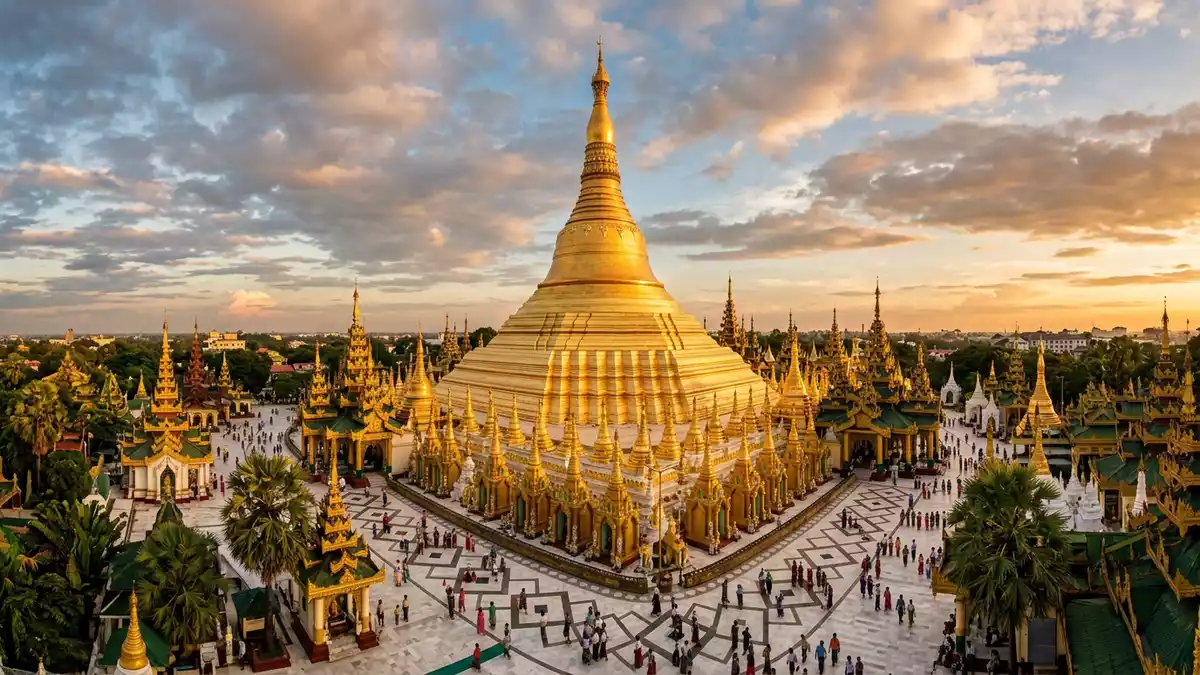
Shwedagon Pagoda in Yangon is a vast Buddhist shrine built around a gilded stupa that crowns Singuttara Hill and dominates the surrounding cityscape with its golden presence. The complex combines the solid central tower, wide terraces and a ring of subsidiary shrines, creating a continuous religious landscape above the streets of Myanmar’s largest city in a form travellers recognise at once as a major pilgrimage site.
The golden stupa on Singuttara Hill
Shwedagon Pagoda stands on Singuttara Hill in Yangon, a low rise whose summit has been reshaped into an extensive platform carrying the main stupa and its surrounding structures.Singuttara Hill in Yangon At the centre of this platform rises the stupa itself, built as a brick core and entirely sheathed in gold, with a tapering profile that narrows towards a jewelled crown.gilded stupa dominates the Yangon skyline The gilded surfaces catch the light across their height, emphasising the tower’s role as the visual focus of the whole complex.
The stupa reaches a height recorded at around 99 m (326 ft), rising above its base terraces and the crest of the hill.height of the pagoda is 326 feet That figure reflects a long history of enlargement: the structure was raised in the fifteenth century under Queen Shin Saw Pu and again in the eighteenth century under King Hsinbyushin, whose work brought it to its present height.raised to its current height of 99 meters The result is a tower that stands above the surrounding city as much for its elevation on the hill as for its own vertical reach.
Layers of history and relic tradition
Traditional chronicles in Myanmar describe Shwedagon Pagoda as more than 2,500 years old, linking it to relics of Gautama Buddha and to earlier Buddhas in Buddhist cosmology.2,500 years of history Legend connects the site with eight strands of hair from the historical Buddha, brought by merchant brothers and enshrined within the stupa, together with items associated with Kassapa, Konagamana and Kakusandha Buddhas.bodily relics of the historical Buddha These relic traditions help explain why Shwedagon Pagoda holds the status of Myanmar’s most sacred Buddhist stupa.
Archaeological and historical research places the earliest construction of the pagoda between the sixth and tenth centuries CE, giving the shrine a documented history that runs back well over a millennium.first built between the 6th and 10th centuries AD Over that span, the structure has been rebuilt and enlarged by successive rulers, including King Binnya U in the fourteenth century, Queen Binnya Thau and Queen Shin Saw Pu in the fifteenth century, and King Hsinbyushin in the eighteenth century.series of enlargements from the 14th to 18th centuries Earthquakes damaged the stupa during this period, but each major repair phase left the monument taller and more heavily gilded than before, reinforcing its role as a royal and religious symbol.
A hilltop complex of shrines and terraces
Shwedagon Pagoda is more than a single tower; it is an entire hilltop complex of religious buildings, open spaces and ritual routes surrounding the main stupa.hilltop complex with smaller pagodas and prayer halls The upper terraces carry smaller pagodas, pavilions and prayer halls arranged around the base of the central stupa, so that views of the gilded tower open and close as visitors move between the structures. The overall layout forms a ring of subsidiary buildings encircling the main reliquary.
Around the foot of Singuttara Hill, covered stairways and access halls lead upwards from the city streets to the summit terraces, turning the ascent itself into a sequence of threshold spaces. Once at the top, visitors find tiled platforms, shrines aligned to the days of the week and open areas where local religious life unfolds around the stupa. The continuous terrace makes the hill feel like a single elevated precinct, with the central tower always present above the surrounding buildings and the city spread out below.
Visiting Shwedagon Pagoda: what travellers from Western Europe should know
- Shwedagon Pagoda stands on Singuttara Hill in the central part of Yangon in southern Myanmar, reached from the city’s road network and local transport.
- The complex occupies a hilltop terrace, with long covered approaches and stairways that involve a sustained climb on foot between the city level and the main platform.
- The summit terraces form a large open precinct, so visitors spend much of their time outdoors on tiled platforms around the stupa and its surrounding shrines.
- The official language is Burmese and the currency is the kyat.
- Entry requirements depend on your nationality; UK travellers can check the FCDO travel advice at gov.uk/foreign-travel-advice, Irish travellers the Department of Foreign Affairs at ireland.ie.
Searching for Shwedagon Pagoda on social platforms
These links open searches for Shwedagon Pagoda on each platform.
Frequently asked questions about Shwedagon Pagoda
Where is Shwedagon Pagoda located?
Shwedagon Pagoda is located on Singuttara Hill in Yangon in southern Myanmar, rising above the central districts of the city as a hilltop religious complex.
What should a visitor expect on a first visit?
A visit centres on the ascent to the summit terraces and time spent walking among shrines, prayer halls and open platforms around the gilded stupa, with the tower always in view.
What makes Shwedagon Pagoda distinctive among Buddhist sites?
Its combination of a tall gilded stupa, relic traditions tied to Gautama Buddha and earlier Buddhas, and a continuous hilltop terrace of subsidiary shrines gives it a distinctive character among Buddhist stupas.


