
Shwedagon Pagoda and its golden hilltop world above Yangon
Published on 08/29/2026 at 06:53 | Editorial responsibility: Rafael Müller, Editor-in-Chief AD HOC NEWS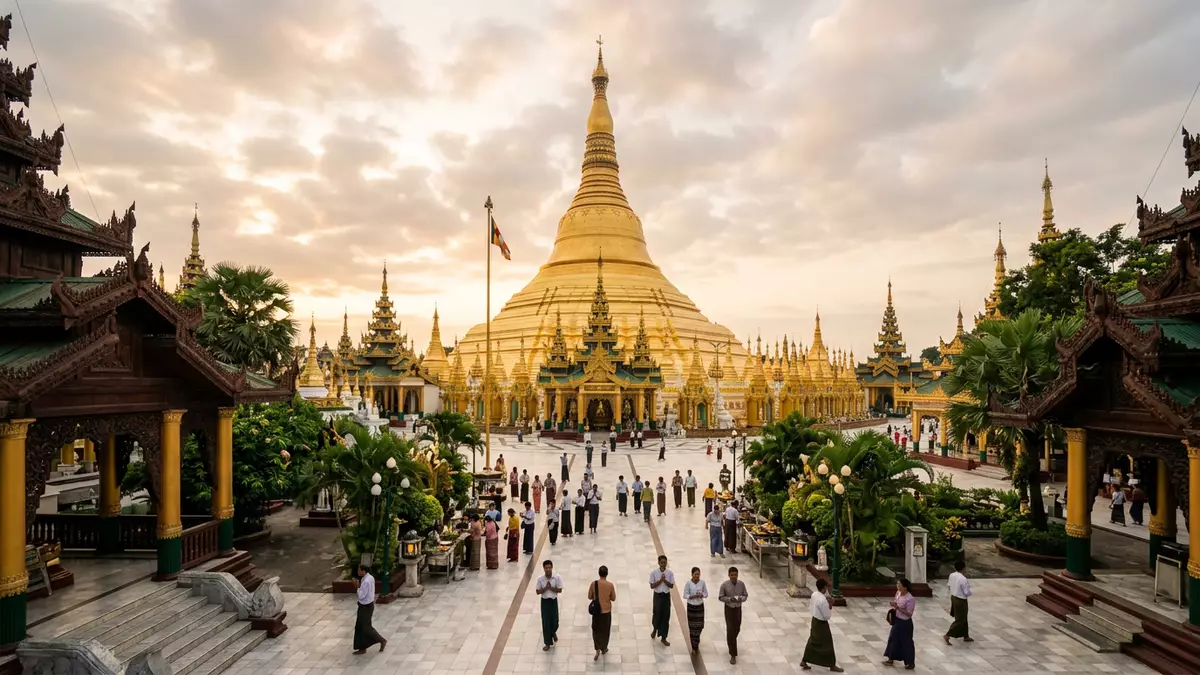
Shwedagon Pagoda in Yangon is dominated by a solid brick stupa sheathed in gold, rising from a hilltop terrace that has grown through centuries of royal patronage and Buddhist devotion. Rooted in traditions reaching back to the early spread of Buddhism in South-East Asia, the monument in its present form reflects major reconstructions from the fourteenth to the eighteenth century.
The golden stupa on Singuttara Hill
Shwedagon Pagoda stands on Singuttara Hill, a rise above the urban grid of Yangon whose summit has been levelled into an expansive platform carrying shrines, halls and subsidiary stupas around the main structure.Singuttara Hill The core of the site is a solid brick stupa, entirely covered with gold and tapering in a sequence of gently curving profiles that narrow towards a multi-tiered metal umbrella at the top.solid brick stupa covered with gold In its current form the main stupa rises to about 99 m (325 ft) above its base, while the hill beneath lifts the platform further above the surrounding streets of Yangon.height of just under 100 metres
A tiered umbrella finial, known as the hti, crowns the uppermost section and is itself an important focus of offerings and renewal; a notable hti was donated by King Mindon Min of Mandalay in the nineteenth century, increasing the overall height of the monument.hti provided by King Mindon Min Around the main stupa the terrace is lined with a ring of smaller stupas, prayer halls and pavilions, creating a dense ensemble of gilded surfaces, whitewashed bases and brightly coloured ornament that encircles the central structure on all sides.
Layers of history and royal patronage
Shwedagon Pagoda is traditionally dated to an early Buddhist era in the region, with legend associating the site with relics of Gautama Buddha and other Buddhas of the present cosmic age.enshrined relics of the Buddha Archaeological and historical research places the first substantial stupa on the hill between the sixth and tenth centuries AD, built by Mon communities who were central to the spread of Theravada Buddhism in Lower Myanmar.first built between the 6th and 10th centuries The earliest secure references in Burmese royal chronicles date to 1362/63, when King Binnya U of the Martaban–Hanthawaddy kingdom restored the stupa after a period of disrepair and raised it to a modest height.
During the fifteenth century, Queen Shin Sawbu, ruling from Bago, enlarged Shwedagon Pagoda and increased the height of the main stupa, establishing gilding as a defining feature of the monument.Queen Shin Sawbu raised the structure A later earthquake in 1768 brought down the upper part of the stupa, and King Hsinbyushin of the Konbaung dynasty rebuilt it in the eighteenth century to a height of about 99 m (325 ft), a profile that shapes the pagoda seen on Singuttara Hill today.King Hsinbyushin raised it to its current height In the nineteenth century King Mindon Min’s new hti added a further layer to the structure’s vertical composition and underlined the continuing royal interest in the shrine even as colonial power was expanding across Lower Myanmar.scene of political activity during the independence movement
A living Buddhist terrace above Yangon
The wide platform around the main stupa has developed into a continuous terrace with processional routes, devotional niches and chapels aligned to the cardinal and intermediate directions. At the base of the stupa, visitors encounter planetary posts and zodiacal shrines linked to Burmese Buddhist calendrical practice, each with its own small structure and water vessels for ritual offerings.terrace with planetary posts Larger halls nearby house images of the Buddha and provide covered space for recitation and meditation, their roofs articulated with layered tiers and decorative finials echoing the vertical rhythm of the central stupa.
Beyond the immediate ring of structures, stairways and covered approaches connect the hilltop terrace with the streets below, framing views of the golden stupa as it rises above city roofs and treetops.terraced hilltop platform The combination of gilded brickwork, white stone bases and decorative metalwork makes Shwedagon Pagoda a distinctive example of a Buddhist stupa complex integrated into an urban landscape, yet set apart by its elevation and continuous religious use dating back many centuries.
Visiting Shwedagon Pagoda: what travellers from Western Europe should know
- Shwedagon Pagoda stands on Singuttara Hill north of central Yangon, reached by road and by covered stairways that climb from several surrounding streets to the hilltop terrace.
- The approaches involve staircases that ascend the hill and further flights of steps on the terrace itself, so a visit includes walking on inclined paths and stone floors at an elevated site.
- The official language is Burmese and the currency is the Myanmar kyat.
- Entry requirements depend on your nationality; UK travellers can check the FCDO travel advice at gov.uk/foreign-travel-advice, Irish travellers the Department of Foreign Affairs at ireland.ie.
Searching for Shwedagon Pagoda on social platforms
These links open searches for Shwedagon Pagoda on each platform.
Frequently asked questions about Shwedagon Pagoda
Where is Shwedagon Pagoda located?
Shwedagon Pagoda is on Singuttara Hill in Yangon, a major city in Myanmar, with the stupa and its terrace rising above the surrounding urban districts.
What can visitors expect on a visit to Shwedagon Pagoda?
Visitors encounter a broad hilltop terrace with the golden main stupa, subsidiary shrines and halls, reached by stairways that climb from the streets below to the elevated platform.
What makes Shwedagon Pagoda distinctive among Buddhist sites?
The combination of a large gilded brick stupa, an encircling terrace of shrines and halls, and a continuous history of reconstruction by rulers such as Queen Shin Sawbu and King Hsinbyushin gives Shwedagon Pagoda a distinctive profile among Buddhist monuments.


