
Shinjuku Gyoen, where three garden worlds meet in Tokyo
Published on 08/30/2026 at 13:18 | Editorial responsibility: Rafael Müller, Editor-in-Chief AD HOC NEWS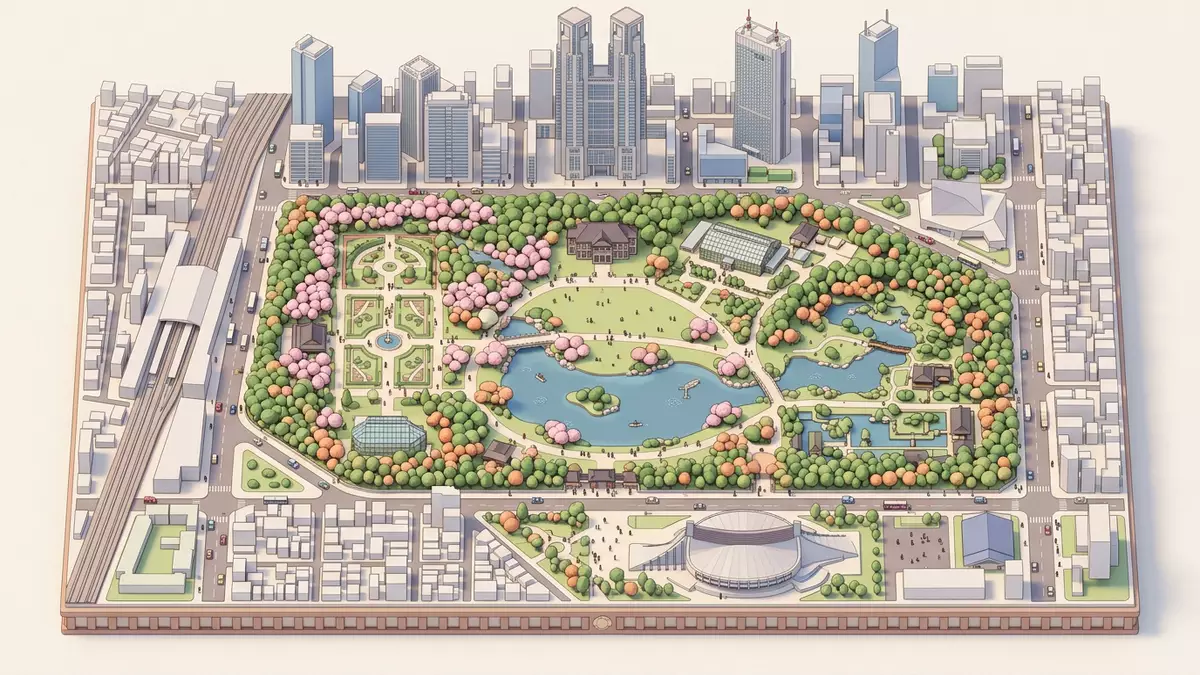
Shinjuku Gyoen is a historic national garden in Tokyo, laid out across the former Edo-period estate of the Nait? family and reshaped into an imperial landscape in 1906. The garden lies in Shinjuku, on land granted to the Nait? clan by Tokugawa Ieyasu in the late sixteenth century, and it has been rebuilt and opened to the public as Shinjuku Gyoen National Garden since 1949.History of Shinjuku Gyoen
A Meiji-era garden on a samurai estate
The story of Shinjuku Gyoen begins in 1590, when Tokugawa Ieyasu granted land in the Shinjuku area to his vassal Nait? Kiyonari, whose residence formed the core of a daimyo estate during the Edo period.Nait? residence in Edo period The Nait? family completed a garden here in the eighteenth century, giving the site its first landscaped character within the wider shogunate city.
Following the Meiji Restoration in 1868, the former feudal grounds took on a new role as the Nait?-Shinjuku Experimental Station, an agricultural research centre introducing Western horticulture and modern farming techniques.Nait?-Shinjuku Experimental Station In 1879 the area became the Shinjuku Imperial Botanical Garden under the Imperial Household Ministry, and in May 1906 it was formally opened as Shinjuku Imperial Garden, a landscaped retreat visited by Emperor Meiji and shaped to reflect Meiji-era engagement with Western garden design.Opening as Shinjuku Imperial Garden in 1906
Three garden styles in one expansive park
Shinjuku Gyoen spreads across about 58.3 ha (144 acres) with a circumference of roughly 3.5 km (2.2 mi), giving its lawns, ponds and groves an unusual sense of scale within central Tokyo.Garden area and circumference Within this area the garden is divided into several distinct zones, so that walking its paths feels like moving between different landscapes within a single enclosed park.
To the east lies the Formal Garden, laid out symmetrically with avenues, borders and structured planting that reflect French formal garden traditions adopted during the Meiji period.Formal, Landscape and Japanese gardens The central Landscape Garden features wide lawns dotted with mature trees and ponds, echoing English landscape parks. Towards the west, the Japanese Traditional Garden offers a strolling route past water, bridges and teahouse-style buildings, while the Tamamo Pond area in the northeast preserves elements of the earlier daimyo garden from the Nait? estate.
From imperial retreat to national garden
In the early twentieth century, Shinjuku Imperial Garden served as a palace garden and venue for official functions, becoming one of the representative modern Western-style gardens of the Meiji era.Modern Western-style garden of Meiji era The layout completed in 1906, influenced by French landscape architect Henry Martinet working with Hayato Fukuba, combined Western formal and landscape elements with a Japanese garden core in a way that remains visible across the grounds.Design by Henry Martinet
Large parts of the garden suffered heavy damage during air raids in 1945, but the site was rebuilt in the post-war decades and its jurisdiction passed from the Imperial Household to government ministries responsible for health and later the environment.Post-war rebuilding and jurisdiction On 21 May 1949 Shinjuku Gyoen reopened to the public as Shinjuku Gyoen National Garden, and its present appearance largely follows the 1906 layout, with the main gates leading into a sequence of plazas, lawns, formal beds and wooded areas that carry the garden’s layered history in their structure.Opening as National Garden in 1949
Visiting Shinjuku Gyoen: what travellers from Western Europe should know
- Shinjuku Gyoen stands in Naito-machi in Shinjuku ward, Tokyo, with its main entrances reached from surrounding city streets and Shinjuku Station on several JR and private railway lines.
- Inside the garden, paths link lawns, ponds and wooded areas, and some routes include gentle gradients and flights of steps between terrace-like levels and around the water features.
- The park sits in a dense urban district, so garden views include both planted landscapes and glimpses of surrounding high-rise buildings beyond the enclosing trees.
- The official language is Japanese and the currency is the yen.
Searching for Shinjuku Gyoen on social platforms
These links open searches for Shinjuku Gyoen on each platform.
Frequently asked questions about Shinjuku Gyoen
Where is Shinjuku Gyoen located in Tokyo?
Shinjuku Gyoen stands in Naito-machi in Shinjuku ward, on the western side of central Tokyo, within walking distance of Shinjuku Station and major city streets.Address in Naito-machi
What can visitors expect on a visit to Shinjuku Gyoen?
Visitors encounter a large enclosed park divided into formal, landscape and traditional Japanese garden areas, with lawns, ponds, wooded sections and views of Tokyo’s skyline beyond the trees.Three distinct garden styles
What makes Shinjuku Gyoen distinctive among Tokyo gardens?
Its layered history from Edo-period daimyo estate to Meiji imperial garden and post-war national garden, combined with French, English and Japanese design elements in a single site, gives Shinjuku Gyoen a character tied closely to Japan’s modernisation.


