
Shibuya Scramble Crossing at the core of Shibuya’s motion
Published on 09/15/2026 at 11:07 | Editorial responsibility: Rafael Müller, Editor-in-Chief AD HOC NEWS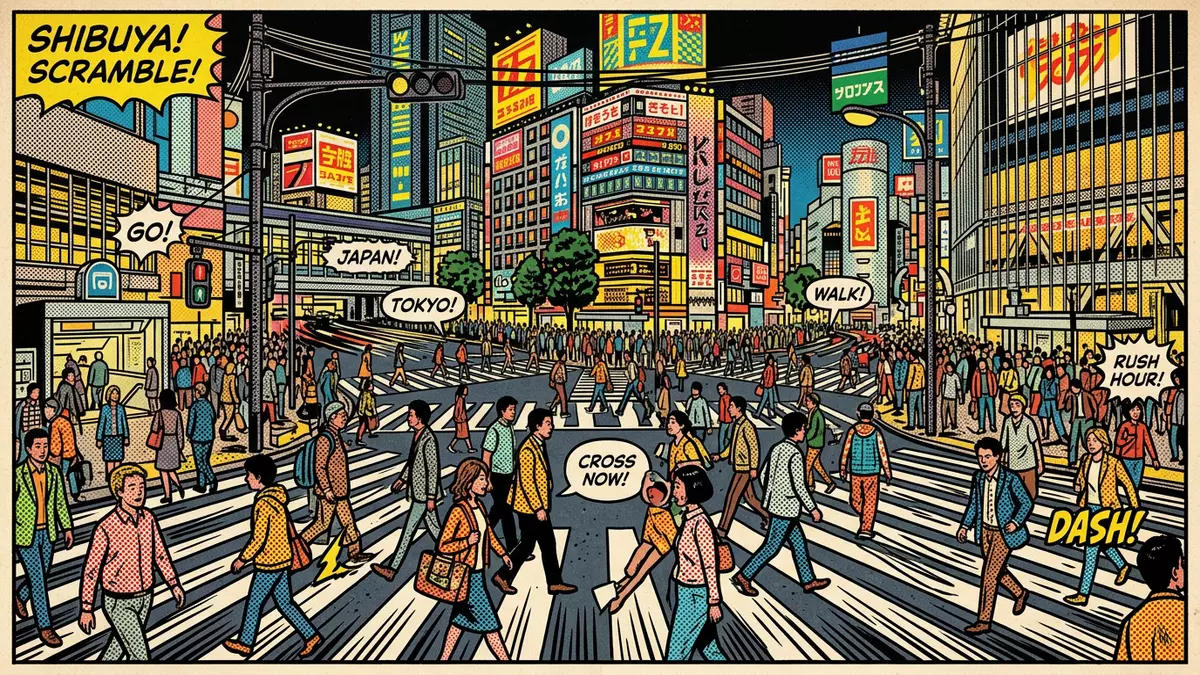
Shibuya Scramble Crossing in Tokio is a city junction where all vehicle traffic halts at once and pedestrian streams move in every marked direction, including diagonally, across a patch of asphalt framed by Shibuya’s towers and station exits. It sits directly in front of Shibuya Station’s Hachiko Exit in Shibuya City, Japan’s capital Tokyo, anchoring one of the city’s busiest commercial districts around a single intersection.
Where Shibuya Scramble Crossing sits in Shibuya
Shibuya Scramble Crossing occupies the junction recorded under the Dogenzaka address area in Shibuya City, on the western side of central Tokyo. The intersection lies immediately outside the Hachiko Exit of Shibuya Station, a major rail hub that brings multiple JR and Tokyo Metro lines together in the Shibuya district.Shibuya, Tokyo, Japan The crossing is formally designated as Shibuya Station Front Intersection, known in Japanese as Shibuya-ekimae Kosaten, reflecting its status as a road junction directly tied to the station frontage.Shibuya-ekimae Kosaten
Urban roads converge on the intersection from several directions, connecting the Dogenzaka slope and other Shibuya streets with the station plaza. Around the crossing, multi-storey retail blocks and station buildings line the street edges, their façades carrying large-scale advertising screens and illuminated signage that look directly onto the carriageways. The Hachiko statue stands between the station and the junction, marking a compact plaza that functions as a landmark meeting point beside the pedestrian approaches.
The scramble crossing phase and the geometry of the junction
In traffic-engineering terms Shibuya Scramble Crossing is arranged as a scramble-style intersection, meaning that every vehicle signal turns red at once and pedestrians are permitted to cross in every marked direction during a dedicated all-walk phase.scramble intersection directly in front of Shibuya Station Scramble phasing was introduced in 1973, giving Shibuya a junction where pedestrians can move not only straight across but also diagonally through the centre of the carriageways.scramble phasing was introduced in 1973 Traffic lanes radiate from the middle of the crossing, with marked crosswalks laid out between the corners; one of these crosswalks runs diagonally from the Hachiko plaza corner towards the QFRONT building on the opposite side.
The diagonal movement across the centre is one of the defining observable properties of Shibuya Scramble Crossing. When the scramble phase begins, pedestrian flows step off the kerbs from every side and weave past each other over the painted stripes. Vehicles stand around the perimeter behind their stop lines until the phase ends and the ordinary directional signals resume. The asphalt surface carries road markings associated with the different lanes, while tactile paving and kerb lines mark the pedestrian waiting areas at each corner.
A junction framed by towers, plazas and station exits
On each side of Shibuya Scramble Crossing, the station complex and surrounding high-rise buildings create a vertical frame to the movement across the road. Station entrances occupy several corners, connecting underground concourses and elevated walkways with the street level immediately beside the crosswalks.located directly outside Shibuya Station's Hachiko exit Nearby, retail towers such as Shibuya Scramble Square and other commercial blocks rise above the junction, their glass and steel façades reflecting the intersection’s lights. At one corner the QFRONT building faces the diagonal crosswalk, its large screen visible from across the crossing.junction of five roads in front of Shibuya Station
The streets feeding into the crossing carry buses, taxis and private cars that queue during the scramble phase, then move through the junction when the signals change. Above and around them, overhead viewing points in nearby buildings, including rooftop decks and upper-floor cafés, offer downward views over the striped crosswalks and the flows of people that occupy them during each cycle. At ground level, the compact spaces between building frontages and kerbs create plazas where pedestrians wait for the signals, meet beside the dog statue or turn into neighbouring streets such as Center Gai.
Visiting Shibuya Scramble Crossing: what travellers from Western Europe should know
- Shibuya Scramble Crossing is in Shibuya City on the western side of central Tokyo, directly outside the Hachiko Exit of Shibuya Station, which is served by JR and Tokyo Metro lines.
- The junction itself is level and paved, with marked crosswalks and kerbs; reaching some nearby viewing points involves lifts, escalators or internal staircases inside the surrounding buildings.
- Shibuya Scramble Crossing sits within a dense urban district of streets, plazas and shopping towers, so moving around the area involves navigating crowds, crossings and station concourses rather than long approaches on foot.
- The official language is Japanese and the currency is the yen.
- Entry requirements depend on your nationality; UK travellers can check the FCDO travel advice at gov.uk/foreign-travel-advice, Irish travellers the Department of Foreign Affairs at ireland.ie.
Searching for Shibuya Scramble Crossing on social platforms
These links open searches for Shibuya Scramble Crossing on each platform.
Frequently asked questions about Shibuya Scramble Crossing
Where is Shibuya Scramble Crossing located in Tokio?
Shibuya Scramble Crossing is in Shibuya City in western Tokyo, Japan, directly outside the Hachiko Exit of Shibuya Station at the Dogenzaka junction area.
What should visitors expect when they reach the crossing?
Visitors encounter a scramble-style intersection where vehicle traffic stops together and pedestrians move across marked crosswalks from every side, with towers, screens and station entrances framing the junction.
What makes Shibuya Scramble Crossing distinctive among urban junctions?
The crossing combines scramble phasing, a diagonal crosswalk through the centre and an immediate relationship with one of Tokyo’s busiest stations, giving the junction a visibly choreographed movement across its asphalt surface.


