
Shibuya Scramble Crossing and the geometry of Tokyo
Published on 09/23/2026 at 17:17 | Editorial responsibility: Rafael Müller, Editor-in-Chief AD HOC NEWS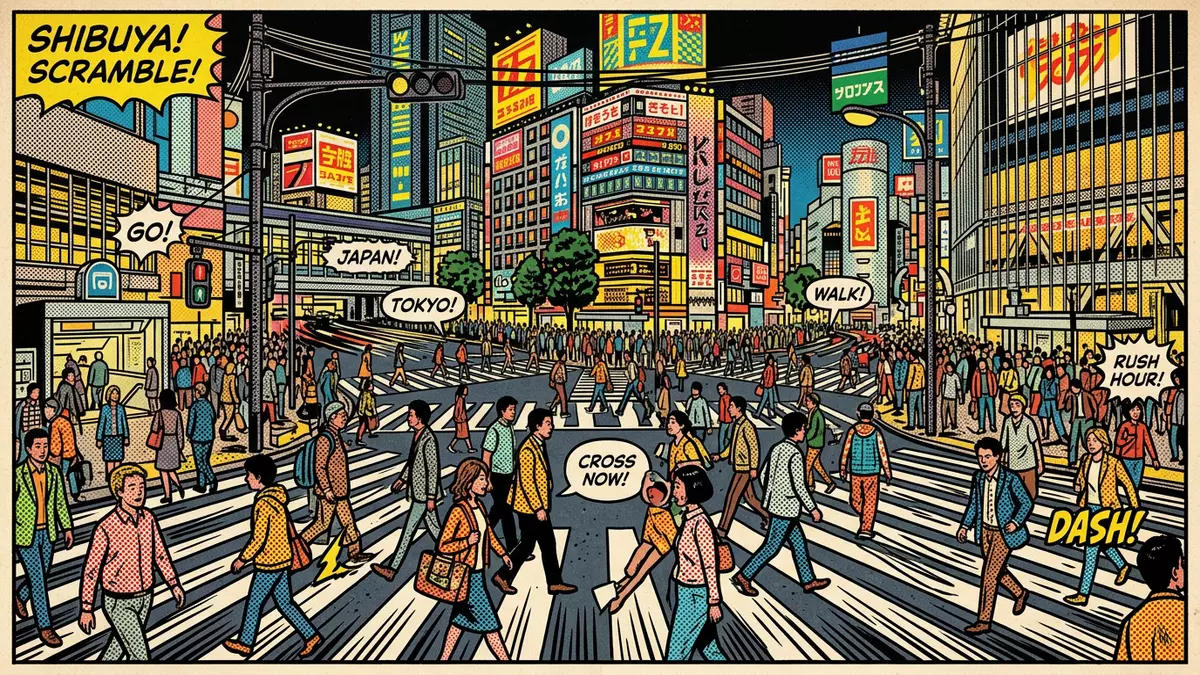
Shibuya Scramble Crossing is a station-front junction in Tokio where marked streets become a shared pedestrian space. The crossing lies directly outside Shibuya Station’s Hachik? Exit, and its all-direction movement dates from 1973.
Diagonal movement outside Shibuya Station
Shibuya Scramble Crossing occupies the eastern side of Shibuya Station in Shibuya City. Several roads meet in front of the station, with vehicle lanes surrounding a broad paved area marked by crossing lines.
During the pedestrian phase, people move across the junction in straight and diagonal directions. The geometry is visible from street level, from the station approaches and from the surrounding buildings, where the white markings form a network across the asphalt.
A 1973 crossing in a railway district
Shibuya Station opened in 1885, giving the district a railway history that reaches into the nineteenth century. The station’s position connected Shibuya with Tokyo’s wider rail network and shaped the commercial setting around the junction.
The scramble arrangement was introduced in 1973. The date places the crossing’s present form within the period when Shibuya developed into a district of department stores, fashion businesses, cinemas, cafés and entertainment venues. The station and the intersection remain closely connected in both physical layout and public identity.
Hachik?, signs and the surrounding streets
The Hachik? Exit provides the clearest street-level reference point. The bronze statue of Hachik? stands beside the station, near the approaches to the crossing and the public space around the exit.
Large advertising screens, illuminated shopfronts and multi-storey buildings frame the junction. From the pavement, the crossing appears as a changing arrangement of signals, traffic lanes and pedestrian markings. From an elevated viewpoint, its intersecting lines form a recognisable pattern within Shibuya’s dense urban fabric.
Visiting Shibuya Scramble Crossing: what travellers from Western Europe should know
- Shibuya Scramble Crossing is directly outside Shibuya Station’s Hachik? Exit in Shibuya City, Tokio.
- Rail access includes the JR Yamanote Line, Tokyo Metro lines, Tokyu railway lines and the Keio Inokashira Line.
- The crossing is level at street height, but station approaches include stairs, escalators and underground passages.
- Hachik?’s statue, station buildings and large advertising screens stand beside the crossing.
- The official language is Japanese and the currency is the Japanese yen.
Searching for Shibuya Scramble Crossing on social platforms
These links open searches for Shibuya Scramble Crossing on each platform.Frequently asked questions about Shibuya Scramble Crossing
Where is Shibuya Scramble Crossing?
It is directly outside Shibuya Station’s Hachik? Exit in Shibuya City, Tokio. The crossing sits among the station’s retail streets and public spaces.
What happens at the crossing?
Vehicle traffic stops during the pedestrian phase. People cross in several directions, including diagonally across the junction.
What makes the crossing distinctive?
Its 1973 scramble arrangement combines a large marked junction with movement from every side. Hachik?’s statue, railway entrances, advertising screens and surrounding buildings frame the scene.


