
Shibuya Scramble Crossing and the choreography of Shibuya
Published on 09/19/2026 at 15:49 | Editorial responsibility: Rafael Müller, Editor-in-Chief AD HOC NEWS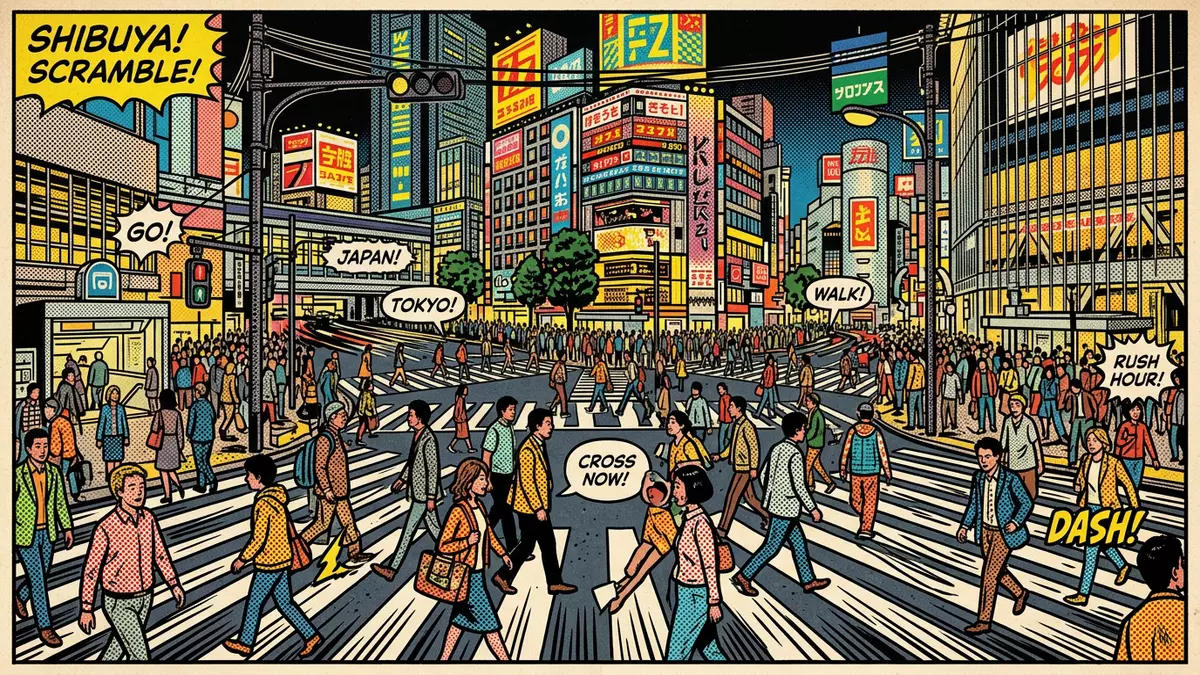
Shibuya Scramble Crossing in Tokio is a road junction in Shibuya City where marked pedestrian crossings cut across a cluster of traffic lanes directly outside Shibuya Station’s Hachiko Exit in Japan’s capital. The intersection has become strongly associated with the all-direction pedestrian phase that releases people into the crossing at once and with the dense urban frontage of towers, plazas and station buildings framing the approaches.
Geometry of a multi-directional crossing
At street level Shibuya Scramble Crossing brings together a junction where several urban streets converge and vehicle traffic is channelled into a set of marked lanes around a central island of pedestrian space. Road authorities record the junction under the official name Shibuya Ekimae Crossing, literally “Shibuya Station Front Intersection”, reflecting its status in the traffic network rather than its later reputation. Shibuya Ekimae Crossing is configured as a scramble-style intersection: vehicle signals halt traffic from each approach so pedestrians can cross in all available marked directions, including diagonally across the centre.
The geometry of the junction is built around five distinct pedestrian crossings that link the corners and edges of the surrounding blocks, one of them running diagonally between the station-side plaza and the frontage facing the QFRONT building. The diagonal span has been measured at roughly 36 m (118 ft), giving a broad sweep of walking space that cuts through the centre of the intersection during the all-walk phase. The diagonal crossing length and the number of marked routes are persistent features of the junction’s layout and help explain why the space fills with intersecting lines of movement whenever signals switch to the pedestrian phase.
From transport node to urban stage
The story of Shibuya Scramble Crossing is bound up with the development of Shibuya Station and the growth of Shibuya as a commercial district across the twentieth century. Shibuya Station opened as a railway stop in 1885, when the surrounding area lay on the edge of urban Tokyo and had yet to take on its later role as a shopping and entertainment hub. During the Taisho period, from 1912 to 1926, and the Showa period that followed from 1926 to 1989, Shibuya evolved into a centre of department stores, cinemas and fashion, and road junctions around the station adjusted to rising traffic and footfall. Shibuya Station opened in 1885 and the later introduction of scramble-style phasing in 1973 turned the already busy intersection into a patterned crossing sequence.
Scramble phasing, introduced at Shibuya Ekimae Crossing in 1973, created a distinct all-direction pedestrian interval in the signal cycle, carving out shared space where streams of people traverse the marked routes at once. A full signal cycle has been timed at about 140 seconds, with the all-walk phase occupying a fraction of that period before traffic resumes. Scramble phasing in 1973 and the measured timing of the cycle give the crossing its characteristic rhythm: vehicle movements pause entirely, pedestrians assemble at the kerbs and then cross in intersecting lines that clear before the next phase of traffic.
Shibuya Scramble Crossing within Shibuya City
Shibuya Scramble Crossing sits within Shibuya City in western Tokio, in the Dogenzaka area recorded under addresses such as 2 Dogenzaka, Shibuya City, Tokyo 150-0043. The junction lies directly outside the Hachiko Exit of Shibuya Station, placing it at the interface between station concourses and street-level public space. Visitors stepping out through the Hachiko Exit arrive at Hachiko Square, where a statue of the dog Hachiko stands near the station façade, and beyond that square the marked crossings spread across the junction. The Dogenzaka address and Hachiko Exit link Shibuya Scramble Crossing to the broader layout of Shibuya’s streets.
Around the crossing, multi-storey retail buildings, station-related structures and illuminated advertising screens line each approach road, forming a dense built frame around the open space of the junction. Shibuya Station itself is served by JR lines and private railway operators, while Shibuya Scramble Crossing is also reached via nearby subway exits connected to underground concourses. Shibuya Station and its exits make the crossing a connective point between rail networks and pedestrian routes into Shibuya’s shopping streets, plazas and side roads that lead away from the junction in several directions.
Visiting Shibuya Scramble Crossing: what travellers from Western Europe should know
- Shibuya Scramble Crossing is in Shibuya City in western Tokio, directly outside the Hachiko Exit of Shibuya Station; JR lines and Tokyo Metro services converge at this station, giving rail access from other parts of the city.
- The junction itself consists of paved streets with kerbs and marked pedestrian crossings; during the scramble phase pedestrians cross on level ground, though the approaches link to station structures with stairs, escalators and interior corridors.
- The crossing lies within the Dogenzaka area of Shibuya, with Hachiko Square on one corner and commercial buildings such as QFRONT lining another, so travellers experience both the transport node and the surrounding shopping and entertainment district in one place.
- The official language is Japanese and the currency is the yen.
- Entry requirements depend on your nationality; UK travellers can check the FCDO travel advice at gov.uk/foreign-travel-advice, Irish travellers the Department of Foreign Affairs at ireland.ie.
Searching for Shibuya Scramble Crossing on social platforms
These links open searches for Shibuya Scramble Crossing on each platform.
Frequently asked questions about Shibuya Scramble Crossing
Where is Shibuya Scramble Crossing located in Tokio?
Shibuya Scramble Crossing is in Shibuya City in western Tokio, directly outside the Hachiko Exit of Shibuya Station, with the junction recorded under Dogenzaka-area addresses such as 2 Dogenzaka, Shibuya City, Tokyo.
What can a visitor expect when crossing the junction?
Visitors encounter a scramble-style phase where vehicle traffic halts in all directions and pedestrians from every corner traverse five marked crossings, including a diagonal route that spans roughly 36 m (118 ft) across the centre.
What makes Shibuya Scramble Crossing distinctive among Tokio’s street junctions?
The combination of a formally designated station-front intersection with five marked pedestrian crossings, scramble phasing introduced in 1973 and dense station-related buildings and plazas around the junction gives Shibuya Scramble Crossing a recognisable multi-directional street choreography.


