
Sheikh Zayed Grand Mosque and the language of marble
Published on 09/07/2026 at 10:37 | Editorial responsibility: Rafael Müller, Editor-in-Chief AD HOC NEWS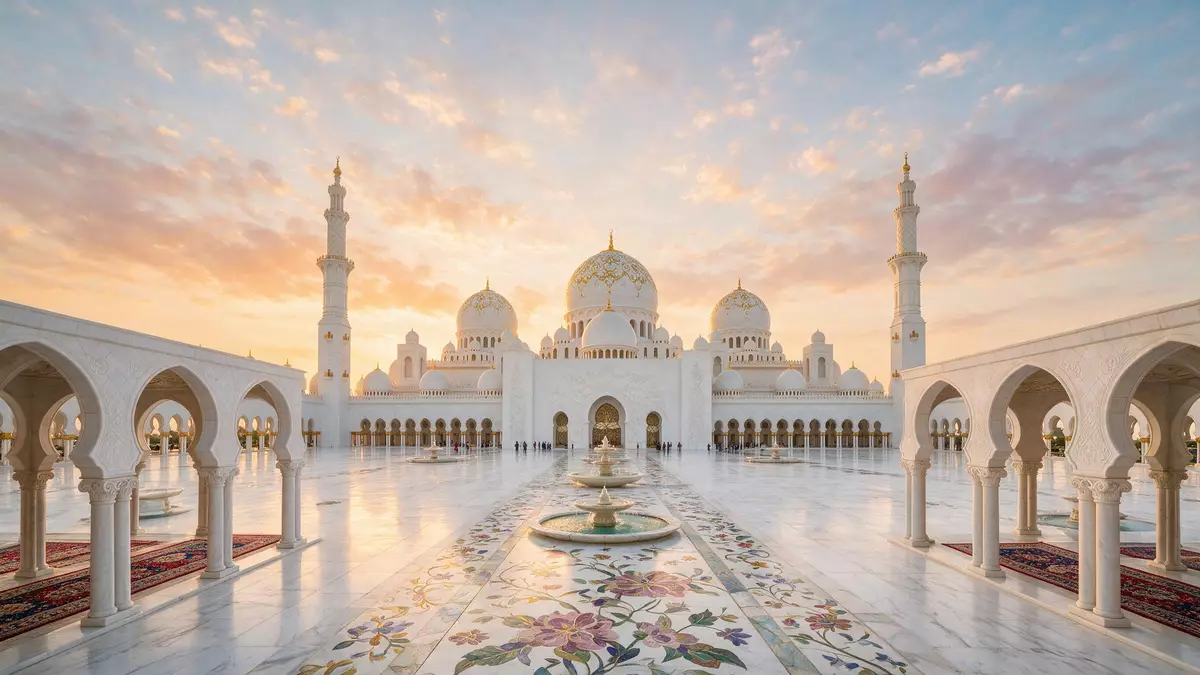
Sheikh Zayed Grand Mosque in Abu Dhabi is a marble-clad religious complex that takes its name from Sheikh Zayed bin Sultan Al Nahyan. Construction began on 5 November 1996, and the building opened for worship in 2007.
Sheikh Zayed Grand Mosque in white marble and domes
The mosque stands on elevated ground on the outskirts of Abu Dhabi. Its white marble exterior, domes and minarets create a composition that reads as formal and expansive rather than compact.
The site gathers together materials from several countries, including Italy, Germany, Morocco, India, Turkey, China, the United Kingdom, New Zealand and Greece. That international mixture sits beside a strongly recognisable Islamic form, linked here to the name of Sheikh Zayed bin Sultan Al Nahyan.Marble and elevation
A late twentieth-century mosque in Abu Dhabi
The mosque belongs to the late twentieth and early twenty-first centuries, with work beginning in 1996 and worship beginning in 2007. It is one of the best-known landmarks associated with Abu Dhabi’s modern skyline of civic and religious buildings.
Sheikh Zayed Grand Mosque reflects the wider vocabulary of modern Islamic architecture through its large prayer spaces, courtyard, columns and decorative surfaces. The building’s scale is reinforced by its broad plan, domes and tall minarets, all visible from different approaches to the complex.Construction in 1996
Materials, craft and a broad visual programme
Natural materials play a central role in the mosque’s appearance, with marble, stone, gold, semi-precious stones, crystals and ceramics used across the complex. The result is a building that combines a pale exterior with richly worked interior surfaces.
Its decorative programme reaches beyond structure into ornament, especially in the columns, walls, prayer halls and courtyard. The mosque is also associated with a large collaborative effort involving more than 3,000 workers and 38 contracting companies, which helps explain its layered finish.Natural materials The mosque’s name keeps the connection to Sheikh Zayed bin Sultan Al Nahyan visible in the building itself, rather than treating it as a remote dedication.Named for Sheikh Zayed
Visiting Sheikh Zayed Grand Mosque: what travellers from Western Europe should know
- Sheikh Zayed Grand Mosque stands on the outskirts of Abu Dhabi on elevated ground. The complex is approached by road and presents broad exterior spaces rather than a tight urban frontage.
- The mosque includes domes, minarets, courtyards and prayer halls. Marble surfaces and extensive decorative work are visible across the building, inside and out.
- The site is a major religious building, so dress and movement follow the conventions of a functioning mosque. Its scale means that the approach, exterior and interior read as different parts of one composition.
- The architecture brings together materials and craft from several countries. That mixture is visible in the surface treatment, the columns and the decorative finishes.
Searching for Sheikh Zayed Grand Mosque on social platforms
These links open searches for Sheikh Zayed Grand Mosque on each platform.
Frequently asked questions about Sheikh Zayed Grand Mosque
Where is Sheikh Zayed Grand Mosque?
It stands in Abu Dhabi, on elevated ground on the outskirts of the city. The mosque is named for Sheikh Zayed bin Sultan Al Nahyan.
What does a visit reveal?
The mosque presents white marble, domes, minarets, courtyards and prayer halls. Decorative surfaces and natural materials are part of the building’s character.
What makes it distinctive?
Its scale, marble surface and international mix of materials define the complex. Sheikh Zayed bin Sultan Al Nahyan remains present in the name and in the building’s identity.


