
Sheikh Zayed Grand Mosque and its luminous marble scale
Published on 09/22/2026 at 20:54 | Editorial responsibility: Rafael Müller, Editor-in-Chief AD HOC NEWS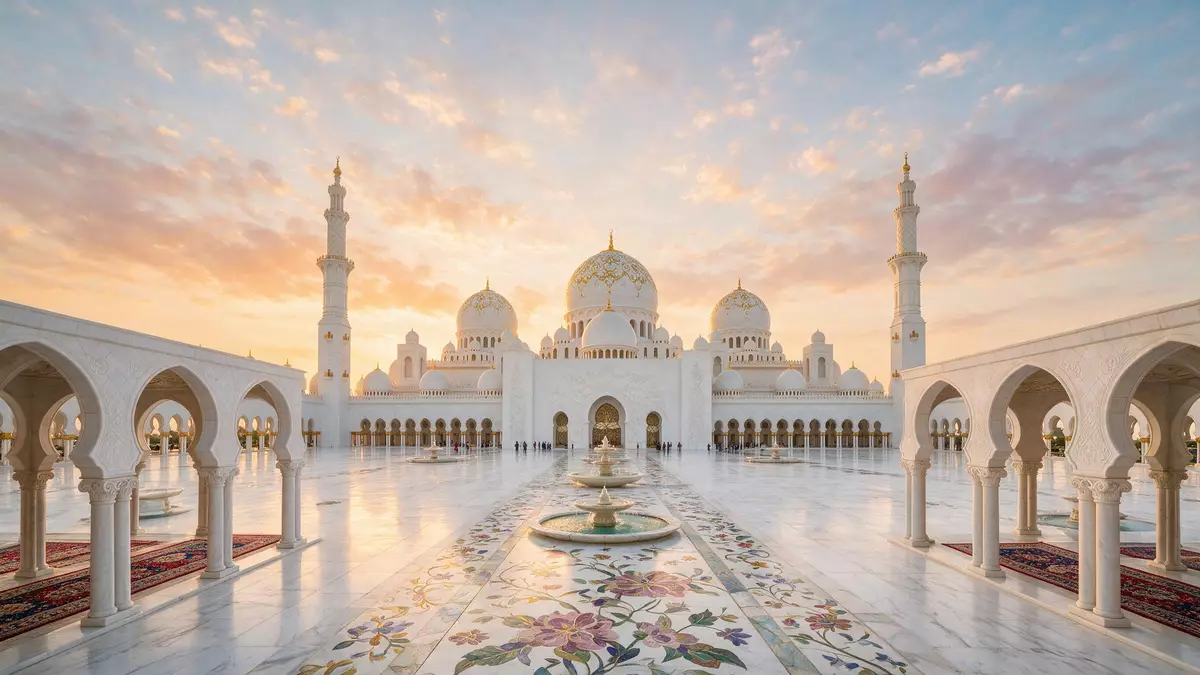
Sheikh Zayed Grand Mosque in Abu Dhabi is an architectural composition of white marble, domes, arcades and reflective water. Its surfaces remain bright beneath the desert sky, while floral mosaics and calligraphy extend across courtyards and prayer halls. Construction began in 1996, and the mosque opened for worship in 2007.
White marble across Sheikh Zayed Grand Mosque
The mosque’s defining material is white marble, used across the exterior walls, columns, domes and paved spaces. The surface gives the complex a consistent visual language, while coloured stone forms botanical patterns in the courtyard and around the principal routes.
Marble columns carry decorative capitals with floral motifs. Their surfaces combine pale stone with coloured inlay, creating repeated patterns across the arcades. The courtyard contains a large marble mosaic whose botanical designs continue the relationship between architecture and plant forms.
The domes and minarets of Abu Dhabi’s mosque
Sheikh Zayed Grand Mosque includes 82 domes of different sizes. The central dome rises above the main prayer hall, with a diameter of approximately 32.6 metres and a height of 84 metres. Its exterior combines white marble cladding, a crown and a crescent finial decorated with gold-coloured glass mosaic. the central dome’s dimensions are recorded in the mosque’s architectural description.
The complex has four minarets at its corners. Their forms combine several Islamic architectural traditions, including Moroccan, Mamluk and Ottoman references. The minarets rise above the lower domes and arcades, giving the mosque a clear vertical outline across Abu Dhabi.
Sheikh Zayed bin Sultan Al Nahyan and the mosque’s history
The mosque bears the name of Sheikh Zayed bin Sultan Al Nahyan, the founding president of the United Arab Emirates. Initial considerations began in the late 1980s, construction started on 5 November 1996, and worship began during Eid Al Adha in 2007. the construction and opening dates place the complex within the late twentieth-century development of Abu Dhabi.
Syrian architect Youssef Abdelke led the design, with architectural development involving Basem Barghouti, Moataz Al-Halabi and Imad Malas. The result combines features associated with Mughal, Moorish, Moroccan and Ottoman traditions, while its scale and materials belong to a contemporary religious complex.
Visiting Sheikh Zayed Grand Mosque: what travellers from Western Europe should know
- Sheikh Zayed Grand Mosque stands on the south-eastern outskirts of Abu Dhabi, beside Sheikh Rashid bin Saeed Street. It is reached by road from the city and connects with Abu Dhabi’s public transport network.
- The complex occupies elevated ground, with broad paved approaches, courtyards, arcades and prayer halls. Visitors encounter long outdoor routes and extensive marble surfaces before reaching the principal interior spaces.
- The official language is Arabic and the national currency is the United Arab Emirates dirham.
- Entry requirements depend on your nationality; UK travellers can check the FCDO travel advice at gov.uk/foreign-travel-advice, Irish travellers the Department of Foreign Affairs at ireland.ie.
Searching for Sheikh Zayed Grand Mosque on social platforms
These links open searches for Sheikh Zayed Grand Mosque on each platform.
Frequently asked questions about Sheikh Zayed Grand Mosque
Where is Sheikh Zayed Grand Mosque?
Sheikh Zayed Grand Mosque is in Abu Dhabi, the capital of the United Arab Emirates. It stands on the city’s south-eastern outskirts beside Sheikh Rashid bin Saeed Street.
What can visitors see there?
Visitors see white marble arcades, courtyards, domes, minarets, reflective pools, floral mosaics and prayer halls decorated with calligraphy and coloured stone.
What makes the mosque distinctive?
Its identity comes from the combination of white marble, 82 domes, four minarets and decorative traditions drawn from several Islamic architectural regions.


