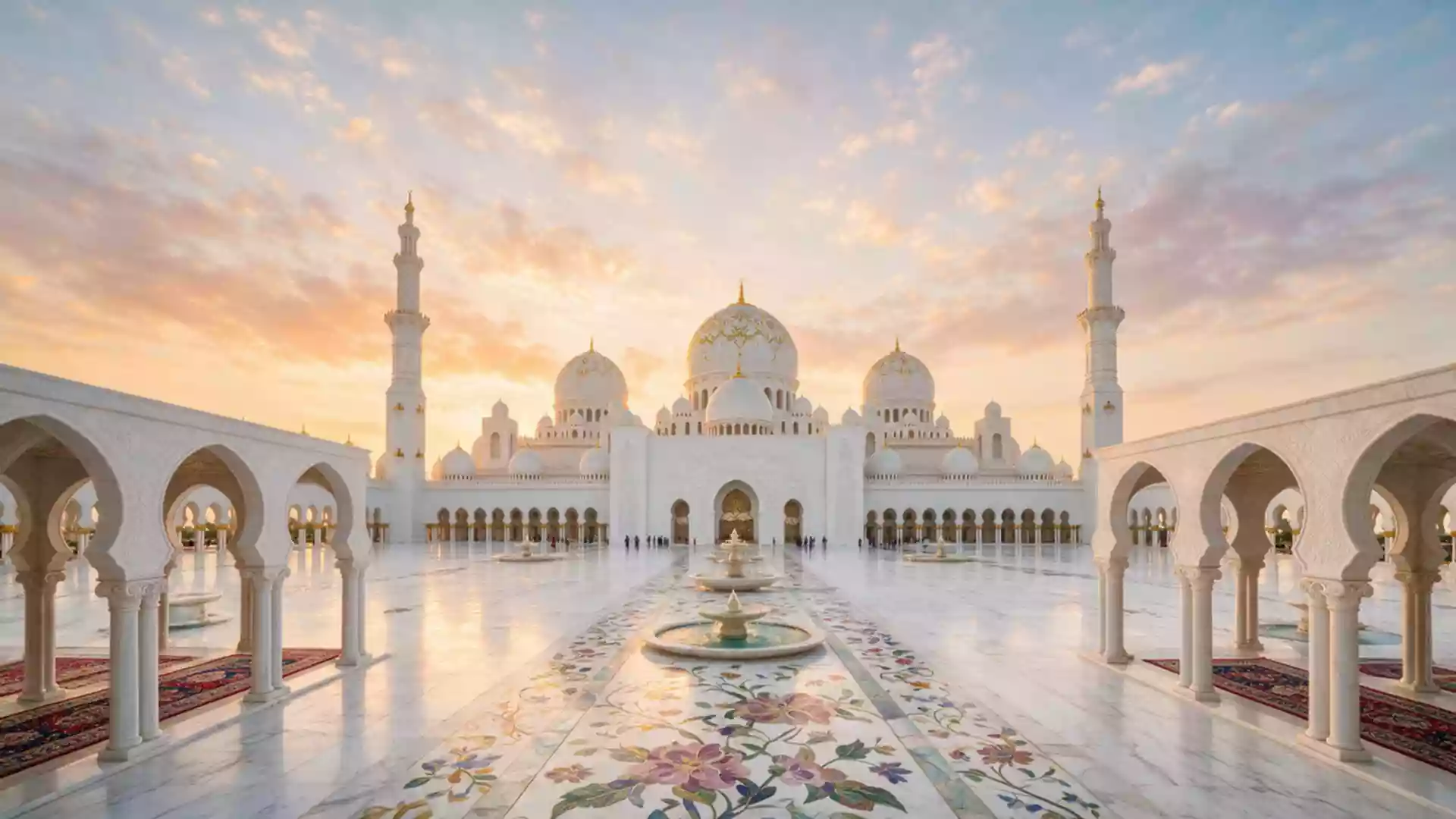
Sheikh Zayed Grand Mosque and its luminous marble scale
Published on 09/11/2026 at 22:07 | Editorial responsibility: Rafael Müller, Editor-in-Chief AD HOC NEWS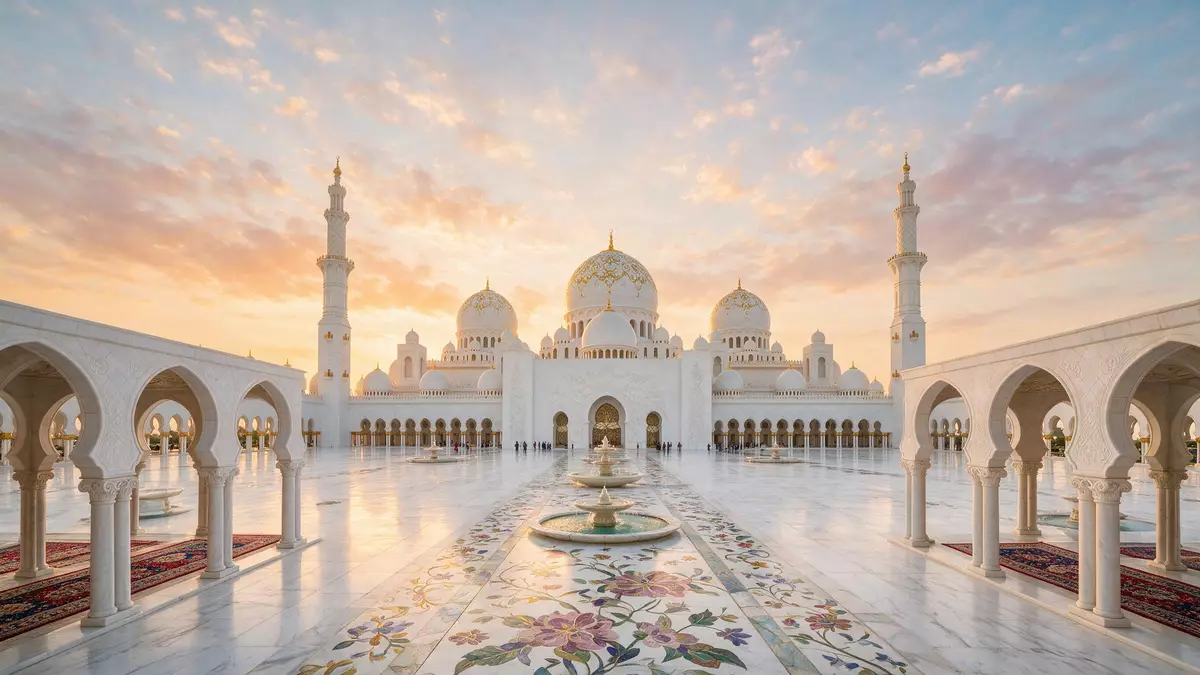
Sheikh Zayed Grand Mosque in Abu Dhabi is a vast composition of white marble, domes and arcades, spreading across an elevated site with a scale that defines the southern approach to the city. Conceived in the late twentieth century and opened for worship in 2007, it brings Islamic architectural traditions into a single complex that can accommodate tens of thousands of worshippers across its prayer halls and courtyards.
Marble, domes and minarets on an elevated platform
The mosque stands on raised ground at the edge of Abu Dhabi, with its main complex occupying more than 12 hectares (around 30 acres), laid out as a rectangle measuring roughly 290 m by 420 m (950 ft by 1,380 ft).The building complex measures approximately 290 by 420 m The wider site extends across more than 555,000 square metres, including landscaped approaches and outer facilities around the walled precinct.The Mosque was built on an elevated land that rises about 10 meters
White marble cladding runs across the arcades, domes and minarets, catching light during the day and under artificial illumination at night.Natural materials were used in its construction, including marble The complex carries 82 domes in different sizes, with the largest dome rising above the main prayer hall and reaching an outer height in the mid?80 m range.The largest of which is located at the centre of the main prayer hall Four minarets stand at the corners of the main courtyard, each rising to about 107 m (351 ft), giving the building a clear vertical emphasis against the lower city around it.The minarets of Sheikh Zayed Grand Mosque are its tallest architectural feature
An international project rooted in Islamic architectural traditions
Planning for Sheikh Zayed Grand Mosque began in the late 1980s, with construction starting on 5 November 1996 and continuing for around eleven years before the prayer halls opened in 2007.Construction began on November 5th, 1996, and it opened for worship on Eid Al Adha 2007 The project was initiated under Sheikh Zayed bin Sultan Al Nahyan, the founding president of the United Arab Emirates, whose name the mosque bears.Sheikh Zayed bin Sultan Al Nahyan
The mosque’s architecture draws on several strands of Islamic design, including Mughal, Moorish and Ottoman influences in its domes, arcades and decorative treatment.The Sheikh Zayed Grand Mosque is built in three styles: Mughal, Moorish, and Ottoman Youssef Abdelke, a Syrian architect, is credited with the overall design, alongside colleagues Basem Barghouti, Moataz Al?Halabi and Imad Malas, who contributed to the architectural development of the complex.The mosque was designed by Syrian architect Youssef Abdelke Artisans and materials were drawn from a wide range of countries, including Italy, Germany, Morocco, India, Turkey, China, the United Kingdom, New Zealand, Greece and the United Arab Emirates, reflecting the international character of its construction.using artisans, craftsmen, and materials from many countries
Prayer halls, courtyards and crafted interior detail
Sheikh Zayed Grand Mosque is the largest mosque in the United Arab Emirates, with a capacity in the tens of thousands across its halls and outdoor spaces.covering an area of more than 12 hectares The main prayer hall stands beneath the central dome and is lined with columns clad in marble and inlay work, supporting the upper galleries and framing the extensive carpet that covers the floor. Side halls provide additional prayer space, with architectural detailing echoing the central hall.
Across the complex, decorative programmes use marble, gold, semi?precious stones, crystals and ceramics, integrating calligraphy, geometric patterns and floral motifs into floors, walls and column capitals.Natural materials were used in its construction, including marble, stone, gold, semi-precious stones, crystals, and ceramics Large chandeliers hang in the main prayer hall, incorporating glass and crystal elements, while the courtyard floor carries extensive marble mosaic work that can be read from upper levels and arcades around the perimeter.Courtyard marble mosaic
Visiting Sheikh Zayed Grand Mosque: what travellers from Western Europe should know
- Sheikh Zayed Grand Mosque stands on elevated ground on the outskirts of Abu Dhabi, close to Sheikh Rashid bin Saeed Al Maktoum Road, and is reached mainly by road transport.
- The complex combines expansive courtyards with long colonnades and stairways; moving between halls and outer areas involves walking across wide paved surfaces and negotiating steps.
- The mosque lies in the United Arab Emirates, where the official language is Arabic and the currency is the UAE dirham.
- Entry requirements depend on your nationality; UK travellers can check the FCDO travel advice at gov.uk/foreign-travel-advice, Irish travellers the Department of Foreign Affairs at ireland.ie.
Searching for Sheikh Zayed Grand Mosque on social platforms
These links open searches for Sheikh Zayed Grand Mosque on each platform.
Frequently asked questions about Sheikh Zayed Grand Mosque
Where is Sheikh Zayed Grand Mosque and how large is the site?
Sheikh Zayed Grand Mosque stands on raised land at the outskirts of Abu Dhabi, with its main complex occupying more than 12 hectares inside a walled rectangle of about 290 m by 420 m.
What should visitors expect during a visit?
A visit involves walking through broad marble courtyards, arcades and stairways, then entering prayer halls lined with columns, chandeliers and extensive decorative marble, stone and inlay work.
What makes Sheikh Zayed Grand Mosque distinctive among Islamic buildings?
The mosque combines Mughal, Moorish and Ottoman influences across a unified field of white marble, with 82 domes, four tall minarets and interiors that integrate calligraphy, geometric patterns and floral motifs on a monumental scale.