
Shaolin Si at Mount Song: temple axes, stone pagodas and kung fu heritage
Published on 09/15/2026 at 15:13 | Editorial responsibility: Rafael Müller, Editor-in-Chief AD HOC NEWS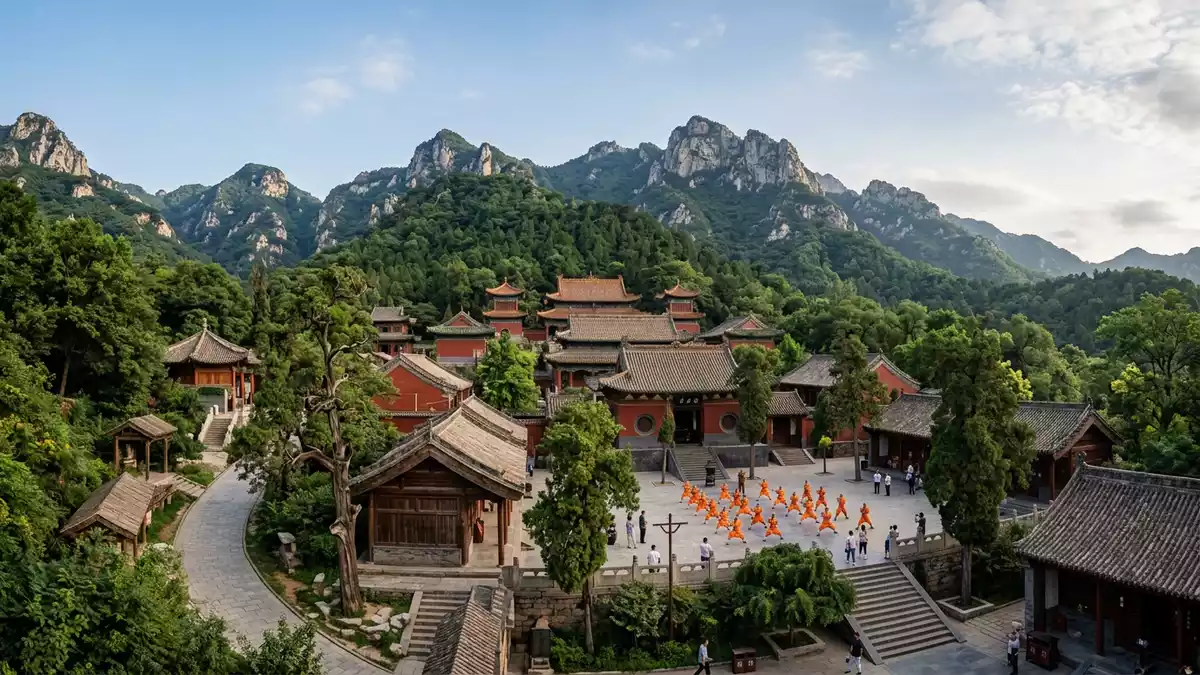
Shaolin Si in Dengfeng, China, is a Chan Buddhist monastery on the slopes of Mount Song that links sacred architecture with a long association with martial arts. Founded in 495 during the Northern Wei dynasty, it has grown into an extensive temple complex set against one of China’s historic sacred mountains.
Temple on a sacred mountain
Shaolin Si stands on the western side of Mount Song in Henan province, within the territory of Dengfeng City. The monastery is described as being established in 495 by Emperor Xiaowen of the Northern Wei dynasty, who ordered a Buddhist temple on the north side of Shaoshi, one of Mount Song’s peaks, to host the Indian monk Batuo.founded in 495 Batuo, also rendered Buddhabhadra, became the first abbot of the monastery and linked the temple with the transmission of Indian Buddhist teachings into northern China.Indian monk Batuo
Over the following centuries Shaolin Si became closely tied to Chinese Chan Buddhism, known elsewhere as Zen, and to a tradition of monastic martial arts that developed into what is often referred to as Shaolin kung fu.origin of Chan Buddhism The temple and its Pagoda Forest form part of the ensemble known as the Historic Monuments of Dengfeng in “The Centre of Heaven and Earth”, a group of sites inscribed on the UNESCO World Heritage List for their long-standing religious and cultural significance.Historic Monuments of Dengfeng
Axes, courtyards and main halls
Architecturally, Shaolin Si presents a classic Chinese Buddhist temple layout in which gates and halls are aligned along a strong north–south axis. From the main entrance, visitors pass through successive gateways into courtyards framed by side buildings, with the most important halls lying on the central line that runs slightly uphill towards the rear of the complex.central axis design The overall composition emphasises symmetry, with paired structures flanking the main route and trees marking the transitions between one courtyard and the next.
Many of the buildings visible today date from the Ming and Qing dynasties, reflecting a long history of rebuilding after fires and conflicts.Ming and Qing era structures Typical halls in the complex include the main Buddha hall, side shrines and spaces associated with monastic life, all constructed in timber with tiled roofs and painted detailing in traditional colours. Stone platforms, stairways and balustrades structure the movement between levels, while incense burners and carved steles stand as markers of religious practice and commemoration.
Pagoda Forest and martial arts heritage
To the west of the main temple complex lies the Pagoda Forest, a concentration of stone and brick pagodas that serves as a burial and memorial ground for generations of abbots and eminent monks.Pagoda Forest near the monastery The pagodas vary in height and form but share a tiered structure and carved inscriptions, creating a dense landscape of religious monuments that spans more than a millennium of history.forest of stone pagodas Walking among them reveals differences in style between dynasties, from relatively simple early towers to more elaborate later examples with rich decorative detail.
Shaolin Si is also associated with monastic martial training and performance, a cultural strand that has made the name Shaolin familiar far beyond Henan. Historical accounts connect figures such as Bodhidharma with the development of physical practices at the monastery, and later narratives link the temple with armed monks active in certain periods of Chinese history.monastery of kung fu and Chan For visitors, this heritage is reflected in the presence of martial arts schools in the wider area, demonstrations of choreographed routines and the strong visual association between the temple and kung fu in films and popular culture.
Visiting Shaolin Si: what travellers from Western Europe should know
- Shaolin Si lies in Dengfeng in Henan province, on the slopes of Mount Song, and is reached by road links from larger regional cities such as Zhengzhou and Luoyang.
- Within the temple complex, approaching the main halls involves walking through successive courtyards and climbing stone stairways, with uneven paving in places.
- The Pagoda Forest stands outside the central axis of halls and consists of numerous stone and brick pagodas set among trees, with footpaths running between them.
- The official language at Shaolin Si is Chinese and the currency is the yuan.
- Entry requirements depend on your nationality; UK travellers can check the FCDO travel advice at gov.uk/foreign-travel-advice, Irish travellers the Department of Foreign Affairs at ireland.ie.
Searching for Shaolin Si on social platforms
These links open searches for Shaolin Si on each platform.
Frequently asked questions about Shaolin Si
Where is Shaolin Si located?
Shaolin Si is in Dengfeng in Henan province in China, on the slopes of Mount Song within the wider area recognised as the Historic Monuments of Dengfeng.
What can visitors expect on a visit to Shaolin Si?
A visit centres on walking through the temple’s sequence of gates, courtyards and halls arranged along a central axis, and exploring nearby areas such as the Pagoda Forest.
What makes Shaolin Si distinctive among Chinese monasteries?
Shaolin Si is distinguished by its combination of Chan Buddhist temple architecture, its long martial arts heritage and the extensive landscape of memorial pagodas associated with the monastery.


