
Shaolin Si and the architecture of Mount Song
Published on 09/23/2026 at 03:42 | Editorial responsibility: Rafael Müller, Editor-in-Chief AD HOC NEWS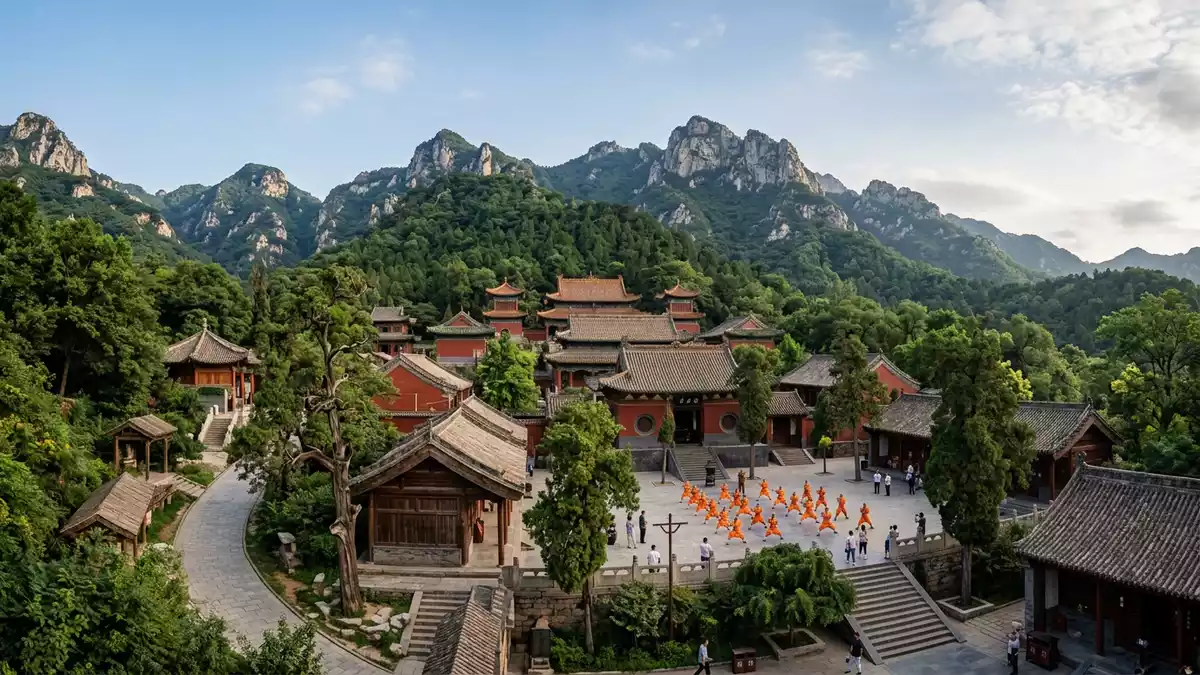
Shaolin Si stands on the southern slopes of Mount Song near Dengfeng in Henan, China. Its halls, courtyards and pagodas form a Buddhist landscape closely associated with Chan practice and Shaolin martial arts.
The monastery’s identity rests on the meeting of architecture, religion and mountain terrain. Founded in 495 during the Northern Wei dynasty, Shaolin Si remains part of the Historic Monuments of Dengfeng in “The Centre of Heaven and Earth”.
Shaolin Si on the slopes of Mount Song
Shaolin Si lies west of Dengfeng, near the foot of Mount Songshan. The surrounding mountain rises to about 1,500 m (4,921 ft), while the temple complex occupies a lower landscape of wooded slopes, stone paths and traditional buildings. Mount Songshan and Dengfeng belong to a wider heritage area extending across historic religious, educational and scientific sites.
The setting gives Shaolin Si a strong relationship with the mountain. The monastery stands on the north bank of the Shaoxi River, with the main compound arranged along a central axis. Gateways lead towards halls used for Buddhist worship, residence and monastic activity.
From Northern Wei foundation to Chan tradition
Emperor Xiaowen of the Northern Wei dynasty ordered the foundation of Shaolin Si in 495 for the Indian monk Batuo, also known as Buddhabhadra. This date places the monastery in the fifth century, when Buddhism was developing across northern China.
Bodhidharma is associated with Shaolin Si as a teacher linked to the early transmission of Chan Buddhism. The tradition connected with the monastery later became known outside China as Zen. The Northern Wei foundation forms the oldest firmly established layer of the temple’s history.
Shaolin Si also became associated with Buddhist monastic martial arts. Shaolin kung fu is now part of the monastery’s cultural identity, alongside meditation, scripture, ritual and the daily life of a Chan Buddhist institution.
Halls, inscriptions and the Pagoda Forest
Many visible buildings belong to the Ming and Qing dynasties, reflecting repeated rebuilding and extension across the monastery’s long history. Timber halls, tiled roofs, stone surfaces, carved details and inscribed tablets create an architectural ensemble rather than a single monument.
The historic complex includes the temple’s central compound, Chuzu Temple and the Pagoda Forest. The Pagoda Forest contains memorial stupas connected with monks and abbots. Their varied forms and sizes record different periods of Shaolin’s religious history.
Frescoes, tablet inscriptions and traditional halls connect the physical site with Buddhist learning and ritual. The buildings are arranged around courtyards, while service spaces and residential areas stand beside worship halls.
The Shaolin architectural complex forms part of the UNESCO property inscribed in 2010. The wider designation includes historic monuments around Dengfeng, including temples, gates, an academy and an observatory.
Visiting Shaolin Si: what travellers from Western Europe should know
- Shaolin Si lies west of Dengfeng at the foot of Mount Song in Henan. Dengfeng is the nearest named city, and the site is reached by road from the city and surrounding Henan transport networks.
- The monastery occupies a mountain setting with stone courtyards, steps and sloping paths. The Pagoda Forest and temple buildings are spread across separate parts of the historic complex.
- The official language is Mandarin Chinese and the currency is the Chinese yuan.
- Entry requirements depend on your nationality; UK travellers can check the FCDO travel advice at gov.uk/foreign-travel-advice, Irish travellers the Department of Foreign Affairs at ireland.ie.
Searching for Shaolin Si on social platforms
These links open searches for Shaolin Si on each platform.
Frequently asked questions about Shaolin Si
Where is Shaolin Si?
Shaolin Si is west of Dengfeng in Henan, China, on the southern side of Mount Songshan. It lies within the wider Historic Monuments of Dengfeng heritage property.
What can visitors expect at the monastery?
The complex contains Buddhist halls, courtyards, inscriptions, residential buildings, Chuzu Temple and the Pagoda Forest. The mountain setting forms part of the site’s physical character.
What makes Shaolin Si distinctive?
Shaolin Si brings together a fifth-century Buddhist foundation, Chan tradition, Shaolin kung fu and a historic architectural complex on Mount Song.


