
Shahi Qila in Lahore, a Mughal citadel of palaces and picture walls
Published on 09/16/2026 at 11:36 | Editorial responsibility: Rafael Müller, Editor-in-Chief AD HOC NEWS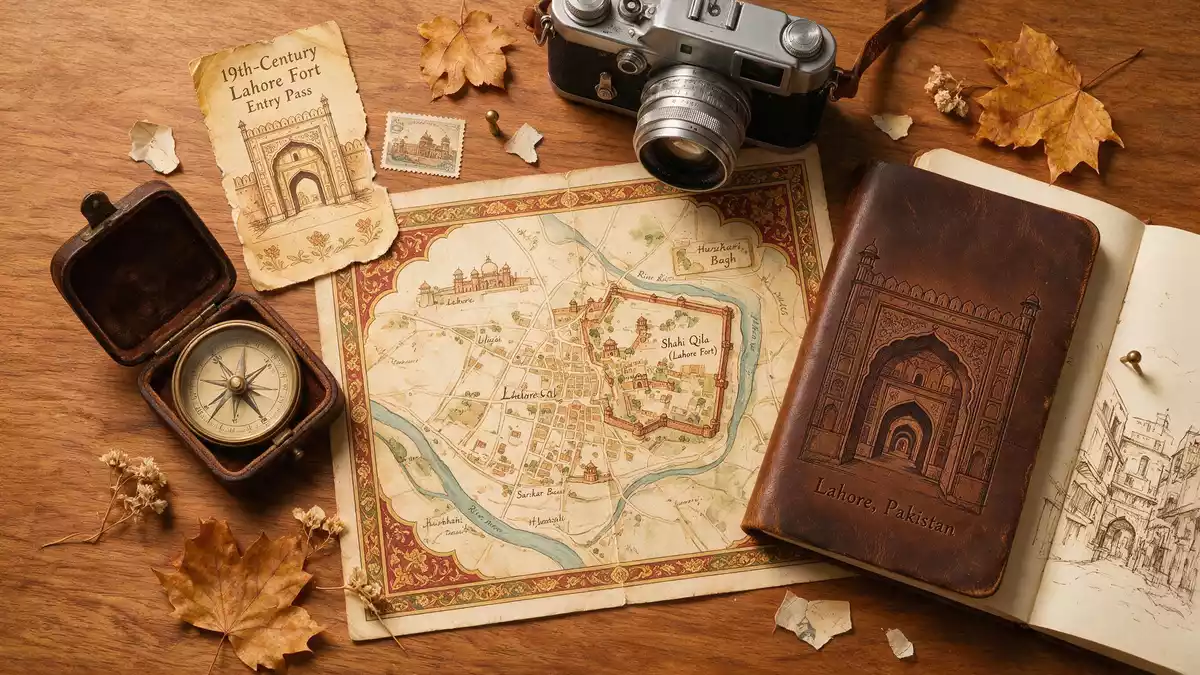
Shahi Qila in Lahore is a sprawling Mughal citadel where fortified walls enclose palaces, mosques, gardens and courtyards laid out across more than 20 hectares (49 acres) at the northern edge of the old walled city.more than 20 hectares Rising above the surrounding streets, it shows how the Mughal emperors turned Lahore into an imperial seat in the late sixteenth and seventeenth centuries.
Mughal power expressed in brick, sandstone and marble
The recorded story of Shahi Qila reaches back into medieval invasions, but the fortress in its present form took shape under the Mughal emperor Akbar in the 1560s.present form began to take shape during the reign of Emperor Akbar Akbar rebuilt earlier mud fortifications in burnt brick masonry, enlarged the complex and introduced red sandstone and structural beams that gave the fort durable substance as well as ceremonial scale.rebuilt the Fort in burnt brick masonry
His successors continued to layer architecture onto the plateau. Jahangir, ruling from 1605 to 1627, added residential buildings such as the Daulat Khana and his quadrangle, creating more intimate palace spaces within the defences.Jahangir Quadrangle in 1618 A.D. Shah Jahan, renowned for the Taj Mahal, left a particularly delicate mark at Shahi Qila with the Shish Mahal (Mirror Palace), marble halls and finely carved chambers dating from the 1630s and 1640s.Shish Mahal and Diwan-e-Khas The great Alamgiri Gate, added by Aurangzeb in 1674, forms a monumental entrance on the western side and anchors the fortress against the open space that separates it from the Badshahi Mosque.Alamgiri Gate in 1674
Courtyards, picture walls and palatial interiors
Inside the outer walls, Shahi Qila divides into administrative areas for royal audiences and more private, palatial quarters.two distinct sections Large quadrangles organise space, each framed by arcades, chambers and pavilions. Some are associated with specific emperors, such as the Jahangir Quadrangle or spaces linked to Shah Jahan, and together they form a sequence of courts that move from public ceremony to more secluded life.
Among the most celebrated features are Shish Mahal, with its intricate mirror work and inlaid decoration, and the Picture Wall, an extended stretch of fortification lined with inset panels that carry images, floral motifs and tile work.marble mosques and palaces built by Mughal emperorsPicture Wall with inset image fields Elsewhere, marble surfaces are carved into delicate screens and arches, while painted ceilings and carved brackets reveal the craft traditions that flourished under Mughal patronage.
A UNESCO-listed fortress at the edge of the old city
Shahi Qila stands at the northern end of Lahore’s walled city, on a plateau that once bordered the course of the Ravi River, and faces directly towards the wide courtyard and domes of the Badshahi Mosque.northern part of Lahore's old walled cityUNESCO World Heritage site The trapezoidal complex measures about 1,400 ft by 1,115 ft and encloses a sequence of monuments, including Sheesh Mahal, Naulakha Pavilion, Moti Masjid and audience halls such as Diwan-e-Aam and Diwan-e-Khas.fort measures 1,400 feet long and 1,115 feet wide
In 1981 Shahi Qila, together with the Shalamar Gardens, was inscribed as “Fort and Shalamar Gardens in Lahore” on the UNESCO World Heritage List, recognising the ensemble’s Mughal architecture and urban planning.inscribed as a UNESCO World Heritage Site The fort also houses museums devoted to Mughal artefacts, arms and Sikh-period material, emphasising that the citadel has seen different rulers and styles while retaining its role as a symbol of authority at Lahore’s historic core.three museums inside the fort
Visiting Shahi Qila: what travellers from Western Europe should know
- Shahi Qila occupies the northern edge of Lahore’s old walled city, opposite the Badshahi Mosque and close to Hazuri Bagh, and is reached by road through the historic centre.opposite the Badshahi-Moschee and near the Hazuri-Garten
- Within the fort, movement between the main courts and terraces involves stairways, changes in level and stone paving, so visiting means spending time on foot across an extended historic site.
- The official language is Urdu and the currency is the Pakistani rupee.
- Entry requirements depend on your nationality; UK travellers can check the FCDO travel advice at gov.uk/foreign-travel-advice, Irish travellers the Department of Foreign Affairs at ireland.ie.
Searching for Shahi Qila on social platforms
These links open searches for Shahi Qila on each platform.Frequently asked questions about Shahi Qila
Where is Shahi Qila located in Lahore?
Shahi Qila occupies a plateau at the northern end of Lahore’s old walled city, opposite the Badshahi Mosque and near Hazuri Bagh.
What can visitors expect to see inside Shahi Qila?
Visitors encounter a fortified complex of quadrangles, palaces, mosques, pavilions, picture walls and museums laid out across an extensive historic site.
What makes Shahi Qila distinctive among Mughal sites?
The combination of large-scale fortifications, refined palatial interiors, extensive decorative walls and its UNESCO-listed pairing with the Shalamar Gardens gives Shahi Qila a distinctive character.


