
Shahi Qila and the red sandstone walls of Lahore
Published on 09/21/2026 at 08:54 | Editorial responsibility: Rafael Müller, Editor-in-Chief AD HOC NEWS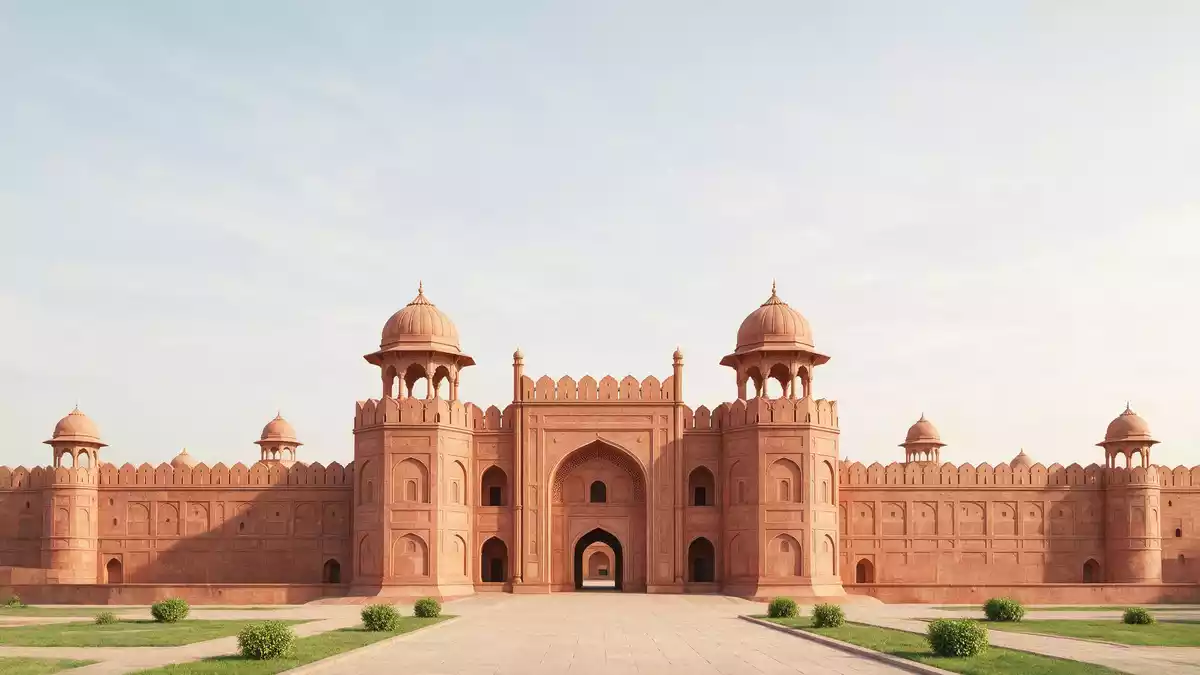
Shahi Qila in Lahore is the city’s great Mughal fortress, with red sandstone walls, marble pavilions and layered courtyards. The name means “Royal Fort”, and the site is tied to Akbar and the Mughal empire.
Akbar’s fortress in Lahore’s old city
The fort belongs to the world of Mughal Lahore, where imperial building made the city one of the main centres of power in the subcontinent. A major rebuilding under Akbar in the late sixteenth century gave the complex much of its present scale and character.
That phase matters because it anchors the place in the history of the Mughal empire, not as a ruin from a single age but as a layered citadel. Later Mughal rulers added palaces and audience halls, leaving a complex that reads as successive royal taste in stone and marble.
Akbar’s rebuilding and the fort’s Mughal phases remain central to its identity.
Courtyards, gateways and marble pavilions
The site combines defensive mass with courtly detail. Thick walls, gatehouses, courtyards and pavilions sit together, and the contrast between red sandstone and pale marble gives the fortress its visual rhythm.
Within the complex, the buildings are arranged as a sequence of spaces rather than a single hall. That layout includes audience spaces, garden courts and decorative structures, all of them part of the fort’s royal fabric.
Among its best-known elements are the Alamgiri Gate and the Shish Mahal, both linked to later Mughal patronage. Their presence shows how the citadel shifted from a military enclosure towards a palace landscape.
Alamgiri Gate and Shish Mahal are among the named parts most associated with the fort, though their exact sequence of construction belongs to different Mughal reigns.
A UNESCO-listed citadel beside the Walled City
Shahi Qila forms part of the historic urban fabric of Lahore’s Walled City. Its position gives the fortress a clear relation to the city around it, with the walls, gates and internal courts standing as a royal counterpart to the dense street pattern outside.
The fort was inscribed on the UNESCO World Heritage List in 1981 together with the Shalimar Gardens. That designation places it within the wider Mughal landscape of Lahore, where architecture, garden design and imperial display intersect.
The site is not a single building but a whole fortified complex with palaces, gateways, terraces and courts. Its scale, materials and surviving Mughal fabric make it one of the city’s most substantial historical presences.
UNESCO World Heritage List and the Walled City frame its place in Lahore’s historic centre.
Visiting Shahi Qila: what travellers from Western Europe should know
- The fort stands in Lahore, in Pakistan, beside the historic Walled City. It is reached through the city streets and the surrounding urban district.
- The complex is large and uneven underfoot, with courts, gateways and changes in level. Its scale is part of the experience, and the main buildings are spread across the enclosure.
- Shahi Qila is a fortified complex rather than a single monument. Visitors encounter red sandstone walls, marble details and a sequence of Mughal spaces.
- The site lies in a dense historic quarter, so the setting is urban rather than isolated. Nearby streets and monuments make it part of a wider heritage landscape.
Searching for Shahi Qila on social platforms
These links open searches for Shahi Qila on each platform.
Frequently asked questions about Shahi Qila
Where is Shahi Qila?
Shahi Qila stands in Lahore, Pakistan, beside the city’s Walled City. It is part of the historic core rather than a separate outlying monument.
What does a visit bring into view?
The complex presents a fortified enclosure with courts, gates, pavilions and marble details. The contrast between heavy defensive walls and refined palace spaces is immediate.
What makes Shahi Qila distinctive?
Its significance lies in the Mughal layers visible in one place, especially the rebuilding associated with Akbar and the later royal additions. The result is a citadel that combines military form and court architecture.


