
Shah-i-Zinda in Samarkand: a turquoise avenue of tombs
Published on 09/14/2026 at 20:32 | Editorial responsibility: Rafael Müller, Editor-in-Chief AD HOC NEWS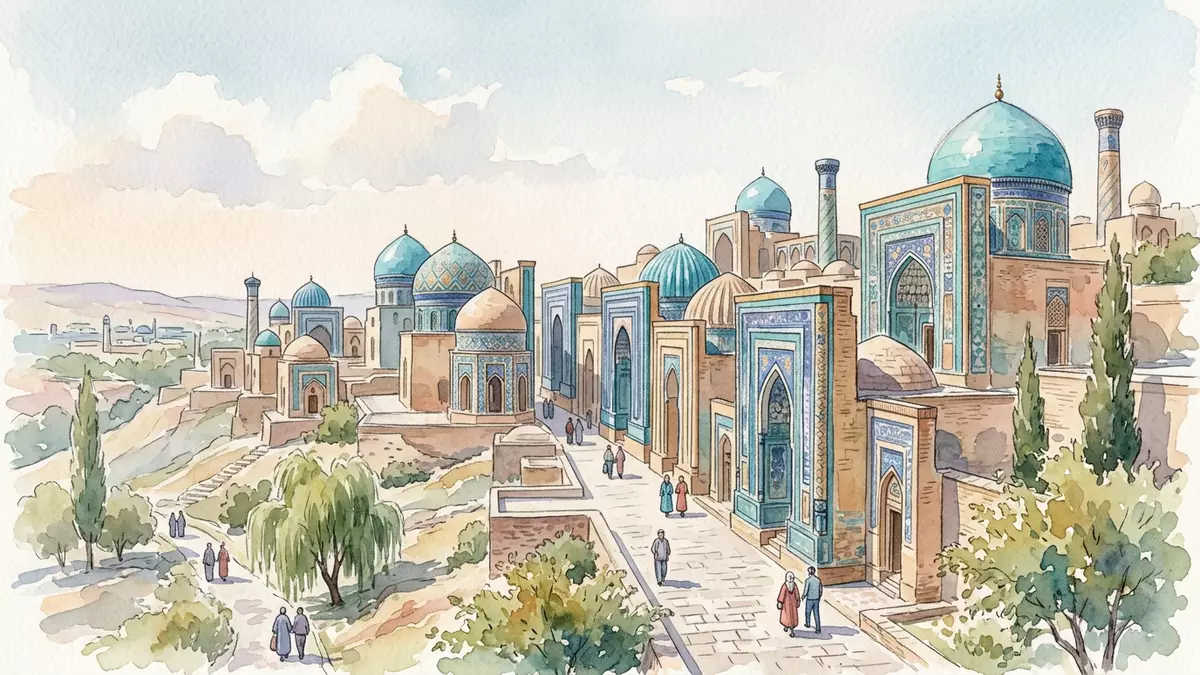
Shah-i-Zinda in Samarkand is a necropolis of mausoleums and prayer spaces climbing the southern slope of the ancient Afrasiab settlement in north-eastern Uzbekistan. Its name, meaning “The Living King”, is linked to the shrine of Qusam ibn Abbas, a cousin of the Prophet Muhammad whose grave forms the spiritual core of the ensemble and anchors centuries of building around it.
A stepped necropolis on the Afrasiab slope
Shah-i-Zinda occupies the south side of the Afrasiab hill, an archaeological rise that marks the site of ancient Samarkand before the Timurid period.the south side of the Afrasiyab hill The complex runs roughly along a north–south axis, with its buildings arranged on either side of a central corridor that steps up the slope. Visitors move through linked levels, passing from the lower group of structures up through middle and upper sections, each connected by arched, domed passageways locally known as chartaks.three main sections
From the corridor, tomb facades rise close together, creating a narrow avenue enclosed by masonry and tile. The necropolis itself is part of a wider cemetery that extends up and around the core buildings, with graves spread across the hillside outside the main architectural ensemble.a now sizeable cemetery The position on the slope offers views outward to the Zarafshan valley and distant peaks, while keeping the tombs themselves inward-facing and closely clustered along the stepped route.
Timurid architecture and a centuries-long building story
Architecturally, Shah-i-Zinda is known as a major ensemble of Timurid-period mausoleums, with construction concentrated in the fourteenth and fifteenth centuries under the Timurids.Timurid architecture Many of its patrons were members of the Timurid elite, including princesses and other nobles who placed their family tombs around the central shrine. Over twenty mausoleums and mosques from different periods remain above ground, forming a dense architectural record of medieval Samarkand.over twenty mausoleums
The building history reaches back earlier than the Timurid dynasty. The historical core of the necropolis is the mausoleum raised over the grave of Qusam ibn Abbas in the eleventh century, with Karakhanid-period structures and tombstones identified on the eastern slope.Karakhanid period Archaeological work indicates that around fifty buildings once formed the complex, although fewer have survived intact in the visible ensemble.about fifty such structures As it stands, Shah-i-Zinda shows a layered chronology from the eleventh to the nineteenth century, reflected in brickwork, tile colours and the forms of domes and portals.
Glazed tile, calligraphy and the shrine of “The Living King”
The facades at Shah-i-Zinda are covered in elaborate tilework that has long been noted as among the richest in the region.richest tilework Glazed ceramics in deep turquoise and blue are combined with white, ochre and other tones, forming geometric patterns, vegetal motifs and framed panels of Arabic calligraphy. Many mausoleums present high pishtaq portals – tall entrance frames – bordered in patterned tiles, leading into quieter interior rooms where decoration continues on walls, niches and the undersides of vaults.
Inside the complex, the shrine associated with Qusam ibn Abbas is set within a group of linked spaces that have been regarded as the holiest part of Shah-i-Zinda.grave of Qusam ibn Abbas The necropolis name, “The Living King”, reflects traditions surrounding this burial and its enduring religious significance. Pilgrimage to the site has been described in local sayings as equivalent to a journey to Mecca, underlining its role in Islamic practice in Central Asia.pilgrimage equals a hajj Beyond its religious function, the ensemble has been recognised in scholarship as a major chapter in the history of medieval architecture across the region.masterpiece of medieval architecture
Visiting Shah-i-Zinda: what travellers from Western Europe should know
- Shah-i-Zinda stands on the north-eastern edge of Samarkand, on Shohi Zinda Street near the Bibi-Khanym Mosque and the Afrasiab settlement, with the necropolis aligned along the slope above the old city wall.near Bibi-Khanym Mosque
- The central corridor rises by a series of stairways and terraces, so a visit involves climbing steps between the lower, middle and upper groups of buildings along the hillside.
- The official language is Uzbek and the currency is the Uzbekistani som.
- Samarkand is reached by road and rail connections within Uzbekistan, and Shah-i-Zinda lies within the urban area, accessible by local transport and taxis.
- Entry requirements depend on your nationality; UK travellers can check the FCDO travel advice at gov.uk/foreign-travel-advice, Irish travellers the Department of Foreign Affairs at ireland.ie.
Searching for Shah-i-Zinda on social platforms
These links open searches for Shah-i-Zinda on each platform.
Frequently asked questions about Shah-i-Zinda
Where is Shah-i-Zinda located?
Shah-i-Zinda is on the north-eastern side of Samarkand in Uzbekistan, on the slope of the Afrasiab hill near the Bibi-Khanym Mosque and the old city wall.
What should visitors expect on a visit?
Visitors encounter a stepped corridor lined with mausoleums and mosques, richly decorated in glazed tile and calligraphy, with stairways connecting lower, middle and upper zones of the necropolis.
What makes Shah-i-Zinda distinctive among Samarkand’s monuments?
Shah-i-Zinda combines a revered shrine of Qusam ibn Abbas with a dense group of Timurid-period tombs, creating an avenue of medieval architecture that climbs the Afrasiab slope in closely packed layers.


