
Shah-i-Zinda in Samarkand: a turquoise avenue of mausoleums
Published on 09/05/2026 at 10:59 | Editorial responsibility: Rafael Müller, Editor-in-Chief AD HOC NEWS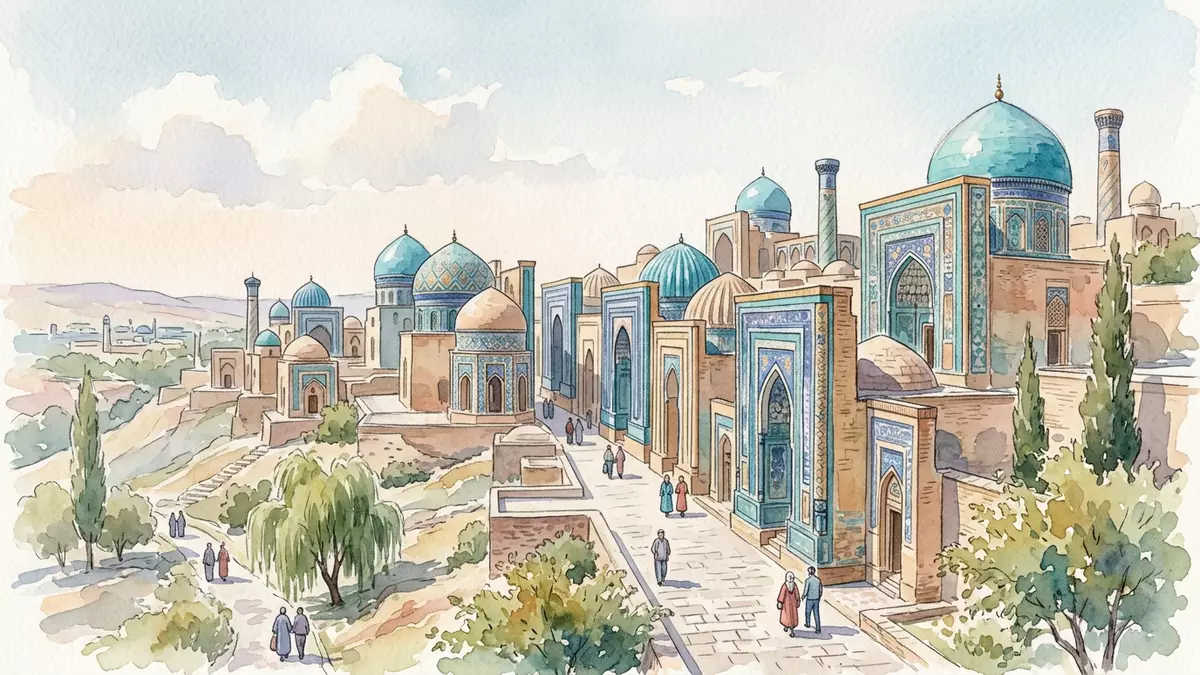
Shah-i-Zinda in Samarkand is a medieval necropolis where mausoleums line a steep ceremonial passage, creating an avenue of glazed tile and carved stone that compresses centuries of Central Asian history into a single walk. Rooted in the Islamic sacred landscape of Uzbekistan, it brings together burials of Karakhanid and Timurid elites around a shrine associated with Qusam ibn Abbas, linking political power, faith and craftsmanship in one compact ensemble.
The “Living King” on the Afrasiab slope
The name Shah-i-Zinda, meaning “Living King”, refers to the shrine connected with Qusam ibn Abbas, a cousin of the Prophet Muhammad whose burial site anchors the complex.Qusam ibn Abbas is associated with the arrival of Islam in this part of Central Asia in the seventh century, giving the necropolis a spiritual significance that predates most of its visible architecture.the grave of Qusam ibn-Abbas The ensemble stands on the slope of the ancient Samarkand settlement of Afrasiab, just north-east of the historic centre, where the older urban layers rise above the surrounding plain.Afrasiab slope
The necropolis forms part of the wider historic area of Samarkand that has been recognised as a World Heritage site, underlining its importance for the cultural history of Uzbekistan and the Silk Road region.Samarkand – Crossroad of Cultures Here, layers of building from the eleventh to fifteenth and nineteenth centuries cluster around the sacred core, creating a palimpsest of dynasties and decorative programmes in one tight architectural composition.11th to 15th and 19th centuries
An avenue of mausoleums and ritual buildings
Architecturally, Shah-i-Zinda is organised as a sequence of lower, middle and upper groups of buildings connected by arched, domed passageways known locally as chartaks, so that a visitor climbs through distinct tiers of the necropolis.three groups of structures More than twenty mausoleums, mosques and other religious structures stand along this route, forming what local descriptions call a “street cemetery”.street cemetery The corridor runs approximately north to south along the slope, with buildings flanking the passage and rising above one another in a dense cluster of domes and facades.long corridor of mausolea
Mausoleums from the Timurid period in the fourteenth and fifteenth centuries dominate the visible architecture, their tiled facades belonging to members of Tamerlane’s family and high-ranking officials.tombs of Tamerlane’s family Earlier burials from the eleventh century survive in rarer form, while nineteenth-century additions complete the ensemble.eleven mausoleums built in 14–15th centuries The necropolis thus records almost nine centuries of building activity under the Karakhanid dynasty and the Timurids, as rulers and nobles added new structures to the sacred street.founded by the Karakhanid dynasty
Turquoise tilework and Timurid craftsmanship
One of the most striking aspects of Shah-i-Zinda is the intense use of glazed ceramic tile in shades of blue and turquoise that covers many of the mausoleum facades, domes and arches.richest tilework in the Muslim world Timurid artisans worked with combinations of relief-carved terracotta, mosaic faience and painted tiles to produce dense patterns of geometry, calligraphy and stylised vegetal motifs, turning each facade into a carefully composed surface. Inside, some chambers retain painted plaster and delicate tile bands, though the exterior decoration remains the most visible expression of the complex’s craft traditions.turquoise necropolis
The mausoleums vary in size and plan, with single-chamber tombs, small mosques and linked structures set on different levels along the passage, yet the consistent use of blue glazing ties them together visually.bright inflorescence of blue domes Above the corridor, domes rise over square bases, while portals frame entrances with tall, recessed arches filled with tile and carved stone. The repeated rhythm of portal, dome and passage, together with the narrowness of the route, creates a concentrated architectural experience distinct from the broader spaces of other Samarkand monuments such as the Bibi-Khanym Mosque nearby.near Bibi-Khanym Mosque
Visiting Shah-i-Zinda: what travellers from Western Europe should know
- Shah-i-Zinda stands on the Afrasiab hill at the north-eastern edge of Samarkand, Uzbekistan, reached from the city by road and local bus routes serving the historic quarter.buses serving the complex
- The necropolis rises along a stepped ceremonial passage; visiting involves climbing a significant flight of stone steps and walking on inclined surfaces between tightly spaced buildings.climb up 40 steps
- Shah-i-Zinda lies close to other major monuments of Samarkand, including the Bibi-Khanym Mosque, making it part of a compact area of historic sites on and around the Afrasiab slope.located near Bibi-Khanym Mosque
- The official language is Uzbek and the currency is the Uzbekistani so?m.
- Entry requirements depend on your nationality; UK travellers can check the FCDO travel advice at gov.uk/foreign-travel-advice, Irish travellers the Department of Foreign Affairs at ireland.ie.
Searching for Shah-i-Zinda on social platforms
These links open searches for Shah-i-Zinda on each platform.
Frequently asked questions about Shah-i-Zinda
Where is Shah-i-Zinda and what kind of place is it?
Shah-i-Zinda is a necropolis on the Afrasiab hill in the north-eastern part of Samarkand, Uzbekistan, consisting of a concentration of mausoleums and ritual buildings.necropolis on the Afrasiab hill
What should visitors expect when walking through the complex?
Visitors follow a stepped passage divided into lower, middle and upper groups of buildings, passing closely spaced mausoleums decorated with blue glazed tile, carved stone and Timurid ornamental patterns.
What makes Shah-i-Zinda distinctive among Samarkand’s monuments?
Its combination of a venerated shrine for Qusam ibn Abbas, a long corridor of mausoleums from the Karakhanid and Timurid periods, and exceptionally rich blue-tiled facades on a compact slope distinguishes Shah-i-Zinda within Samarkand’s historic ensemble.


