
Shah-i-Zinda and the tiled avenues of Samarkand
Published on 08/27/2026 at 20:14 | Editorial responsibility: Rafael Müller, Editor-in-Chief AD HOC NEWS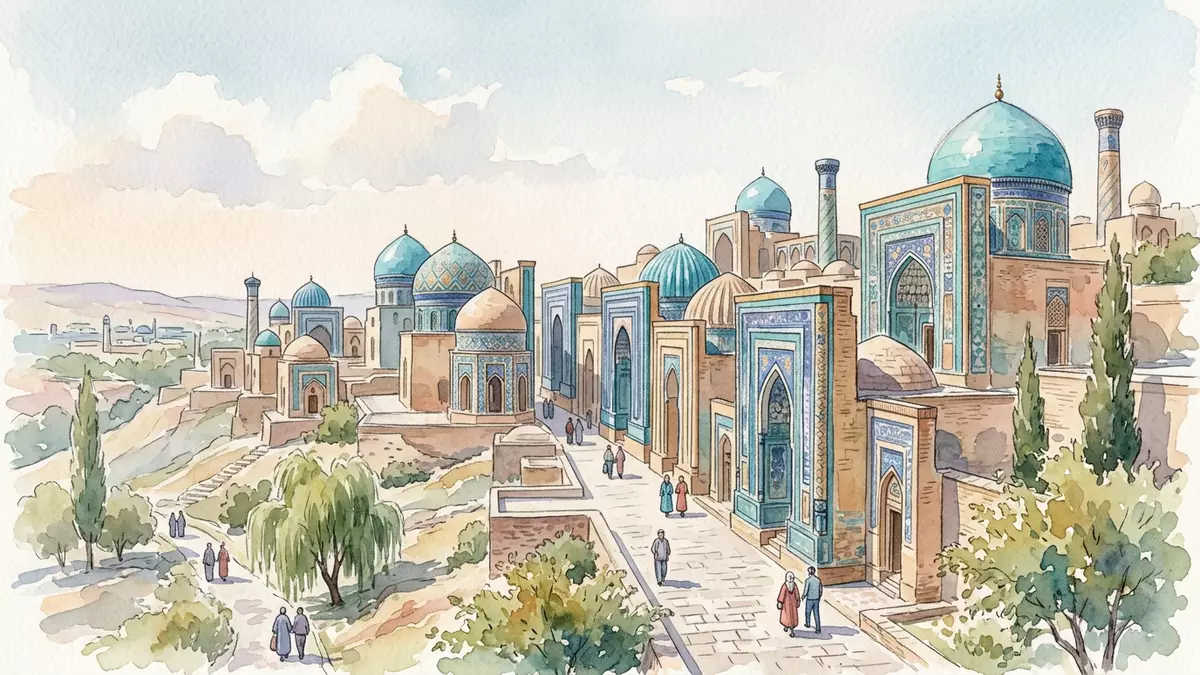
Shah-i-Zinda in Samarkand is a necropolis of mausoleums, ritual buildings and tiled passageways. Its name, linked to the figure of Qutham ibn Abbas, belongs to a place shaped across the eleventh to nineteenth centuries.
Tiled walls and clustered mausoleums
The ensemble is set in north-eastern Samarkand, within the historic town recognised by UNESCO as Samarkand – Crossroad of CulturesWorld Heritage site. It forms part of the city’s Timurid heritage, where the fourteenth and fifteenth centuries left the strongest mark on the surviving monuments.
Shah-i-Zinda is known for its concentrated sequence of mausoleums and decorated facadesShah-i-Zinda complex. Blue and turquoise tilework, carved surfaces and narrow links between buildings give the place a compressed, layered appearance.
Layers of Timurid Samarkand
The earliest buildings belong to the eleventh and twelfth centuries, while much of what survives dates from the fourteenth and fifteenth centuries. Later rebuilding in the sixteenth to nineteenth centuries did not alter the overall arrangement.
The compound is organised in lower, middle and upper groups connected by arched passages. That arrangement makes the sequence of tombs and portals easy to read as a historical series rather than a single monument.
Shah-i-Zinda also belongs to the wider sacred landscape of Samarkand, where the Gur-Emir ensemble, Bibi-Khanum Mosque and Registan form other major reference pointsSamarkand’s major monuments. Within that setting, Shah-i-Zinda is the most tightly packed of the great historic ensembles.
The legend of the Living King
The name Shah-i-Zinda means “the Living King” and is tied to the burial place of Qutham ibn Abbas, a cousin of Muhammad. That association gives the necropolis a strong religious identity alongside its architectural interest.
The site combines mausoleums, mosques and other ritual structures rather than a single funerary building. Its visual identity comes from repeated vaults, portals and surfaces covered in tile, with every part folded into a narrow urban hillside setting.
In the history of Samarkand, Shah-i-Zinda stands alongside the Timurid monuments that define the city’s most visible heritageTimurid-era ensemble. The result is a place where devotion and dynastic memory are expressed through dense architecture rather than monumentality alone.
Visiting Shah-i-Zinda: what travellers from Western Europe should know
- The necropolis lies in north-eastern Samarkand, within the historic city area. It is reached as part of the wider Samarkand monument zone rather than as a separate outlying site.
- The route through the ensemble includes steps, narrow passages and changes in level. The buildings are close together, and the sequence is best understood as a walking route through linked groups.
- The official language is Uzbek and the currency is the Uzbek so'm. Entry requirements depend on your nationality; UK travellers can check the FCDO travel advice at gov.uk/foreign-travel-advice, Irish travellers the Department of Foreign Affairs at ireland.ie.
- The site belongs to the UNESCO-listed historic fabric of Samarkand. Its setting links it to other major monuments, including the Registan and Gur-Emir.
Searching for Shah-i-Zinda on social platforms
These links open searches for Shah-i-Zinda on each platform.
Frequently asked questions about Shah-i-Zinda
Where is Shah-i-Zinda?
Shah-i-Zinda is in north-eastern Samarkand, Uzbekistan, within the historic city area. It belongs to the UNESCO-listed Samarkand heritage zone.
What should travellers expect?
Expect a compact necropolis of tiled mausoleums, narrow passages and steps. The buildings are close together and linked into a sequence of lower, middle and upper groups.
What makes it distinctive?
Its value lies in the combination of religious association, Timurid architecture and dense decorative tilework. The ensemble reads as a layered funerary street rather than a single isolated tomb.


