
Setenil de las Bodegas and its streets beneath the rock
Published on 09/22/2026 at 08:57 | Editorial responsibility: Rafael Müller, Editor-in-Chief AD HOC NEWS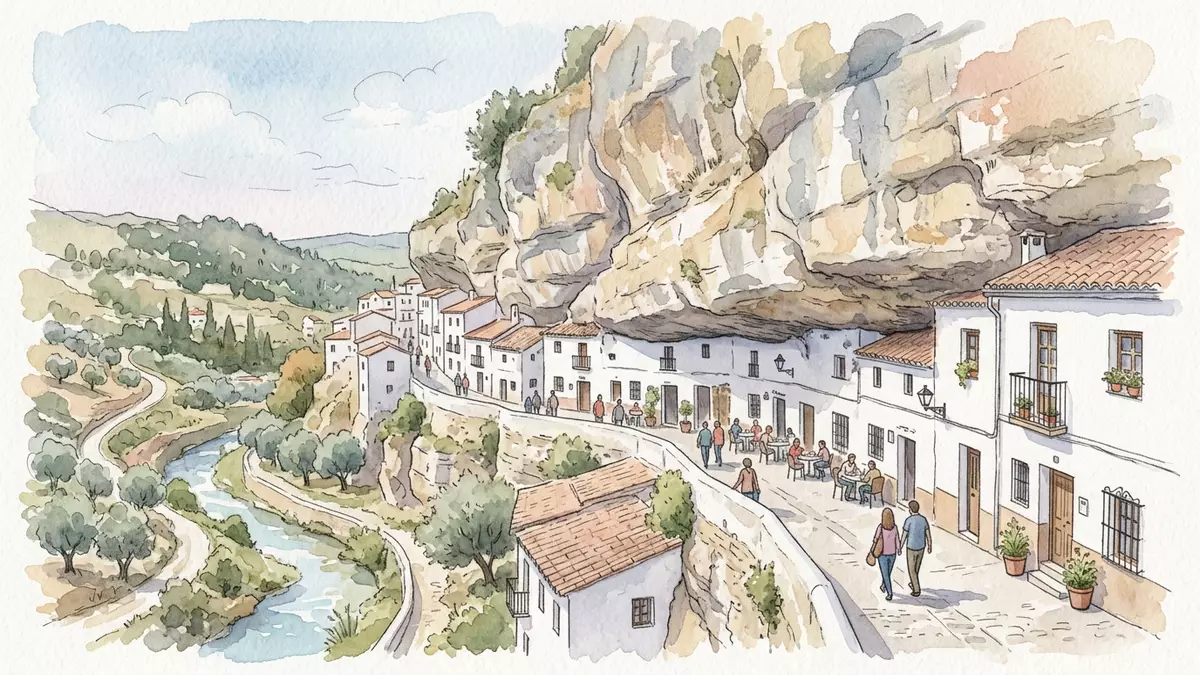
Setenil de las Bodegas is an Andalusian town where whitewashed houses sit beneath broad rock overhangs. In the lower streets, the stone ceiling belongs to the landscape, while the façades, doors and balconies belong to an inhabited town.
Setenil de las Bodegas beneath the Guadalporcún gorge
The town lies in the province of Cádiz, in the gorge of the Guadalporcún River. Its streets follow the river and the folds of the rock, creating a settlement arranged across several levels.
The two best-known streets are Calle Cuevas del Sol and Calle Cuevas de la Sombra. Both run beside the river, with white façades pressed against the rock. In Cuevas del Sol, the street opens towards the southern side of the gorge. In Cuevas de la Sombra, a substantial overhang covers the route and the buildings beneath it.
Setenil belongs to the route of the White Villages of Cádiz. Its architecture differs from the simple image of a whitewashed hill town because natural rock forms roofs and walls above parts of the urban fabric. The town’s tourism site describes the cave streets as places where living stone, homes and public routes meet the cave streets.
Cuevas del Sol and Cuevas de la Sombra
The names of the two streets provide a simple map of Setenil’s lower quarter. Cuevas del Sol faces the brighter side of the gorge, while Cuevas de la Sombra runs beneath a rock roof. Their relationship is visible from the river crossings and adjoining lanes.
The houses are not simply rooms hollowed from a cliff. Many are built lengthwise beneath the overhang, with ordinary fronts opening onto narrow streets. The rock forms the upper and rear enclosure, while masonry, plaster and timber complete the inhabited spaces.
Jabonería, Cabrerizas, Calcetas and Herrería extend this architecture beyond the two celebrated cave streets. Their routes climb or turn with the river corridor, linking the lower settlement with the higher town. Calle Herrería includes a narrow passage beneath rock and a small plaque bearing the words “Bésame en este rincón”.
Local food is part of the street scene, particularly along the lower routes. Andalusian dishes associated with Setenil include migas, asparagus dishes, soups and cured meats. Olive oil, quince and traditional cakes also belong to the area’s culinary vocabulary.
From Neolithic traces to the Almohad fortress
Human presence in the caves around Setenil reaches back into prehistory. Archaeological material associated with the area includes a small prehistoric figurine known as the Lady of Setenil, displayed in the Casa de la Damita de Setenil.
The settlement gained strategic importance during the medieval period. An Almohad fortress occupied the high rock, with a keep and an underground cistern connected to the defensive complex. The surviving Torreón and the cistern mark the military history of the upper town.
Setenil was captured by the Catholic Monarchs on 21 September 1484. The Old Town Hall preserves a Mudejar coffered ceiling and a commemorative inscription connected with that conquest. The date remains part of the town’s architectural record.
The Church of Our Lady of the Incarnation reflects the centuries following the conquest. Its construction began at the turn of the sixteenth century and continued until 1614. Gothic, Mudejar and Renaissance features appear within the unfinished building, whose position above the lower streets links religious architecture with the older fortress landscape.
The Hermitage of San Sebastián occupies a high part of the settlement and belongs to the period following the Christian conquest. The Hermitage of Our Lady of Carmen dates from the eighteenth century and stands near the Cerrillo quarter. Together with the church, the tower and the cistern, these buildings create a route through Setenil’s religious and military history.
Visiting Setenil de las Bodegas: what travellers from Western Europe should know
- Setenil lies in Cádiz province, in southern Spain. Road travel connects the town with Ronda, the White Villages route and surrounding Andalusian settlements.
- The lower streets follow the Guadalporcún gorge. Upper routes rise towards the tower, churches and viewpoints, with stairs and sloping lanes between the levels.
- Cuevas del Sol and Cuevas de la Sombra are narrow urban streets beneath rock overhangs. Comfortable footwear suits their uneven surfaces and changes in gradient.
- The official language is Spanish and the currency is the euro.
Searching for Setenil de las Bodegas on social platforms
These links open searches for Setenil de las Bodegas on each platform.
Frequently asked questions about Setenil de las Bodegas
Where is Setenil de las Bodegas?
Setenil de las Bodegas is in Cádiz province, Andalusia, in the gorge of the Guadalporcún River. It belongs to the route of the White Villages of Cádiz.
What can travellers expect to see?
The lower town contains streets beneath rock overhangs, including Cuevas del Sol and Cuevas de la Sombra. Higher routes lead towards the Almohad tower, churches, viewpoints and historic civic buildings.
What makes Setenil distinctive?
Natural rock forms roofs above inhabited streets and houses. The combination of whitewashed façades, river-side lanes and overhanging stone gives Setenil its characteristic urban form.


