
Serengeti National Park and the sweep of savannah
Published on 08/31/2026 at 17:15 | Editorial responsibility: Rafael Müller, Editor-in-Chief AD HOC NEWS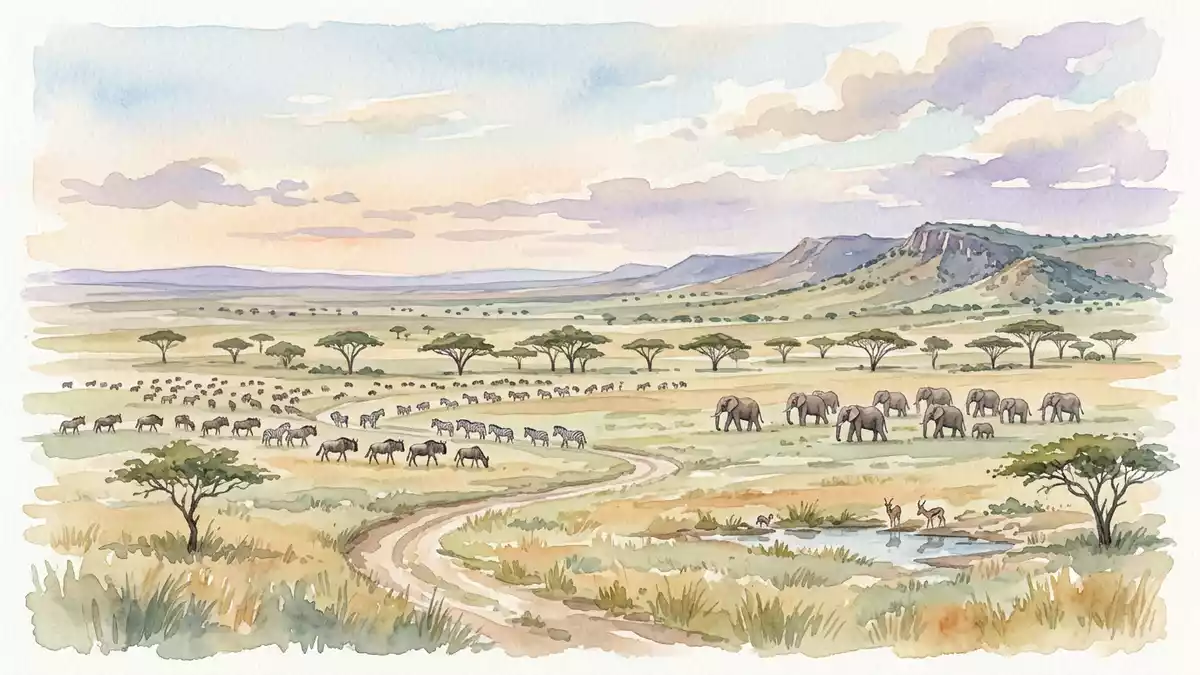
Serengeti National Park is a broad tract of savannah in northern Tanzania, established in 1951 and listed as a UNESCO World Heritage Site in 1981. Its scale and open grassland give Serengeti its most immediate character, with acacia woodland and river corridors adding variety.
Serengeti plains and woodland edges
The park covers 14,763 square kilometres and lies on the Serengeti Plain in north-central Tanzania. It sits partly beside the Kenya border and northwest of Ngorongoro Conservation Area, placing it within a wider cross-border landscape.
14,763 square kilometres is the figure most often attached to the park itself, while the wider Serengeti landscape extends well beyond it. The contrast between open plains and woodland gives the park its layered appearance, especially where river systems cut across the grassland.
1951, 1981, and the park’s formal identity
Serengeti National Park took its present form in 1951, with its status later reinforced by UNESCO inscription in 1981. The park’s formal identity rests on that combination of date, place and protected status.
1951 marks the year the park was created, and 1981 marks the year of World Heritage listing. Those two dates frame the park’s modern identity more clearly than any anecdotal description could.
The great migration across open ground
The best-known feature of Serengeti National Park is the annual movement of wildebeest, zebras and gazelles across the plains. The park’s open ground, rivers and woodland make that movement part of its lasting character.
The UNESCO description links the Serengeti plains with an annual migration of vast herds in search of pasture and water. The Serengeti plains form the setting for that migration, while plains animals such as wildebeest, gazelles and zebras define much of the park’s public image.
Visiting Serengeti National Park: what travellers from Western Europe should know
- The park lies in northern Tanzania, near the Kenya border and northwest of Ngorongoro Conservation Area. Road routes from the south are common, and the wider region also uses airstrips linked to safari circuits.
- The ground is mostly open savannah, with woodland and river corridors in several areas. Distances inside the park are large, and travellers move between habitats rather than between compact monuments.
- The Serengeti is tied to a transboundary ecosystem that reaches into Kenya. That means the park belongs to a broader wildlife landscape, not an isolated reserve.
- The official language is Swahili and the currency is the Tanzanian shilling.
Searching for Serengeti National Park on social platforms
These links open searches for Serengeti National Park on each platform.
Frequently asked questions about Serengeti National Park
Where is Serengeti National Park?
Serengeti National Park lies in northern Tanzania, on the Serengeti Plain and close to the Kenya border. It sits northwest of Ngorongoro Conservation Area.
What defines a visit there?
Expect a large savannah landscape broken by woodland, rivers and broad open ground. The park is closely associated with long wildlife movements across that terrain.
What makes Serengeti National Park distinctive?
Its defining features are the 1951 park creation, the 1981 World Heritage status and the annual migration across the plains. Serengeti is also identified with the wide grassland landscape itself.


