
Serengeti National Park and the open plain
Published on 09/16/2026 at 11:46 | Editorial responsibility: Rafael Müller, Editor-in-Chief AD HOC NEWS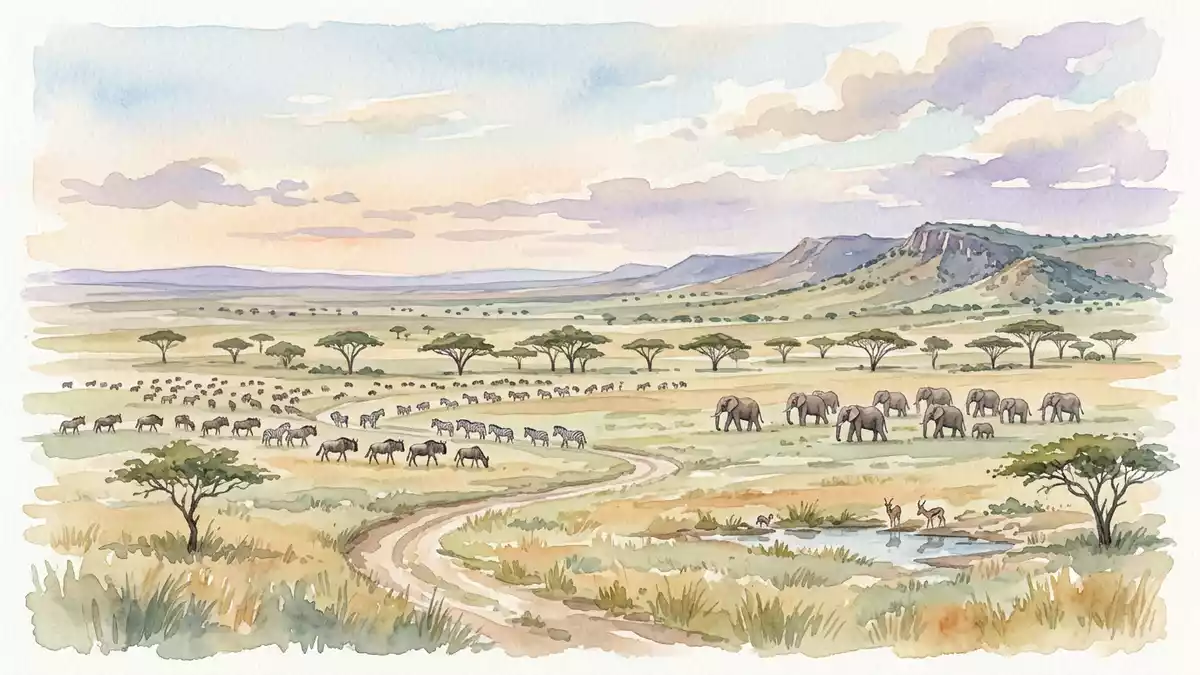
Serengeti National Park is a national park in northern Tanzania, centred on the Serengeti Plain and known for its broad grasslands and acacia woodland. It was established in 1951 and later listed as a UNESCO World Heritage Site.
Serengeti’s grassland horizon
The park extends across an immense open landscape that is not defined by a single monument or skyline. Instead, the eye moves between short grass, scattered trees and long lines of animal movement.
Its visible scale is part of its identity. The park covers 14,763 square kilometres, and the protected area holds savannah over a wide sweep of country.14,763 square kilometres The UNESCO page describes 1.5 million hectares of savannah within the Serengeti landscape.1.5 million hectares
1951 and the modern park
The park’s modern identity is tied to 1951, when it was established as a national park. That date sits alongside its later recognition as a World Heritage Site in 1981.
North-central Tanzania and the Kenya border frame the park’s position, while Lake Victoria lies to the west of the wider region.north-central Tanzania Britannica also places it on the Serengeti Plain and notes the surrounding grassland range and woodland savanna.Serengeti Plain
Wildlife, movement and open country
The park is closely associated with the great movement of wildebeest, gazelles and zebras across the plains. That movement is one of the most recognised features of the Serengeti landscape and its ecology.
The UNESCO listing highlights the annual migration of herds of herbivores, followed by predators, across the savannah. Britannica places the park among the main settings where vast land-animal migration still occurs in Africa.annual migration vast land-animal migrations
Visiting Serengeti National Park: what travellers from Western Europe should know
- The park lies in northern Tanzania, with access through the wider safari routes that run from the Arusha side and along the Kenya frontier.
- The terrain is open and extensive, with grassland, woodland and long sightlines across a large plain.
- Seronera lies near the centre of the park and serves as a named point within the protected area.
- The official language is Swahili and the currency is the Tanzanian shilling.
- Entry requirements depend on your nationality; UK travellers can check the FCDO travel advice at gov.uk/foreign-travel-advice, Irish travellers the Department of Foreign Affairs at ireland.ie.
Searching for Serengeti National Park on social platforms
These links open searches for Serengeti National Park on each platform.
Frequently asked questions about Serengeti National Park
Where is Serengeti National Park?
It lies in northern Tanzania, on the Serengeti Plain and close to the Kenya border. The wider landscape reaches towards Lake Victoria in the west.
What does a visit usually involve?
The park is a large open savannah landscape with grassland, woodland and long-distance wildlife viewing. Seronera is a named centre point within the park.
What makes Serengeti National Park distinctive?
Its combination of 1951 park status, World Heritage recognition and the seasonal movement of large herbivore herds gives it a clear identity. The open plain is the setting that ties those elements together.


