
Serengeti National Park and the great migration of the plains
Published on 09/18/2026 at 09:28 | Editorial responsibility: Rafael Müller, Editor-in-Chief AD HOC NEWS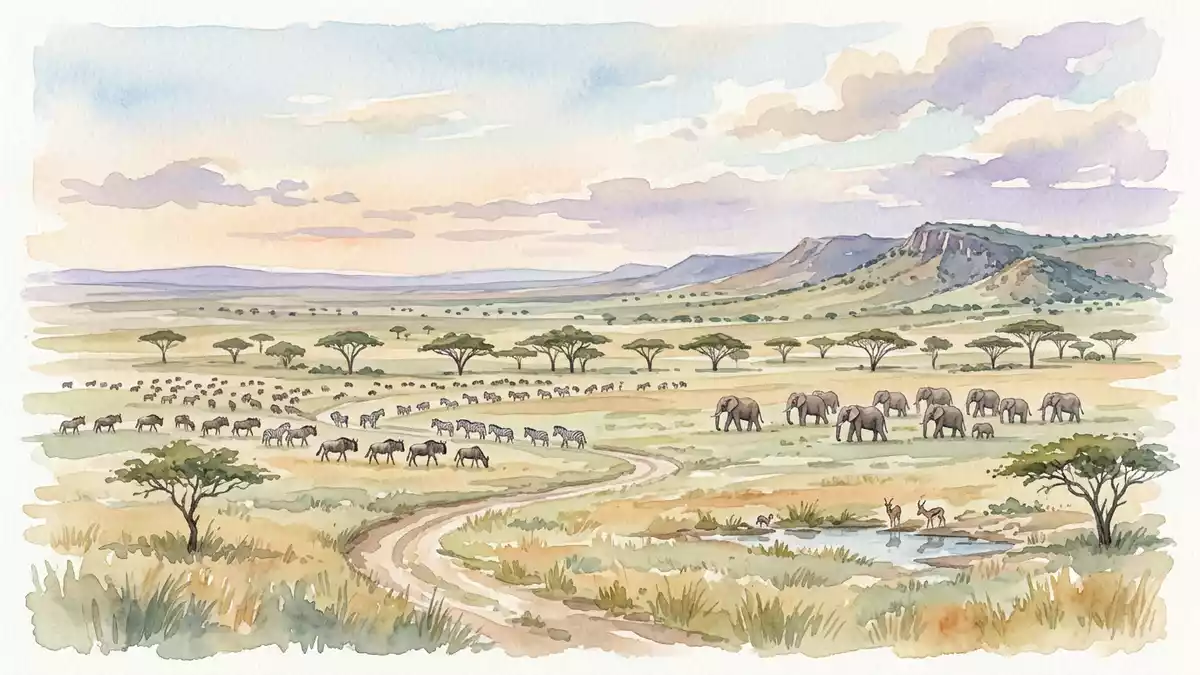
Serengeti National Park in northern Tanzania stretches across broad grassland plains where grazing herds and their predators move in vast seasonal cycles that have become one of Africa’s defining wildlife spectacles. Established as a national park in 1951 and later inscribed on the UNESCO World Heritage List in 1981, Serengeti links protected plains, woodlands and river valleys into one continuous landscape that still supports an immense land?animal migration.national park and wildlife refuge
Endless plains and a protected ecosystem
Serengeti National Park lies in north?central Tanzania, in the wider Serengeti region that borders Kenya and forms part of the Serengeti–Mara ecosystem spanning both countries.conservation area located in the Mara and Simiyu regions The protected area covers about 14,763 km² (5,700 sq mi) of ground, with elevations rising from roughly 920 m to 1,850 m (3,020–6,070 ft) above sea level across the plains and low hills.covers 5,700 square miles
The park’s name derives from the Maasai word “Siringet”, usually translated as “wide endless plains”, and that description fits the southern and central grassland areas where the horizon often runs unbroken except for scattered rock outcrops known as kopjes.meaning of Serengeti Within the wider ecosystem, which extends far beyond the park boundary, several protected areas together encompass roughly 30,000 km² of savannah, woodland and riverine habitat, with Serengeti National Park forming the core of this landscape.protected area encompasses about 30,000 square kilometers
The great migration across grassland and rivers
Serengeti is most closely associated with the annual migration of grazing ungulates that move in a broad circular route through Tanzania and Kenya in search of grass and water. Each year, very large herds of wildebeest, together with zebras and gazelles, follow a roughly 1,000 km (620 mi) path that crosses Serengeti National Park and the adjoining Maasai Mara across the border.1,000 km long annual circular trek The movement of these animals, tracked by predators such as lions, cheetahs and hyenas, is cited by UNESCO as one of the largest remaining unaltered animal migrations in the world.largest remaining unaltered animal migration
Different parts of Serengeti’s landscape show distinct faces of this migration. The short?grass plains to the south are closely associated with calving and the concentration of grazing herds, while the western corridor around the Grumeti River brings together riverine forest, open plains and river crossings used by the animals as they move on.three main eco-regions In the north, towards the Kenya border, open woodlands and hills lead into the Maasai Mara, and it is here that parts of the migration cross an international frontier between protected areas.
Habitats, wildlife and conservation status
Beyond the migrating herds, Serengeti National Park supports a wide range of habitats and resident wildlife. Broad grassland savannah, patches of acacia woodland, river valleys and wetlands combine to form an ecosystem that holds large predators including lions, leopards and cheetahs alongside herbivores such as giraffes, elephants and various antelope species.protected savannah, woodland, and river ecosystems The park also records hundreds of bird species, from vultures and eagles over the plains to smaller species in wetlands and woodland.
Serengeti was first protected as a game reserve in 1929, and its current national park status dates from 1951, making it the oldest national park in Tanzania.central Part of the park was declared a Game Reserve in 1929 In 1981 it was inscribed on the UNESCO World Heritage List for its outstanding natural values, and it also forms part of a biosphere reserve recognised under UNESCO’s Man and Biosphere Programme.inscribed on the World Heritage List These designations underline the park’s role in conserving large?scale ecological processes as well as individual species.
Visiting Serengeti National Park: what travellers from Western Europe should know
- Serengeti National Park lies in north?central Tanzania in the Serengeti region, west of the Ngorongoro Conservation Area and south of Kenya’s Maasai Mara, and is reached by road or light aircraft from hubs such as Arusha and Kilimanjaro International Airport.
- The ground in Serengeti consists of open savannah, rocky kopjes and seasonal rivers, so time in the park usually involves travel in safari vehicles on unpaved tracks rather than walking long distances.
- Within the wider Serengeti ecosystem, lodges and camps cluster around areas such as Seronera in central Serengeti, the western corridor and the northern sector near the border, each linked to airstrips used by small aircraft.
- The official language in Tanzania is Swahili, alongside extensive use of English, and the national currency is the Tanzanian shilling.
- Entry requirements depend on your nationality; UK travellers can check the FCDO travel advice at gov.uk/foreign-travel-advice, Irish travellers the Department of Foreign Affairs at ireland.ie.
Searching for Serengeti National Park on social platforms
These links open searches for Serengeti National Park on each platform.
Frequently asked questions about Serengeti National Park
Where is Serengeti National Park?
Serengeti National Park is in north?central Tanzania in the Serengeti region, west of the Ngorongoro Conservation Area and south of Kenya’s Maasai Mara.
What can visitors expect on a visit to Serengeti?
A visit centres on travelling through savannah and woodland in safari vehicles, watching grazing herds, predators and birds across different parts of the park’s plains and river valleys.
What makes Serengeti National Park distinctive among African parks?
Serengeti is distinctive for its broad grassland plains and the large?scale annual migration of wildebeest, zebras and gazelles that still moves across an unfenced ecosystem shared with Kenya.


