
Sequoia National Park’s giant trees and deep Sierra canyons
Published on 08/31/2026 at 14:35 | Editorial responsibility: Rafael Müller, Editor-in-Chief AD HOC NEWS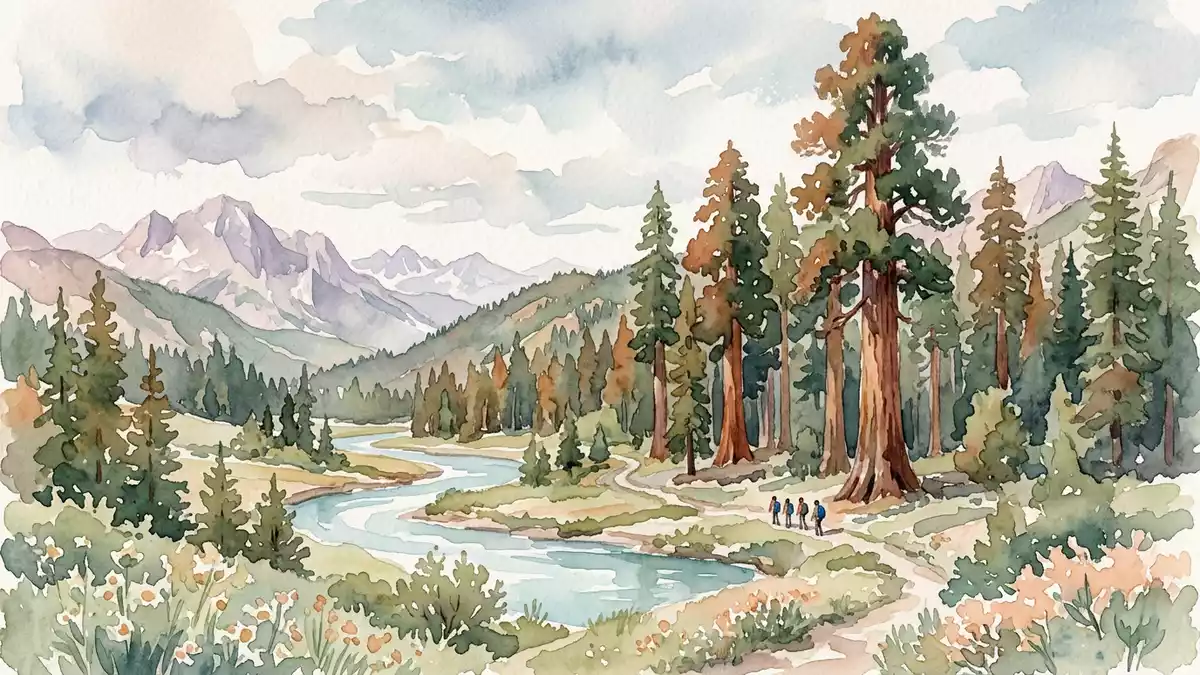
Sequoia National Park in the southern Sierra Nevada of California brings together giant sequoia forests and rugged mountain landscapes in one continuous protected area. Established on 25 September 1890, it was created to safeguard some of the largest trees on Earth and the high country around them, forming a national park that remains closely associated with the town of Three Rivers on its southern approaches.
Giant sequoias as living architecture
The giant sequoias of Sequoia National Park, including the General Sherman Tree in the Giant Forest, are central to the park’s identity as a landscape of living monuments. The General Sherman Tree stands about 83.8 m (275 ft) high and carries a massive trunk whose circumference at the ground has been measured at more than 31 m (around 102 ft), figures that underline why it is recorded as the largest single tree by volume anywhere.Statistics about the General Sherman Tree The tree’s estimated age in the range of 2,200 years places it among the oldest individual organisms documented in the park, alongside long?lived species such as western juniper and foxtail pine.Interesting facts about Sequoia National Park
Giant sequoias belong to the species Sequoiadendron giganteum and grow in groves on the mid?elevation slopes of the Sierra Nevada, where the Giant Forest forms one of the most accessible concentrations of mature trees. Their trunks rise almost without taper for considerable heights, turning each tree into a vertical wall of reddish?brown bark that dwarfs surrounding conifers. Around them, mixed conifer forest fills valleys and slopes, so that a walk among the sequoias alternates between dense woodland and clearings where individual trunks dominate open ground.
A park shaped by elevation and rivers
Sequoia National Park extends from foothill zones near Ash Mountain into high Alpine terrain, with elevations running from low river valleys to mountain summits above the tree line.Location and elevation details The southern entrance near Three Rivers stands at around 520 m (1,700 ft) and gives access to blue oak woodlands and chaparral in the California Foothills ecosystem, before the park road climbs towards cooler mixed forests and sequoia groves. Higher still, open granite, sub?alpine meadows and bare ridges appear, revealing how the protected area spans several ecological bands.
The headwaters of major rivers, including the Kaweah, Kern, Kings and San Joaquin, lie within Sequoia and neighbouring Kings Canyon National Park, making the park system an important source of Sierra water for the Central Valley.Quick fact sheet on Sequoia and Kings Canyon Canyons carved by these rivers cut deeply into the mountains, with steep walls and forested slopes shaping many of the views from roads and trails. In places, giant sequoias stand close to these descents, bringing the scale of the trees into direct contrast with the depth of surrounding valleys and the distant, differently coloured granite faces.
From nineteenth?century protection to a broader mountain park
Sequoia National Park was authorised on 25 September 1890, during the presidency of Benjamin Harrison, as the second national park in the United States after Yellowstone.Establishment documentation Early efforts focused on protecting giant sequoia groves from logging, including stands along the South Fork of the Kaweah River, and laid the basis for the park’s founding as a “pleasure ground” for the public.Notes on Sequoia National Park’s creation Later in the twentieth century, Sequoia and the adjacent Kings Canyon National Park came under joint administration, and in 1976 they were designated together as an International Biosphere Reserve, recognising the range of oak woodlands, chaparral, conifer forests and high?country environments preserved there.
The Giant Forest and other named groves are therefore part of a wider conservation area that includes wilderness zones, high passes and back?country basins. Trails lead from sequoia stands into upland regions where granite domes and ridges frame long views towards the Central Valley or deeper into the Sierra Nevada. In this way, the monumental trees that first drew attention to the region sit within a broader twentieth?century understanding of mountain landscapes, with protection extending beyond individual groves to entire river systems and elevational gradients.
Visiting Sequoia National Park: what travellers from Western Europe should know
- Sequoia National Park lies in Tulare County, in the southern Sierra Nevada of California, with road access from Three Rivers along Highway 198 and onward by the Generals Highway.
- The park includes foothill zones with considerable gradients and higher areas reached by mountain roads; walking routes in the sequoia groves involve maintained paths and stairways.
- Much of the protected area consists of high?elevation terrain, where weather can change quickly and parts of the landscape are exposed above the forest.
- The official language is English and the currency is the United States dollar.
- Entry requirements depend on your nationality; UK travellers can check the FCDO travel advice at gov.uk/foreign-travel-advice, Irish travellers the Department of Foreign Affairs at ireland.ie.
Searching for Sequoia National Park on social platforms
These links open searches for Sequoia National Park on each platform.
Frequently asked questions about Sequoia National Park
Where is Sequoia National Park located?
Sequoia National Park is in Tulare County in the southern Sierra Nevada of California, east of Visalia and reached from Three Rivers along Highway 198.
What should visitors expect on a visit?
Visitors encounter steep mountain terrain, mixed conifer forests, groves of giant sequoias such as the Giant Forest, and high?country views over deep river canyons.
What makes Sequoia National Park distinctive?
The park combines long?protected groves of enormous, ancient giant sequoias with extensive Sierra Nevada high?country, including the headwaters of several major California rivers.


