
Seoraksan Gungnip Gongwon: granite peaks above Sokcho
Published on 09/16/2026 at 14:33 | Editorial responsibility: Rafael Müller, Editor-in-Chief AD HOC NEWS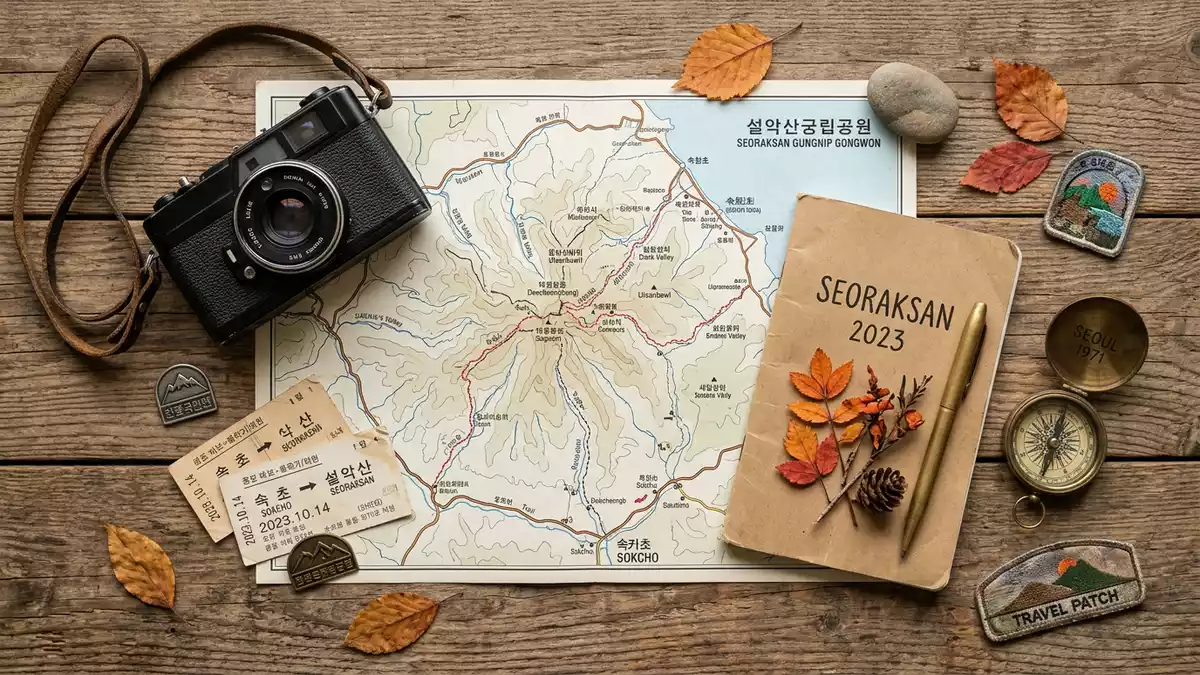
Seoraksan Gungnip Gongwon, known in English as Seoraksan National Park, stretches inland from Sokcho in north-eastern South Korea with jagged granite peaks rising above deep, forested valleys in the Taebaek mountain range. Designated as South Korea’s fifth national park in 1970 and recognised as part of the Mount Sorak biosphere reserve under UNESCO’s Man and the Biosphere Programme in 1982, it combines steep mountain terrain, mixed forests and river systems within a protected area where conservation and carefully managed access sit side by side.South Korea’s fifth national park Its highest summit, Daecheongbong, reaches 1,708 m (5,604 ft), giving Seoraksan a dominant presence along the east-central Korean peninsula and above the coastal plain around Sokcho.Daecheongbong peak at 1,708 m
Granite ridges, forested valleys and a divided mountain
The character of Seoraksan Gungnip Gongwon is shaped by its bedrock: the Taebaek range here consists largely of granite and gneiss, dissected into rocky hills, sheer faces and narrow crests.granite and gneiss landscapes Standing on the valley floor, the skyline forms a succession of sharp ridges and spires, with the bulk of Seoraksan rising behind them rather than as a single isolated cone. This relief creates a layered landscape in which steep slopes, cliffs and wooded ravines sit within sight of one another, giving the park many distinct viewpoints on the same massif.
Administratively and geographically, Seoraksan Gungnip Gongwon extends across several districts of Gangwon Province, including Sokcho, Goseong, Yangyang and Inje.spread across four districts The national park covers close to 400 km² (around 154 sq mi), making it one of the larger protected mountain areas in the country.approximately 400 square kilometres Within this area, the mountain is commonly described in three broad sectors: Inner Seorak in the higher western reaches around Inje, Outer Seorak on the eastern slopes above Sokcho and Goseong, and South Seorak towards Yangyang. Valleys cut into these sectors, carrying streams through boulder fields and along forested slopes, with trails following the watercourses or climbing towards saddles and ridges.
From Sokcho to Seorak-dong: the eastern gateway
Sokcho serves as the principal urban gateway to Seoraksan Gungnip Gongwon, sitting on the coast of the East Sea with road links inland towards the mountain.Sokcho as gateway city Express buses run from Seoul bus terminals to Sokcho, connecting the capital with Gangwon Province for travellers heading towards Seoraksan.express buses from Seoul to Sokcho From Sokcho, local buses link the city to the Seorak-dong area at the foot of the eastern slopes, where the main Seorakdong or Sogongwon entrance brings visitors into a valley backed by cliffs and ridges.
The eastern side around Seorak-dong concentrates many of the park’s most accessible paths, viewpoints and facilities. Arrival in this valley places visitors among mixed forests and rock formations, with walking paths radiating out towards temples, waterfalls, short viewpoints and longer mountain routes. Cable cars and mountain trails on this side rise towards higher points on the eastern ridges, giving views across the Taebaek range and down to the Sokcho plain, while lower circuits follow rivers that flow through wooded gorges and boulder-strewn channels.
Protected status and Mount Sorak biosphere reserve
Beyond its national designation, Seoraksan Gungnip Gongwon holds an important place in international conservation frameworks. Mount Sorak, the summit area at the core of the park, forms the centre of a biosphere reserve recognised under UNESCO’s Man and the Biosphere Programme.Mount Sorak biosphere reserve This reserve covers tens of thousands of hectares, with zoned areas that balance strict protection with buffer zones and spaces where traditional land uses continue under guidelines. Recognition reflects the coexistence of steep mountain terrain, mixed forests and river systems within a single, clearly defined landscape.
Within national frameworks, Seoraksan Gungnip Gongwon was designated as a nature preservation area in 1965 before receiving its full status as the fifth national park of South Korea in 1970.1965 preservation listing and 1970 park designation Internationally, the IUCN recognises Seoraksan as a category II protected area, confirming its role as a relatively large natural or near-natural area set aside for ecosystem protection and recreation.IUCN category II national park Together, these designations emphasise the importance of its forests, cliffs and river valleys, and they help sustain long-term protection for both rare species and the wider mountain environment.
Visiting Seoraksan Gungnip Gongwon: what travellers from Western Europe should know
- Seoraksan Gungnip Gongwon lies inland from Sokcho in Gangwon Province on South Korea’s east-central peninsula, with the Seorak-dong entrance reached by local buses from Sokcho’s bus terminals.
- The eastern gateway at Seorak-dong sits in a mountain valley backed by steep slopes and cliffs, and the approach within the park involves walking on uneven paths and stairways.
- The national park covers highland terrain rising above 1,700 m (5,577 ft), so weather and conditions can differ markedly from those on the coastal plain around Sokcho.
- Sokcho is reached mainly by intercity buses from major South Korean cities, and the onward connection to Seorak-dong is provided by local city bus routes.
- The official language is Korean and the currency is the South Korean won; entry requirements depend on your nationality, UK travellers can check the FCDO travel advice at gov.uk/foreign-travel-advice, Irish travellers the Department of Foreign Affairs at ireland.ie.
Searching for Seoraksan Gungnip Gongwon on social platforms
These links open searches for Seoraksan Gungnip Gongwon on each platform.
Frequently asked questions about Seoraksan Gungnip Gongwon
Where is Seoraksan Gungnip Gongwon and how is it related to Sokcho?
Seoraksan Gungnip Gongwon lies in Gangwon Province on South Korea’s east-central peninsula, inland from the coastal city of Sokcho, which functions as its main urban gateway.
What should visitors expect when entering the park at Seorak-dong?
The Seorak-dong side brings visitors into a mountain valley enclosed by cliffs and ridges, with forested slopes, rivers, walking paths and facilities clustered around the main entrance area.
What makes Seoraksan Gungnip Gongwon distinctive among South Korean mountain parks?
Its combination of jagged granite peaks, deep forested valleys and long-standing protection as both a national park and a UNESCO biosphere reserve gives Seoraksan a particularly layered and formally recognised mountain landscape.


