
Seoraksan Gungnip Gongwon, granite peaks above Sokcho
Published on 08/21/2026 at 19:03 | Editorial responsibility: Rafael Müller, Editor-in-Chief AD HOC NEWS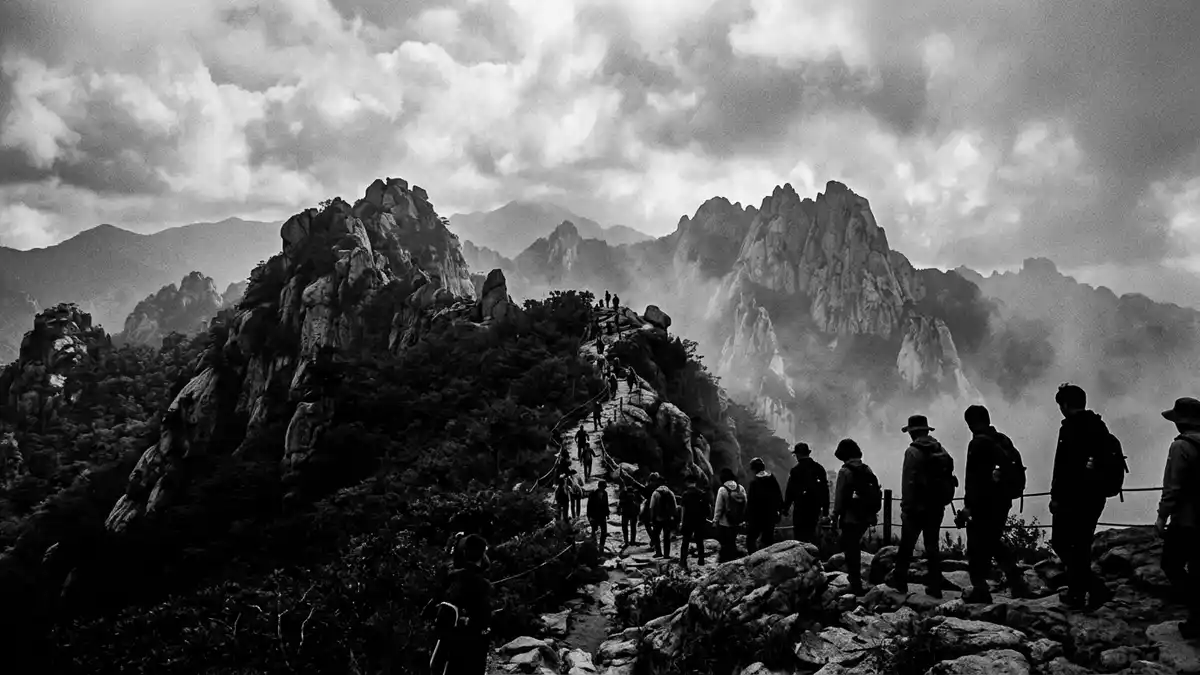
Seoraksan Gungnip Gongwon, known in English as Seoraksan National Park, spreads across the granite peaks and forested valleys of the Taebaek mountain range inland from Sokcho in north-eastern South Korea. Its centrepiece is Mount Seorak, crowned by the main summit Daecheongbong at around 1,708 m (5,604 ft), a height that makes it one of the country’s highest peaks and a defining anchor of the park’s skyline.Daecheongbong peak at 1,708 metres
Granite ridges, valleys and the Taebaek range
The core of Seoraksan Gungnip Gongwon lies in the Taebaek mountain range, a spine of rock that runs down the east-central Korean peninsula and here breaks into jagged ridges and steep-sided valleys. Mount Seorak itself rises as the highest massif in this part of the range, its flanks dissected into rocky spurs with names such as Dinosaur Ridge that hint at sharp silhouettes and exposed crests.Mount Seorak in the Taebaek mountain range
The wider park covers a substantial tract of Gangwon Province, extending inland across several administrative areas that include Sokcho and neighbouring counties, and enclosing a landscape of granite and gneiss slopes cut by rivers and streams.a national park in Gangwon Province High ground gives way abruptly to lower valleys, so that within a relatively compact area travellers encounter sheer rock faces, wooded hillsides and pockets of cultivated land where access roads reach the main park entrances.
A biosphere reserve of rock, forest and water
Beyond its status as a national park, Seoraksan Gungnip Gongwon holds a formally recognised position in international conservation as part of a UNESCO biosphere reserve centred on Mount Sorak.Mount Sorak biosphere reserve This designation reflects the combination of steep mountain terrain, mixed forests and river systems within a defined area of tens of thousands of hectares, set aside for both protection and carefully managed human activity. It also links the park to a wider network of sites where natural processes and local communities are studied together.
Within the park boundaries, travelling from Outer Seorak near Sokcho towards Inner and South Seorak leads through contrasting zones in which the relationship between rock outcrops, vegetation and watercourses shifts repeatedly.Inner, South and Outer Seorak Some sectors are dominated by craggy summits and exposed ridges, others by forested slopes where trails follow streams and cross small bridges. Seasonal changes add another layer of variation, influencing river levels and vegetation cover while leaving the underlying landforms unchanged.
Approaching the peaks from Sokcho
Sokcho is the closest city to Seoraksan Gungnip Gongwon and provides the main urban gateway to the park, with local buses running inland to the Seorak-dong entrance and its surrounding cluster of facilities.local buses from Sokcho to Seorak-dong Arrival here brings travellers into a valley backed by sheer cliffs and high ridges, where walking paths fan out towards viewpoints, temples, waterfalls and longer mountain trails. The combination of a sizeable city and a major protected area within such close reach is one of the park’s characteristic features.
A network of marked trails climbs from valley floors to higher lookouts and, for experienced hikers, to the summit of Daecheongbong itself. Approaches to the main peak involve sustained ascents on mountain paths that cross roots and rocks and may include flights of steps or sections of steeper gradient, reflecting the rugged nature of the terrain at altitude.Seoraksan hiking routes in a 400 km² area Lower-level routes stay closer to valley floors and offer shorter walks to viewpoints, riverbanks and cultural sites within the park.
Visiting Seoraksan Gungnip Gongwon: what travellers from Western Europe should know
- Seoraksan Gungnip Gongwon lies inland from Sokcho in Gangwon Province in the north-east of South Korea, reached by intercity and local buses that link the city with park entrances.
- Within the park, trails range from short valley walks to demanding mountain ascents, and routes to higher viewpoints and summits include long sections of steps, steep gradients and uneven rocky ground.
- The terrain combines forested slopes, exposed ridges and river valleys, so footwear and clothing need to cope with mountain paths, changing weather and significant elevation changes on longer hikes.
- The official language is Korean and the currency is the South Korean won.
- Entry requirements depend on your nationality; UK travellers can check the FCDO travel advice at gov.uk/foreign-travel-advice, Irish travellers the Department of Foreign Affairs at ireland.ie.
Searching for Seoraksan Gungnip Gongwon on social platforms
These links open searches for Seoraksan Gungnip Gongwon on each platform.
Frequently asked questions about Seoraksan Gungnip Gongwon
Where is Seoraksan Gungnip Gongwon located?
Seoraksan Gungnip Gongwon lies in Gangwon Province in north-eastern South Korea, in the Taebaek mountain range inland from the coastal city of Sokcho.
What should travellers expect on a visit?
A visit brings mountain scenery with granite ridges, forested valleys and river courses, with a choice of marked trails that range from short walks to demanding summit hikes.
What makes Seoraksan Gungnip Gongwon distinctive among South Korean parks?
Its combination of high peaks such as Daecheongbong, a large protected area recognised as a biosphere reserve and close access from Sokcho gives it a particular standing among South Korea’s national parks.


