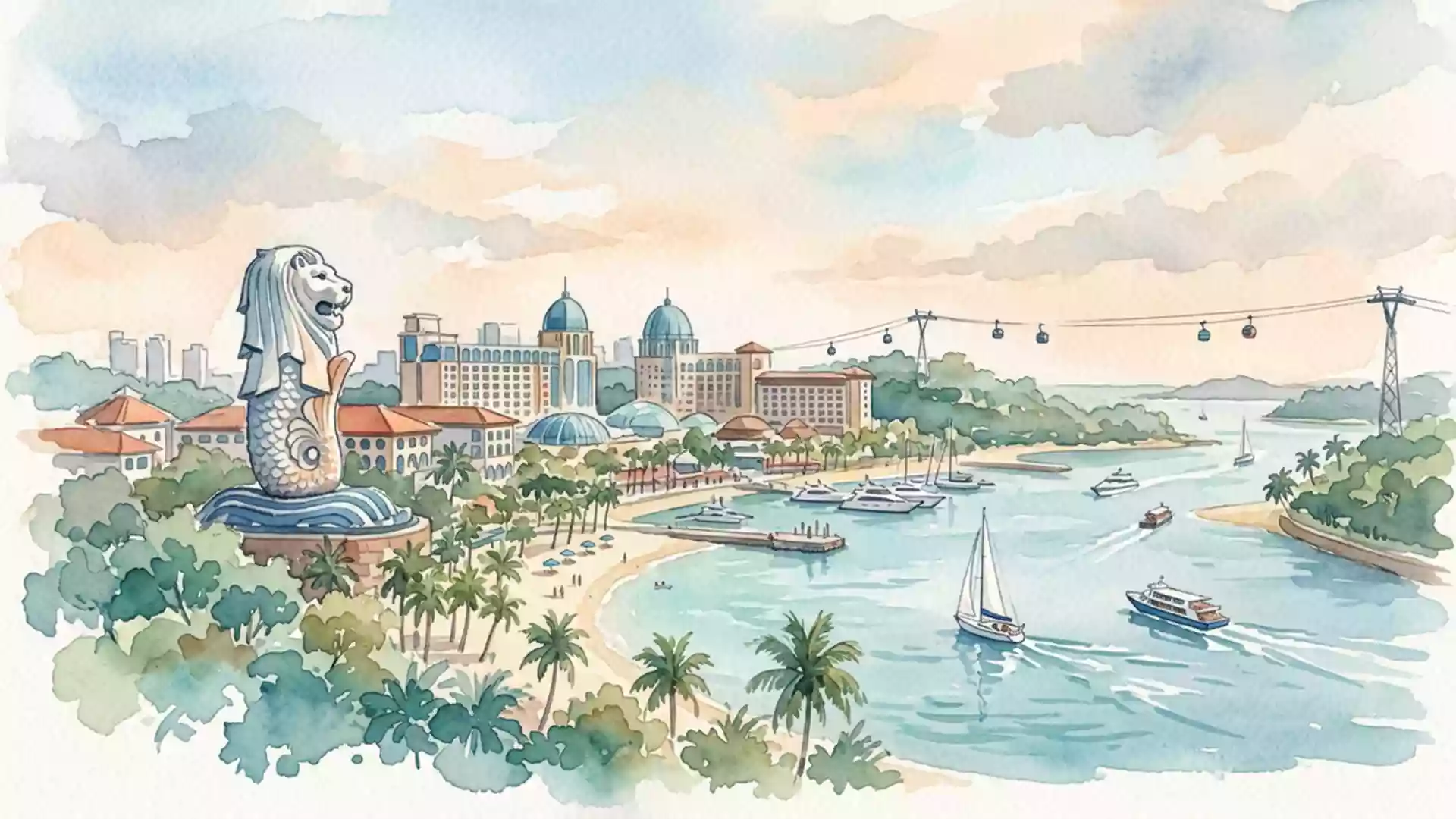
Sentosa’s layered island of forts, forests and beaches
Published on 08/28/2026 at 18:50 | Editorial responsibility: Rafael Müller, Editor-in-Chief AD HOC NEWS
Off the southern coast of Singapore lies Sentosa, an island where colonial forts, forested slopes and groomed beaches share the same compact terrain. Once known as Pulau Blakang Mati and used for military installations, it began a deliberate transformation into a leisure resort in the early 1970s, turning gun batteries and barracks into a backdrop for holiday escapes.
From Blakang Mati to leisure island
Sentosa sits just south of Singapore’s main island, separated by a short strait and facing the busy shipping lanes that lead to Keppel Harbour. Its position along these approaches made it strategically important under British rule, long before it was associated with beach clubs and family attractions.strategically important under British rule Early on, the island held a fishing village and later a network of artillery batteries and barracks, linked to coastal defence of the wider harbour approaches.
In the 1970s, Singapore’s government set out to redevelop Sentosa as a resort, formally establishing it as a leisure destination in 1972. That shift brought golf fairways, landscaped lagoons and themed attractions alongside its existing beaches.establishing it as a leisure destination in 1972 Over the following decades, new hotels and a broad mix of entertainment facilities arrived, yet remnants of older uses remain visible in the built fabric.
Fort Siloso and the ring of coastal defences
Sentosa’s western heights are crowned by Fort Siloso, one of several coastal forts constructed in the late nineteenth century to guard approaches to Singapore.constructed in the late nineteenth century Built on Mount Siloso, the fort originally carried muzzle-loading guns that were later replaced by breech-loading artillery, a sequence that reflected evolving naval technology. The gun emplacements, underground magazines and tunnel networks carved into the hillside are still part of the landscape, giving a clear impression of how this outer ring of defences once operated.
During the Second World War, Fort Siloso and neighbouring batteries on Blakang Mati were turned inland to face Japanese forces advancing from the north, and the coastal guns eventually fell silent as fixed artillery was phased out in the mid-twentieth century.turned inland to face Japanese forces Today, the preserved structures around Fort Siloso form a military museum and heritage site, with casemates, barracks and tunnels accessible to visitors. In 2022, the fort was gazetted as a National Monument, underscoring its role in the island’s story.gazetted as a National Monument in 2022
Forested hills, heritage trails and curated shores
Move away from the western headland and Sentosa’s interior rises into hills clothed in secondary forest, notably around Mount Imbiah. A nature trail on this hill runs for several kilometres through tropical vegetation, passing remnants of infrastructure such as former monorail tracks and bunkers amid the trees.nature trail on this hill The Sentosa Heritage Trail weaves together these upland paths with the coastal forts and converted barracks, offering a structured way to explore the island’s layered development and early attractions such as the Singapore Cable Car and other now-defunct facilities.Sentosa Heritage Trail
Along the shore, Sentosa presents beaches shaped into sheltered curves with imported sand and calm water, framed by palms and low-slung promenades. Behind them, resort hotels, themed entertainment complexes and attractions such as Universal Studios Singapore cluster around pedestrian plazas and transport nodes.Universal Studios Singapore cluster One part of the island, Sentosa Cove, has become a residential enclave with marinas and waterfront housing, illustrating yet another layer of its redevelopment from working island to mixed-use coastal district.Sentosa Cove residential enclave
Visiting Sentosa: what travellers from Western Europe should know
- Sentosa lies just off the southern coast of Singapore, reached from the city by road and by transport links such as the Singapore Cable Car and a dedicated light-rail line.
- Terrain on the island varies from level promenades along the beaches to steep slopes around Fort Siloso and Mount Imbiah, where stairways, elevated walks and forest paths climb the hills.
- Sentosa’s coastal forts, heritage trails and landscaped beaches sit close together, so moving between historic sites, forested interiors and resort areas involves short walks rather than long transfers.
- English is an official language in Singapore and the currency is the Singapore dollar.
Searching for Sentosa on social platforms
These links open searches for Sentosa on each platform.Frequently asked questions about Sentosa
Where is Sentosa in relation to Singapore?
Sentosa is an island just south of Singapore’s main island, across a short strait from the city and close to the approaches to Keppel Harbour.
What can visitors expect on a day around Sentosa?
Visitors encounter groomed beaches, resort hotels and themed entertainment alongside preserved military sites such as Fort Siloso and forest trails on hills like Mount Imbiah.
What makes Sentosa distinctive among Singapore’s coastal areas?
Sentosa combines nineteenth- and twentieth-century fortifications, heritage trails, residential waterfront districts and curated leisure beaches within a single compact island setting.