
Senso-ji: Tokyo’s oldest temple and gateway to Asakusa
Published on 09/14/2026 at 12:11 | Editorial responsibility: Rafael Müller, Editor-in-Chief AD HOC NEWS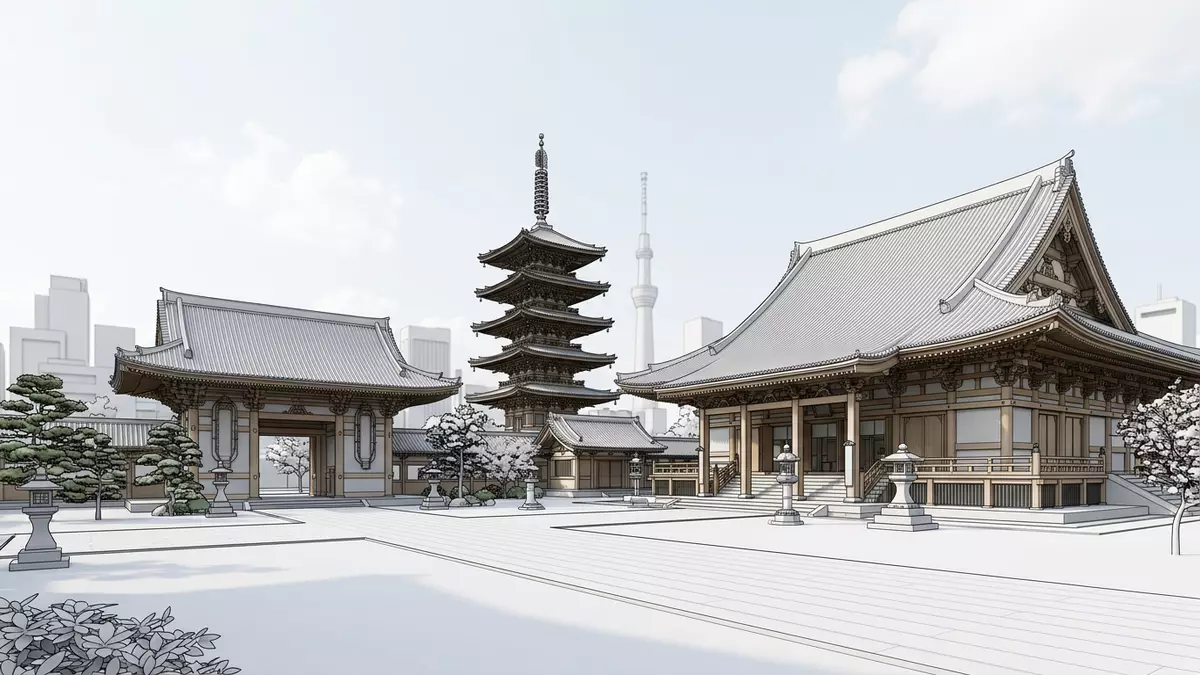
Senso-ji in Tokio is Tokyo’s oldest Buddhist temple, anchoring the historic Asakusa district with a sequence of gates, halls and streets that form a continuous ritual approach. The temple complex traces its foundation to the year 645, when a formal hall was established to enshrine Kannon, the bodhisattva of compassion, on a site of earlier devotion.
An ancient temple woven into Tokyo’s history
Senso-ji is a Buddhist temple in Asakusa, in the Taito ward of Tokyo, and is officially known as Kinryu-zan Senso-ji. It stands at 2-3-1 Asakusa, a location that has grown into a dense urban district clustered around the temple precincts.Buddhist temple in Asakusa The temple is dedicated to Kannon, also called Sho Kannon, and over time it has been known by the name Asakusa Kannon.
The origins of Senso-ji reach back to 628, when, according to long-standing tradition, two local fishermen drew a statue of Kannon from the Sumida River and brought it to the village chief, who remodelled his dwelling into a place of worship.legend of the Kannon statue In 645, the monk Shokai Shonin established a dedicated hall to enshrine the image, marking the formal foundation of the temple complex.formal establishment in 645 Through the Heian, Kamakura and Edo periods, figures such as Ennin, Taira no Kinmasa, Minamoto no Yoritomo and Tokugawa Ieyasu were associated with rebuilding, expanding and protecting the temple, embedding it deeply in Japanese religious and political history.historical patrons and periods
Gates, main hall and pagoda: a ceremonial axis
Approaching Senso-ji on foot, the most recognisable sequence runs through its outer and inner gates, past a long shopping street and into the temple courtyard. The outer gate, Kaminarimon, stands as the symbolic entrance to the temple’s approach, followed by the Nakamise-dori, a straight street lined with stalls leading towards the inner gate and main hall.Kaminarimon and Nakamise-dori Vendors here operate from permanent units rather than temporary stands, and the covered route creates a distinct threshold between the city beyond and the temple grounds.
Beyond the shopping street, visitors pass through Hozomon, the inner gate, into the open space that frames the main hall and the five-storey pagoda. The main hall, also known as the Kannon-do, houses the hidden image of Kannon, which is not ordinarily displayed.main hall and hidden image A large incense burner stands on the central axis between Hozomon and the hall, and a stone-paved forecourt accommodates worshippers and visitors moving towards the building. To one side rises the pagoda, whose multiple tiers and distinct rooflines give vertical emphasis to the complex and echo earlier wooden Buddhist architecture.five-storey pagoda
Reconstruction, urban fabric and everyday use
The buildings standing on the site now are the result of extensive reconstruction after the Second World War, when air raids in 1945 destroyed much of the temple complex.damage in 1945 Post-war rebuilding recreated key structures such as the main hall, Kaminarimon and the pagoda, restoring the overall layout while using durable modern materials. This combination of historical form and relatively recent construction gives Senso-ji a layered character: a place with origins in the seventh century, rebuilt in the twentieth century, yet aligned with its long-established plan.
The temple grounds are integrated into the surrounding streets of Asakusa, with smaller shrines, auxiliary halls and gardens distributed around the main axis. The Nishinomiya Inari shrine, entered through its own gate within the complex, marks one such secondary space.Nishinomiya Inari shrine Market areas, stone lanterns and planted zones give the precinct a variety of scales and textures, while the proximity of the Sumida River and the broader Asakusa district keeps the temple closely tied to the wider city.
Visiting Senso-ji: what travellers from Western Europe should know
- Senso-ji stands in Asakusa in Taito ward, north-east of central Tokyo, and is reached on foot from Asakusa Station on lines such as the Tokyo Metro Ginza Line and the Tobu Skytree Line.
- The approach to the main hall involves walking along Nakamise-dori and crossing open paved courtyards, with steps leading up into gates and the hall itself.
- The Sumida River runs nearby, and the urban surroundings combine dense streets with open temple spaces, so moving around the complex involves frequent transitions between narrow passages and broader forecourts.
- The official language is Japanese and the currency is the yen.
- Entry requirements depend on your nationality; UK travellers can check the FCDO travel advice at gov.uk/foreign-travel-advice, Irish travellers the Department of Foreign Affairs at ireland.ie.
Searching for Senso-ji on social platforms
These links open searches for Senso-ji on each platform.
Frequently asked questions about Senso-ji
Where is Senso-ji located in Tokio?
Senso-ji is in the Asakusa district of Taito ward, north-east of central Tokyo, with its address recorded as 2-3-1 Asakusa in Taito-ku.
What should visitors expect on a visit to Senso-ji?
Visitors encounter a structured route through Kaminarimon, the Nakamise-dori shopping street, Hozomon, open courtyards, the incense burner, the main hall and a five-storey pagoda.
What makes Senso-ji distinctive among Tokyo’s religious sites?
Senso-ji combines origins in the seventh century, formal establishment in 645 and reconstruction after 1945 air raids with a prominent gate-and-street approach that shapes Asakusa’s urban fabric.


