
Senso-ji: Tokio’s temple of layered history
Published on 09/22/2026 at 11:48 | Editorial responsibility: Rafael Müller, Editor-in-Chief AD HOC NEWS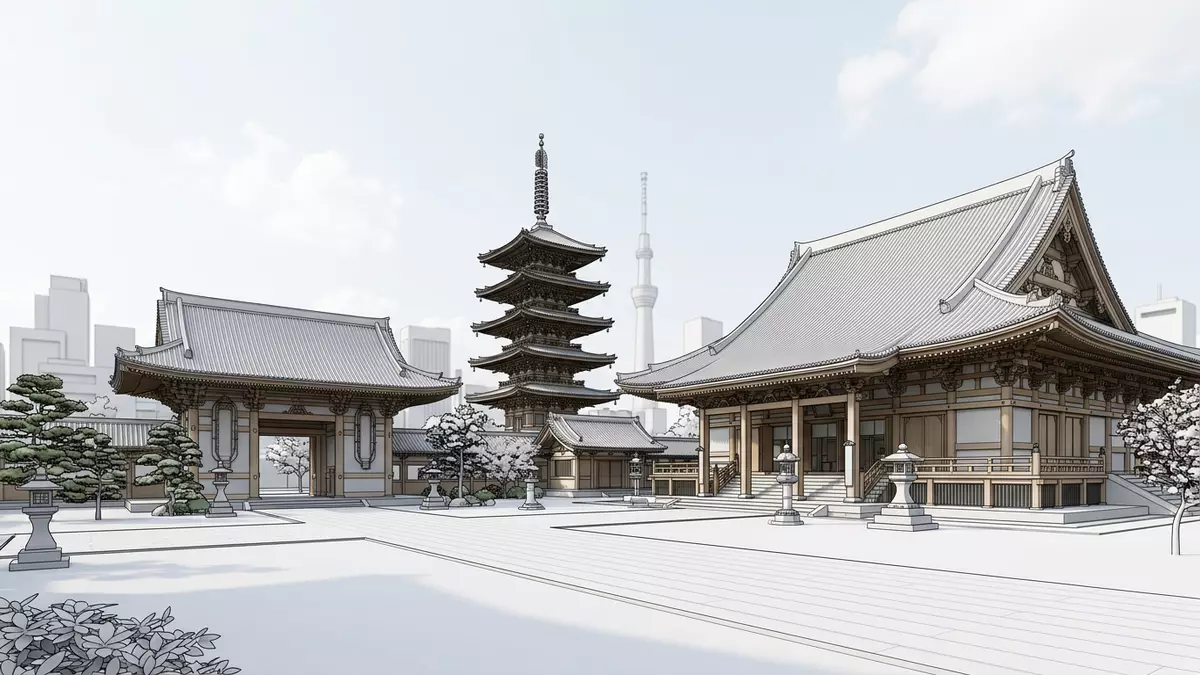
Senso-ji is a Buddhist temple in Asakusa, Tokio, recognised by its red Kaminarimon gate, broad Nakamise shopping street and large main hall. The complex joins a living religious site with buildings shaped by centuries of Japanese history.
Senso-ji begins at Kaminarimon
The approach starts at Kaminarimon, or the Thunder Gate, whose monumental entrance is associated with Asakusa. A large lantern hangs beneath the roof, while statues of the Buddhist guardians Fujin and Raijin occupy the gate’s sides.
Beyond Kaminarimon, Nakamise stretches towards the temple grounds. The street contains rows of small shops selling sweets, crafts and souvenirs, creating a clear transition from the busy district into the religious precinct.
A temple rebuilt through changing eras
Senso-ji traces its foundation to 628, when a statue of Kannon was associated with the Sumida River. Kannon is the Buddhist bodhisattva linked with compassion, and the temple remains dedicated to this figure.
The temple’s buildings have not survived unchanged through Japanese history. Fire, earthquakes and war affected the complex, while reconstruction preserved familiar forms in timber, tile and painted surfaces.
The present main hall is a post-war reconstruction completed in 1964. Its elevated roof, deep eaves and spacious interior give the building a strong visual presence within the precinct.
Inside the Asakusa temple precinct
The main hall, called Kannondo, contains the principal devotional focus of Senso-ji. Visitors encounter incense, offerings and Buddhist imagery before the hall’s raised interior.
A five-storey pagoda stands within the grounds, adding a vertical element beside the lower temple roofs. The pagoda is associated with Buddhist architecture across Japan and forms part of the familiar Asakusa skyline.
Senso-ji also includes smaller halls, gates and paths within its wider grounds. Their arrangement creates a sequence of public spaces, devotional buildings and covered passages around the main sanctuary.
Visiting Senso-ji: what travellers from Western Europe should know
- Senso-ji is in Asakusa, in eastern Tokio. The Tokyo Metro, Toei Subway and Tobu Railway provide rail connections to Asakusa Station.
- The precinct includes broad paved approaches, steps at temple buildings and dense pedestrian movement around the main route.
- The official language is Japanese and the currency is the Japanese yen.
Searching for Senso-ji on social platforms
These links open searches for Senso-ji on each platform.
Frequently asked questions about Senso-ji
Where is Senso-ji?
Senso-ji is in Asakusa, an historic district in eastern Tokio. Asakusa Station connects the area with the Tokyo Metro, Toei Subway and Tobu Railway.
What can visitors expect at Senso-ji?
The route includes Kaminarimon, Nakamise, the main hall, a pagoda and smaller temple buildings. The precinct combines religious practice, architecture and streetside commerce.
What makes Senso-ji distinctive?
Senso-ji joins a foundation traditionally dated to 628 with reconstructed buildings and a highly recognisable entrance sequence. Its identity comes from the relationship between temple ritual, Asakusa streets and enduring Buddhist forms.


